IEEE Referencing Examples for Eight Source Types
Every IEEE reference format entry below came from our citation engine using the IEEE style, from real publication details checked against Crossref and the publishers' records; page numbers in the in-text examples are illustrative. In your paper, the journal, book and proceedings titles are italic.
SourceClaude Shannon's 1949 paper in the Proceedings of the IRE, vol. 37, no. 1, with a DOI.
IEEE reference[1] C. E. Shannon, “Communication in the presence of noise,” Proc. IRE, vol. 37, no. 1, pp. 10–21, Jan. 1949, doi: 10.1109/JRPROC.1949.232969.
The journal name is in its official abbreviated form, Proc. IRE.
SourceHe, Zhang, Ren and Sun's paper at CVPR 2016 (DOI 10.1109/CVPR.2016.90), title set in sentence case.
IEEE reference[2] K. He, X. Zhang, S. Ren, and J. Sun, “Deep residual learning for image recognition,” in 2016 IEEE Conference on Computer Vision and Pattern Recognition (CVPR), 2016, pp. 770–778, doi: 10.1109/CVPR.2016.90.
“in” comes before the proceedings title. All four authors are listed; a comma comes before doi.
SourceKernighan and Ritchie's The C Programming Language, 2nd edition, Prentice Hall, 1988.
IEEE reference[3] B. W. Kernighan and D. M. Ritchie, The C Programming Language, 2nd ed. Englewood Cliffs, NJ, USA: Prentice Hall, 1988.
The city, state and country come before the publisher.
SourceLeCun and Bengio's chapter in The Handbook of Brain Theory and Neural Networks, edited by Michael A. Arbib.
IEEE reference[4] Y. LeCun and Y. Bengio, “Convolutional networks for images, speech, and time series,” in The Handbook of Brain Theory and Neural Networks, M. A. Arbib, Ed., Cambridge, MA, USA: MIT Press, 1995, pp. 255–258.
The editor follows the book title, marked “Ed.”
SourceNIST's page on leap seconds, no named author, read on October 26, 2026.
IEEE reference[5] National Institute of Standards and Technology, “Leap second and UT1-UTC information,” NIST. Accessed: Oct. 26, 2026. [Online]. Available: https://www.nist.gov/pml/time-and-frequency-division/time-realization/leap-seconds
The organization stands in as author; no period after the URL.
SourceIEEE 754-2019, the floating-point standard, DOI 10.1109/IEEESTD.2019.8766229.
IEEE reference[6] IEEE Standard for Floating-Point Arithmetic, IEEE Std 754-2019, 2019, doi: 10.1109/IEEESTD.2019.8766229.
The standard's title is italic and comes first; there's no author.
SourceNIST Special Publication 800-145 by Peter Mell and Timothy Grance, 2011.
IEEE reference[7] P. Mell and T. Grance, “The NIST definition of cloud computing,” National Institute of Standards and Technology, Gaithersburg, MD, USA, NIST SP 800-145, 2011, doi: 10.6028/NIST.SP.800-145.
The report number follows the organization and place.
SourceClaude Shannon's 1940 master's thesis at MIT, in MIT's DSpace repository.
IEEE reference[8] C. E. Shannon, “A symbolic analysis of relay and switching circuits,” M.S. thesis, Massachusetts Institute of Technology, Cambridge, MA, USA, 1940. [Online]. Available: https://dspace.mit.edu/handle/1721.1/11173
Say M.S. thesis or Ph.D. dissertation, then the university.
How to Write References in IEEE Format, Step by Step
Use these steps for referencing in IEEE format in any paper, lab report or senior design report.
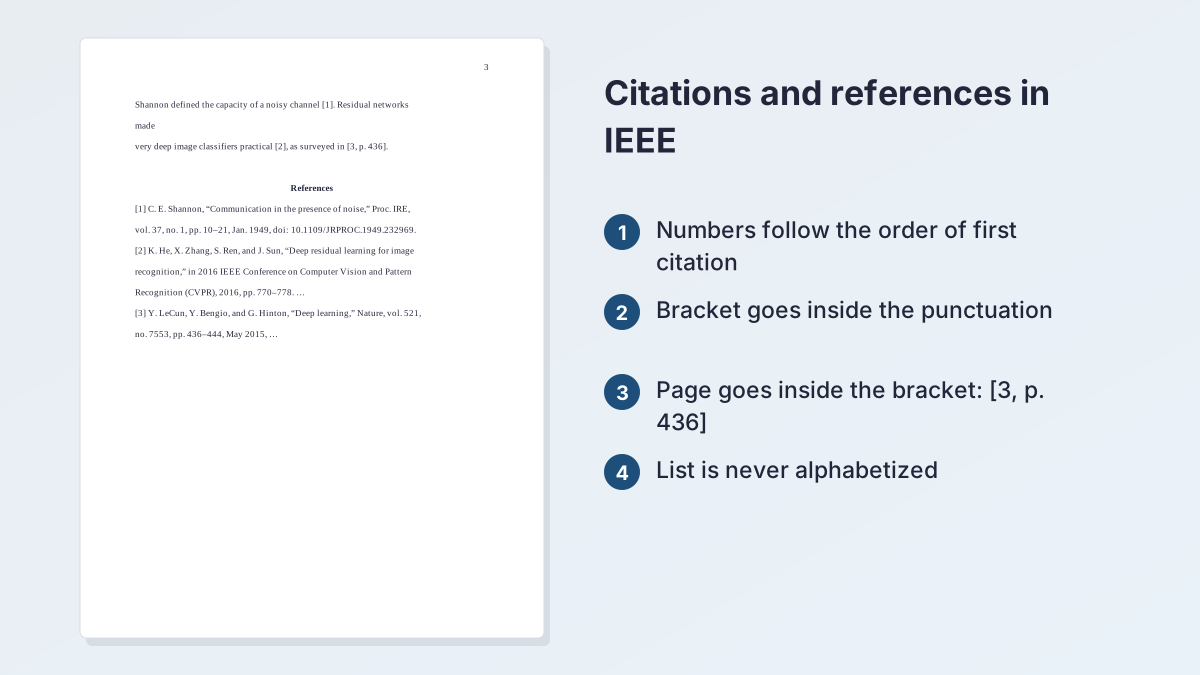
- Number sources as you cite. Give the first source you cite [1], the next new source [2], and so on. Reuse a source's number every time you cite it again.
- Add brackets in your sentences. Put the number in square brackets inside the punctuation: “… as shown in [1].” Add a page when you quote: [1, p. 5].
- Collect each source's details. Note the authors, title, journal or book, volume, issue, pages, date and DOI. For web pages, note the date you read them.
- Format each entry. Write initials before last names, put article titles in quotation marks and journal or book titles in italics, and abbreviate months.
- List references in number order. Title the list References and arrange it by number, not alphabetically, with the numbers flush left.
How Referencing in IEEE Format Works
IEEE (the Institute of Electrical and Electronics Engineers) uses a numbered citation system. In IEEE reference format, instead of an author and year in parentheses, you put a number in square brackets in your sentence. The References section at the end lists the sources by number, in the order you first cited them. It's standard in electrical engineering and computer science courses.
Citation order, not alphabetical order
The first source you cite is [1], the second new source is [2], and so on. If you cite source [1] again on page 6, it's still [1]. Because the list follows citation order, you never alphabetize an IEEE reference list. Purdue OWL's IEEE reference list page sums it up: references are “listed and numbered in order of citation, not alphabetically.”
Paste a source above
The IEEE citation generator embedded above handles the formatting. Paste a DOI, URL, ISBN or title, check the fields, and copy the numbered entry. Add sources in the order you cite them so the numbers match.
Parts of every reference
Each entry in IEEE reference format follows the same pattern: authors as initials and last name, the title of the part in quotation marks, the title of the whole in italics, then the publication details, the date and a DOI or URL. The entry ends with a period unless it ends with a URL.
IEEE In-Text Citation Rules and Examples
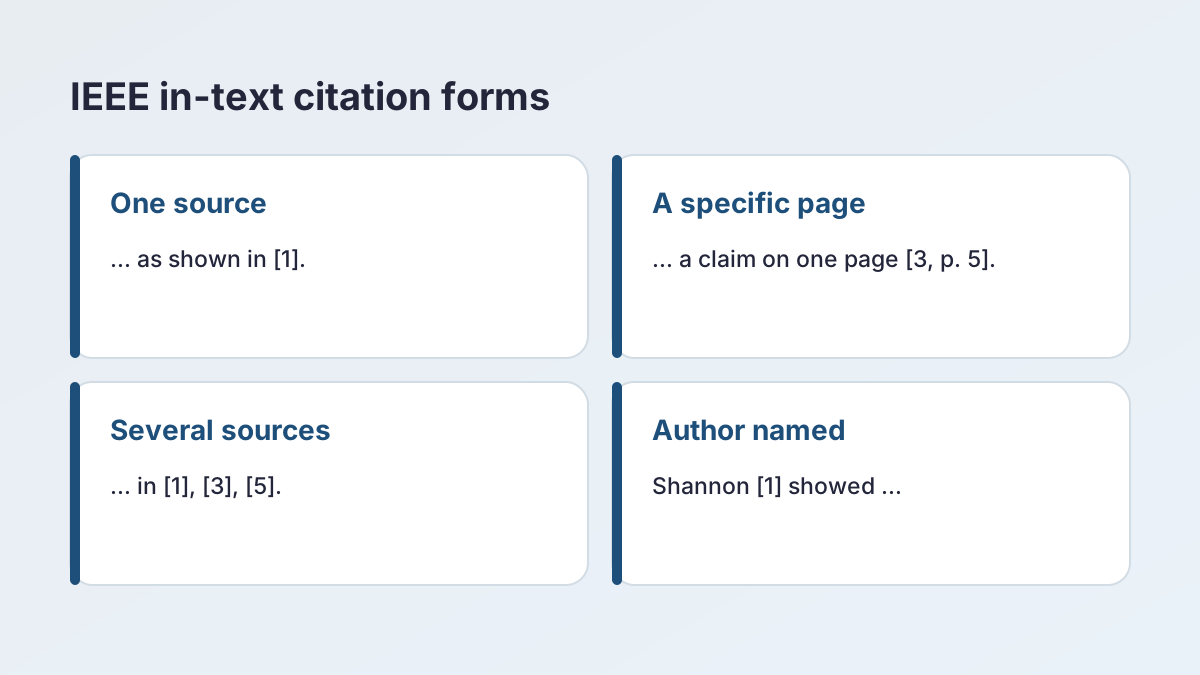
An IEEE in-text citation is just the reference number in square brackets. It sits on the line, not as a superscript, and goes inside the punctuation: “… as shown in [1].” Refer to the source by its number alone, so write “in [1],” not “in reference [1].”
| Situation | IEEE in-text citation | Notes |
|---|---|---|
| One source | [1] | Inside the period or comma |
| A page or page range | [1, p. 5] or [1, pp. 5–10] | Also Sec., Fig., Table or eq. |
| Several sources | [1], [3], [5] | Each number in its own brackets |
| A run of sources | [2]–[4] or [2], [3], [4] | See the note on ranges below |
| Author named | Shannon [1] showed … | The number follows the name |
| Three or more authors named | He et al. [2] … | Use et al. in the text |
Page numbers and parts of a source
To point to a specific spot, put it inside the bracket after a comma: [1, p. 5], [1, pp. 5–10] or [1, Fig. 3].
Several sources at once
To cite several sources in one IEEE in-text citation, give each number its own brackets, separated by commas: [1], [3], [5]. For three or more numbers in a row, Purdue OWL and many instructors use an en dash: [2]–[4]. The current IEEE Reference Guide (version 3.28.2025) has dropped the dash and writes each number out: [2], [3], [4]. Follow your instructor.
Naming the author
An IEEE in-text citation can also follow the author's name in your sentence: Shannon [1] showed that every channel has a capacity. For a source with three or more authors, the IEEE Reference Guide says to use the first author's name and “et al.” in the text: He et al. [2].
An IEEE in-text citation example in a paragraph
Residual networks made very deep image classifiers practical [2]. He et al. [2] trained networks far deeper than the convolutional designs of the 1990s [4], [8]. The lab code is written in C [3, p. 5].
IEEE Reference Format for Journal Articles
The journal article is the most common entry in IEEE reference format, and the IEEE format citation for a journal is the one students need first. The template from the IEEE Reference Guide is:
J. K. Author, “Name of paper,” Abbrev. Title of Periodical, vol. x, no. x, pp. xxx–xxx, Abbrev. Month year, doi: xxx.
| Part | How IEEE writes it | Example |
|---|---|---|
| Authors | Initials, then last name; “and” before the last | Y. LeCun, Y. Bengio, and G. Hinton |
| Article title | Sentence case, in quotation marks, comma inside | “Deep learning,” |
| Journal | Italic, abbreviated if there's an official abbreviation | Nature; Proc. IRE |
| Volume, issue, pages | vol., no., pp. | vol. 521, no. 7553, pp. 436–444 |
| Date | Abbreviated month and year | May 2015 |
| DOI | At the end, after “doi:” | doi: 10.1038/nature14539 |
Abbreviated journal names
IEEE asks for official journal abbreviations: Proc. IRE for Proceedings of the IRE, or IEEE Trans. Power Electron. for IEEE Transactions on Power Electronics. The IEEE Author Center links a spreadsheet of IEEE journal abbreviations. One-word titles such as Nature and Science aren't abbreviated. Many instructors accept full names in a student paper.
How many authors to list
List every author up to six. With more than six, give the first author followed by et al., as in “A. Author et al.” The IEEE citation generator applies this rule automatically.
Months
Shorten month names to three or four letters with a period, such as Jan., Feb., Aug. and Oct. Purdue OWL's list writes May, June and July in full and uses Sept.; the IEEE Reference Guide itself, like our tool, prints Jun., Jul. and Sep.
Conference Papers, Books and Book Chapters
These three types fill most of the rest of a list in IEEE reference format.
Conference papers
Template: J. K. Author, “Title of paper,” in Abbreviated Name of Conf., (location optional), year, pp. xxx–xxx, doi: xxx. The easiest route is to paste the paper's DOI into the citation generator, which recognizes proceedings papers; see entry [2] in the examples above. Some instructors want the conference name abbreviated, as in Proc. IEEE Conf. Comput. Vis. Pattern Recognit.
Books
Template: J. K. Author, Title of Book, xth ed. City, State, Country: Publisher, year. Include the state only for US cities, and cite a specific page in the text, as in [3, p. 5].
Book chapters
Template: J. K. Author, “Title of chapter,” in Title of Book, X. Editor, Ed., City, State, Country: Publisher, year, pp. xxx–xxx. Use “Eds.” for more than one editor.
IEEE Citation for a Website
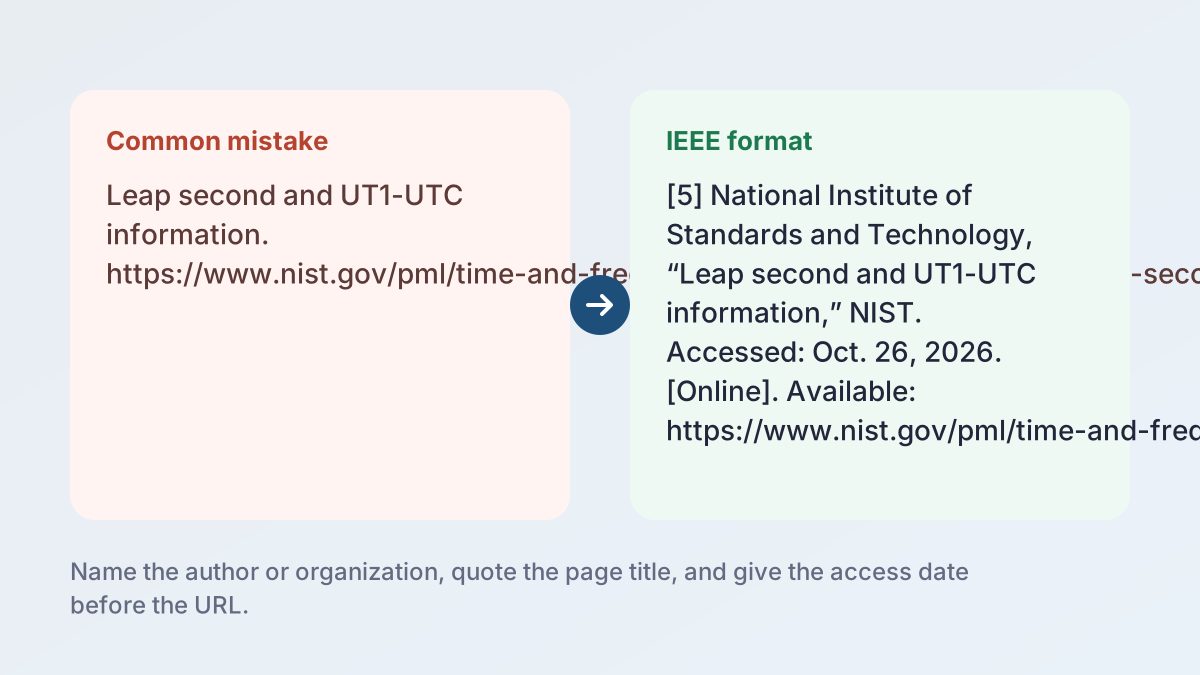
An IEEE citation for a website needs a few extra parts: the site name, the date you accessed the page and the address. The template our engine follows, from the CSL style for the 2023 guide, is:
Author (or organization), “Title of page,” Website Name. Accessed: Abbrev. Month day, year. [Online]. Available: URL
Websites with no author
In an IEEE citation for a website with no named person, the organization that wrote the page stands in as author, as in the NIST example above. If there's no clear organization either, start the entry with the page title: [6] “Leap second and UT1-UTC information,” NIST. Accessed: Oct. 26, 2026. [Online]. Available: https://www.nist.gov/pml/time-and-frequency-division/time-realization/leap-seconds
Dates and access dates
Web pages change, so write the date you read the page after “Accessed:” with an abbreviated month.
Punctuation differences you may see
The IEEE Reference Guide's own website template separates the parts with periods (Author. “Title.” Website.), while the open CSL style used by most reference managers, including ours, uses commas. Purdue OWL shows an older form that ends with the access date in parentheses. All three carry the same information; use whichever your instructor's sample shows.
Standards, Reports, Theses and Patents
Engineering papers cite technical documents that other styles rarely see. Each has its own template in IEEE reference format.
Standards
Template: Title of Standard, Standard number, date. Standards have no personal author, so the italic title comes first. IEEE standards have DOIs on IEEE Xplore, and pasting the DOI into the citation generator fetches the title and publisher. Some standard records arrive without the year or the standard number, so add the year in the tool and type the number into your final list.
Technical reports
Template: J. K. Author, “Title of report,” Company, City, State, Country, Rep. no., date. NIST publications, white papers and datasheets fit here.
Theses and dissertations
Template: J. K. Author, “Title of thesis,” M.S. thesis, Abbrev. Dept., Abbrev. Univ., City, State, Country, year. Use “Ph.D. dissertation” for a doctoral work, and add [Online]. Available: with a repository link if you read it online.
Patents: format these by hand
The citation generator has no patent type, so write patents yourself from the IEEE template: J. K. Author, “Title of patent,” U.S. Patent x xxx xxx, Abbrev. Month day, year. For example:
[9] A. G. Bell, “Improvement in telegraphy,” U.S. Patent 174 465, Mar. 7, 1876.
IEEE writes the patent number with spaces instead of commas, and keeps the day of the month.
IEEE Referencing Style Examples: A Full Reference List
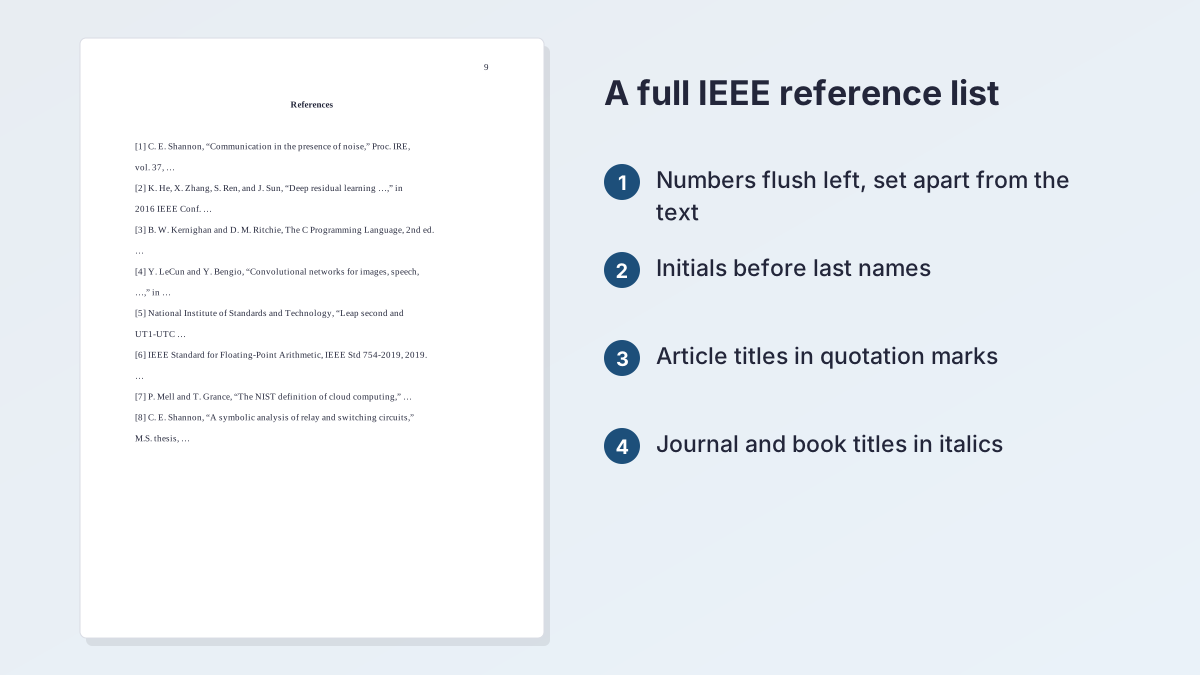
Here's how these IEEE referencing style examples fit together on one References page, as they'd appear at the end of a lab report or term paper. Each number is the order in which the paper first cites the source.
| No. | Type | Reference |
|---|---|---|
| [1] | Journal article | C. E. Shannon, “Communication in the presence of noise,” Proc. IRE, vol. 37, no. 1, pp. 10–21, Jan. 1949, doi: 10.1109/JRPROC.1949.232969. |
| [2] | Conference paper | K. He, X. Zhang, S. Ren, and J. Sun, “Deep residual learning for image recognition,” in 2016 IEEE Conference on Computer Vision and Pattern Recognition (CVPR), 2016, pp. 770–778, doi: 10.1109/CVPR.2016.90. |
| [3] | Book | B. W. Kernighan and D. M. Ritchie, The C Programming Language, 2nd ed. Englewood Cliffs, NJ, USA: Prentice Hall, 1988. |
| [4] | Book chapter | Y. LeCun and Y. Bengio, “Convolutional networks for images, speech, and time series,” in The Handbook of Brain Theory and Neural Networks, M. A. Arbib, Ed., Cambridge, MA, USA: MIT Press, 1995, pp. 255–258. |
| [5] | Website | National Institute of Standards and Technology, “Leap second and UT1-UTC information,” NIST. Accessed: Oct. 26, 2026. [Online]. Available: https://www.nist.gov/pml/time-and-frequency-division/time-realization/leap-seconds |
| [6] | Standard | IEEE Standard for Floating-Point Arithmetic, IEEE Std 754-2019, 2019, doi: 10.1109/IEEESTD.2019.8766229. |
| [7] | Report | P. Mell and T. Grance, “The NIST definition of cloud computing,” National Institute of Standards and Technology, Gaithersburg, MD, USA, NIST SP 800-145, 2011, doi: 10.6028/NIST.SP.800-145. |
| [8] | Thesis | C. E. Shannon, “A symbolic analysis of relay and switching circuits,” M.S. thesis, Massachusetts Institute of Technology, Cambridge, MA, USA, 1940. [Online]. Available: https://dspace.mit.edu/handle/1721.1/11173 |
Layout of the page
Title the page References and put the bracketed numbers flush left, with each entry's text aligned after them. Follow your instructor's spacing rules.
Where to go next
For the numbered list itself, let the IEEE referencing generator build it as you work. If you're writing for a humanities course instead, the Turabian format guide covers notes and bibliographies, and the APA format guidelines guide covers author-date papers.
IEEE vs ASME and Other Engineering Reference Formats
Mechanical engineering students often meet ASME style (American Society of Mechanical Engineers). Like IEEE, it cites bracketed numbers in order of first citation.
The difference between ASME referencing and IEEE format
The differences are in the entries. ASME writes the author's last name first with initials after (Adams, Z.), puts the year right after the authors, and uses a hyphenated range for consecutive citations, such as [5-7]. IEEE reference format puts initials first (Z. Adams), places the date near the end, and writes the numbers out or uses an en dash between bracketed numbers.
Which engineering reference format to use
Use the style your course, department or target journal names.
Common IEEE Reference Format Mistakes
These are the errors instructors mark most often when students are referencing in IEEE format, with the fix for each.
| Mistake | Fix |
|---|---|
| Alphabetized reference list | Order the list by citation number |
| Full first names | Use initials before the last name: C. E. Shannon |
| New number for a repeated source | Reuse the source's first number every time |
| Superscript numbers | Put the number on the line in square brackets |
| “reference [1]” in the sentence | Write “in [1]” or name the author: Shannon [1] |
| Title in title case, no quotation marks | Sentence case in quotation marks for articles |
| Missing access date for a web page | Add “Accessed:” and the date before the URL |
| Full month names everywhere | Abbreviate: Jan., Feb., Aug., Sept. or Sep., Oct. |
The IEEE Reference Guide and Which Version to Follow
IEEE publishes the rules of IEEE reference format in the IEEE Reference Guide and the IEEE Editorial Style Manual. Both are now hosted as Google Docs linked from the IEEE Editorial Style Manual page on the IEEE Author Center, along with the list of journal abbreviations. The guide is updated in place; the version we checked is dated March 28, 2025.
Purdue OWL and your instructor
Purdue OWL's IEEE in-text citation page is a clear student summary. Where it differs from the newest IEEE guide, as with citation ranges, follow your instructor.
Which version our tool uses
The citation generator uses the open CSL style “IEEE Reference Guide version 11.29.2023,” maintained by Zotero and CSL volunteers, not by IEEE. Its IEEE reference format output follows the guide's 2023 templates closely. Every guide we publish is listed on the student writing guides page.
IEEE Reference Format FAQ
What is the IEEE reference format?
It's a numbered style. Sources are cited as bracketed numbers such as [1] and listed in that order at the end.
Are IEEE references in alphabetical order?
No. They're listed in the order you first cite them. The first source cited is [1], the next new one [2], and so on.
How do you do an IEEE in-text citation?
Put the source's number in square brackets inside the punctuation: “… as shown in [1].” Add a page for quotes: [1, p. 5].
How do you cite multiple sources in IEEE?
Give each number its own brackets: [1], [3], [5]. For a run, Purdue OWL uses [2]–[4]; the current IEEE Reference Guide writes [2], [3], [4].
How do you write an IEEE citation for a website?
Author or organization, “Page title,” Website Name. Accessed: Oct. 26, 2026. [Online]. Available: URL. With no author, start with the page title.
When do you use et al. in IEEE?
In the reference list, when a source has more than six authors: list the first author and et al. In the text, use et al. when you name a source with three or more authors.
Do you abbreviate journal names in IEEE?
IEEE asks for official abbreviations, such as Proc. IRE or IEEE Trans. Power Electron. Many instructors accept full names in student papers.
How do you cite a patent in IEEE?
Author, “Title of patent,” U.S. Patent number, Abbrev. Month day, year, such as A. G. Bell, “Improvement in telegraphy,” U.S. Patent 174 465, Mar. 7, 1876.
More free guides
- MLA In-Text CitationsAuthor-page citations for every kind of source, with examples.
- How to Cite a Website in MLAWorks Cited entries and in-text citations for web pages.
- MLA Works Cited PageFormat, order and hanging indents, with a full example page.
- MLA Annotated BibliographyFormat, annotation types and a complete example.
- APA Table FormatNumber, title, body and notes for APA 7 tables, with templates.
- MLA HeadingThe four-line first-page heading and the page header, with Word and Google Docs steps.
See all 80 free tools for students
Related tools
Last updated by The Study Corp editorial team.