Turabian Book Citation Examples for Every Book Type
Each note and bibliography entry comes from our citation engine under Turabian 9 notes-bibliography rules, using real books (several appear in the official Turabian quick guide). Added or changed by hand: the Kindle label in both forms, the “Vol. 1 of” wording and the volume-first order for Caro, and the short notes quoted from the official quick guide for Sassler and Miller and for D’Agata. Page numbers are illustrative. Italicize book titles in your paper.
BookKatie Kitamura, A Separation, Riverhead Books, 2017, page 25.
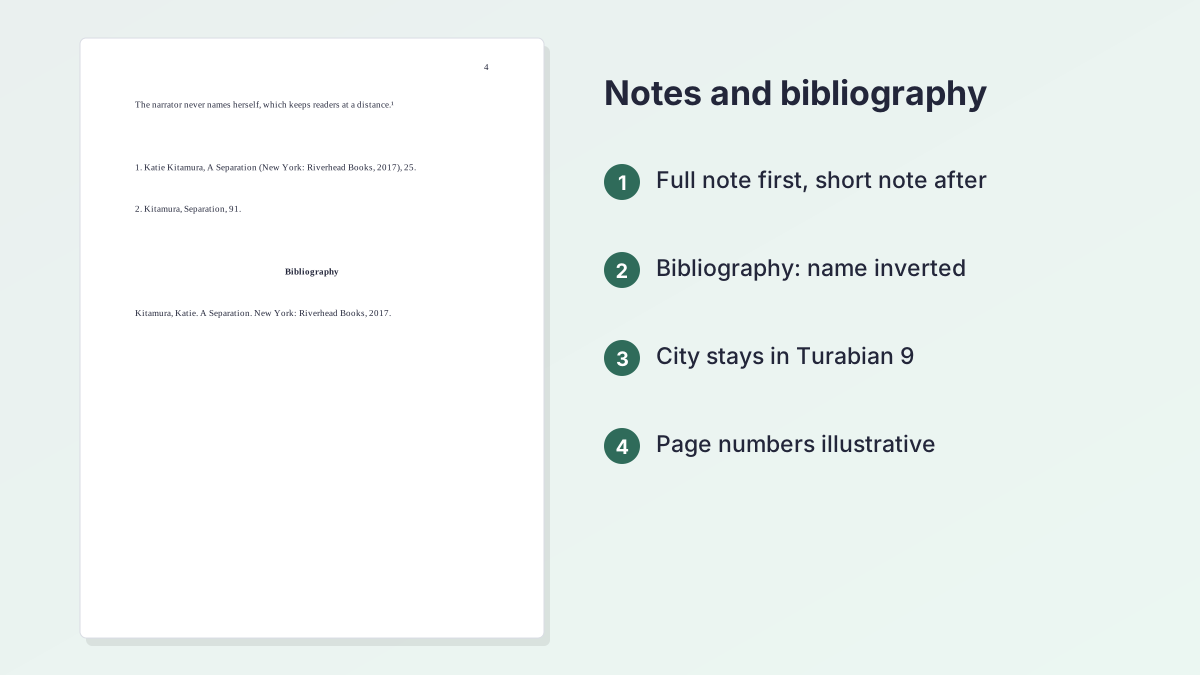
Note, then bibliography entryNote: 1. Katie Kitamura, A Separation (New York: Riverhead Books, 2017), 25. Bibliography: Kitamura, Katie. A Separation. New York: Riverhead Books, 2017.
Notes use commas and parentheses; the bibliography uses periods and no page.
BookSharon Sassler and Amanda Jayne Miller, Cohabitation Nation, University of California Press, 2017.
Note, then bibliography entryNote: 2. Sharon Sassler and Amanda Jayne Miller, Cohabitation Nation: Gender, Class, and the Remaking of Relationships (Oakland: University of California Press, 2017), 114. Bibliography: Sassler, Sharon, and Amanda Jayne Miller. Cohabitation Nation: Gender, Class, and the Remaking of Relationships. Oakland: University of California Press, 2017.
Short note: Sassler and Miller, Cohabitation Nation, 205.
BookBooth, Colomb, Williams, Bizup and FitzGerald, The Craft of Research, 4th edition, University of Chicago Press, 2016.
Note, then bibliography entryNote: 3. Wayne C. Booth et al., The Craft of Research, 4th ed. (Chicago: University of Chicago Press, 2016), 45. Bibliography: Booth, Wayne C., Gregory G. Colomb, Joseph M. Williams, Joseph Bizup, and William T. FitzGerald. The Craft of Research. 4th ed. Chicago: University of Chicago Press, 2016.
Note: first author and et al.; the bibliography lists everyone.
BookJohn D’Agata, editor, The Making of the American Essay, Graywolf Press, 2016, pages 19–20.
Note, then bibliography entryNote: 4. John D’Agata, ed., The Making of the American Essay (Minneapolis: Graywolf Press, 2016), 19–20. Bibliography: D’Agata, John, ed. The Making of the American Essay. Minneapolis: Graywolf Press, 2016.
The editor takes the author's place; short note: D’Agata, American Essay, 48.
BookMary Rowlandson's chapter “The Narrative of My Captivity” in The Making of the American Essay.
Note, then bibliography entryNote: 5. Mary Rowlandson, “The Narrative of My Captivity,” in The Making of the American Essay, ed. John D’Agata (Minneapolis: Graywolf Press, 2016), 19–20. Bibliography: Rowlandson, Mary. “The Narrative of My Captivity.” In The Making of the American Essay, edited by John D’Agata, 19–56. Minneapolis: Graywolf Press, 2016.
The bibliography gives the chapter's page range; the note, your page.
BookJhumpa Lahiri, In Other Words, translated by Ann Goldstein, Alfred A. Knopf, 2016.
Note, then bibliography entryNote: 6. Jhumpa Lahiri, In Other Words, trans. Ann Goldstein (New York: Alfred A. Knopf, 2016), 146. Bibliography: Lahiri, Jhumpa. In Other Words. Translated by Ann Goldstein. New York: Alfred A. Knopf, 2016.
“trans.” in the note, “Translated by” in the bibliography.
BookJane Austen, Pride and Prejudice, Penguin Classics, 2007, read on a Kindle.
Note, then bibliography entryNote: 7. Jane Austen, Pride and Prejudice (New York: Penguin Classics, 2007), chap. 3, Kindle. Bibliography: Austen, Jane. Pride and Prejudice. New York: Penguin Classics, 2007. Kindle.
With no fixed pages, cite a chapter; a Kindle location alone isn't enough.
BookRobert A. Caro, The Path to Power, volume 1 of The Years of Lyndon Johnson, Alfred A. Knopf, 1982.
Note, then bibliography entryNote: 8. Robert A. Caro, The Path to Power, vol. 1 of The Years of Lyndon Johnson (New York: Alfred A. Knopf, 1982), 120. Bibliography: Caro, Robert A. The Path to Power. Vol. 1 of The Years of Lyndon Johnson. New York: Alfred A. Knopf, 1982.
Name the volume and the set.
How to Cite a Book in Turabian Format, Step by Step
To write a Turabian book citation, work from the book's title page and copyright page, not the cover or a store listing.
- Collect the book's details. Copy the authors or editors, title, edition, city, publisher and year from the title and copyright pages.
- Write the full note. Write First Last, Title (City: Publisher, Year), page, with the superscript number after the punctuation.
- Shorten later notes. Use Last name, Short Title, page. Drop a leading A, An or The.
- Write the bibliography entry. Invert the first author's name, use periods, and leave out the page. The Turabian citation tool builds both forms from an ISBN.
- Format the list. Alphabetize, single-space with a blank line between entries, and use a 0.5-inch hanging indent.
Turabian Book Citation Basics (9th Edition)
A Turabian book citation follows Kate L. Turabian's A Manual for Writers of Research Papers, Theses, and Dissertations, 9th edition, which applies the 17th edition of The Chicago Manual of Style to student papers. Most history and religion courses use its notes-bibliography system: a superscript number points to a footnote, and a bibliography lists every book.
Each book can appear in three forms:
- Full note the first time you cite it: Katie Kitamura, A Separation (New York: Riverhead Books, 2017), 25.
- Short note after that: Kitamura, Separation, 91.
- Bibliography entry: Kitamura, Katie. A Separation. New York: Riverhead Books, 2017.
Paste a title or ISBN into the citation tool above to see all three. The official Turabian book citation examples in the notes-bibliography quick guide from the University of Chicago Press shows the same pattern for each book type below. For note placement, see Turabian footnotes; for the bibliography page, see the Turabian bibliography guide.
The University of Chicago Press lists a 10th edition for late 2026, so keep to the 9th until your school switches. Our guide to Turabian vs Chicago explains how the manuals relate.
Turabian Book Bibliography Entry and Note Patterns
Every Turabian book bibliography entry uses the same parts as the note, in a different order with different punctuation. The special cases below add one element each.
| Form | Pattern |
|---|---|
| Full note | First Last, Title: Subtitle (City: Publisher, Year), page. |
| Short note | Last, Short Title, page. |
| Bibliography entry | Last, First. Title: Subtitle. City: Publisher, Year. |
| Author-date reference | Last, First. Year. Title: Subtitle. City: Publisher. |
| Author-date in text | (Last Year, page) |
Titles and pages
Italicize book titles and capitalize them headline style, with a colon before the subtitle. A Turabian book bibliography entry never takes a page. Notes end with the exact page, a bare number with no "p." Union University's notes guide makes the same point: omit page numbers in the bibliography and keep them in notes.
Authors: One, Two, Three or Four or More
One author
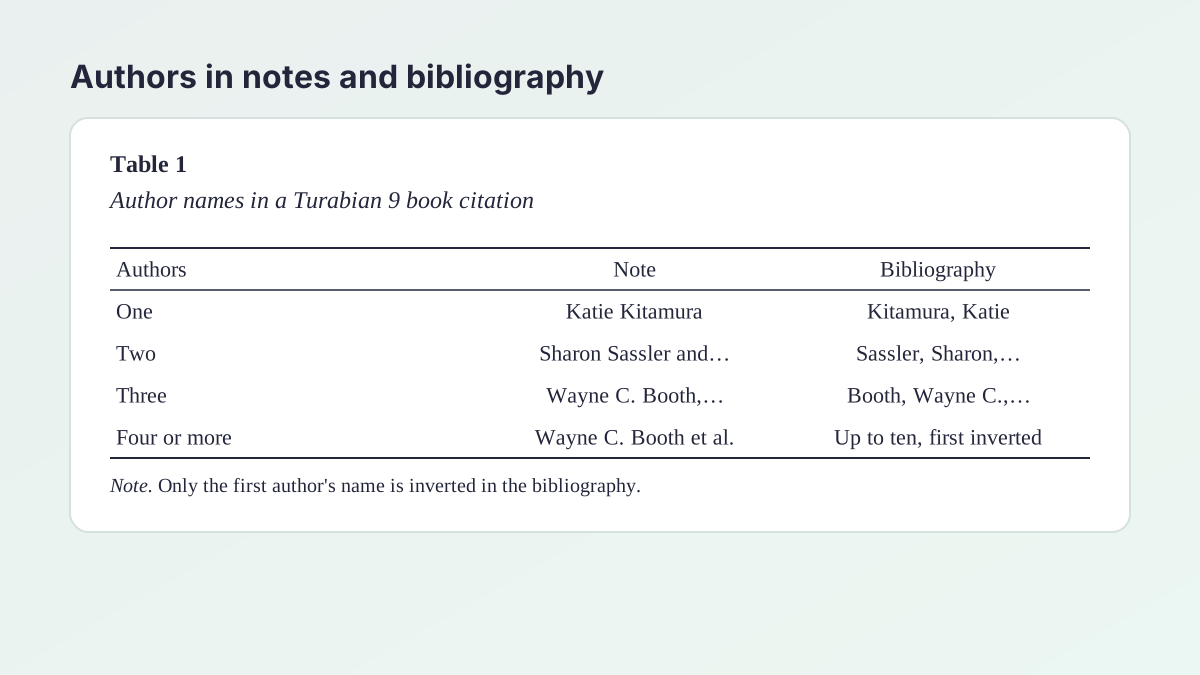
In the note, give the name in normal order as it appears on the title page. In the bibliography entry, invert it: Kitamura, Katie.
Two or three authors
List every author in both forms, joined by "and." In the bibliography, invert only the first name and put a comma before "and" when there are three: Booth, Wayne C., Gregory G. Colomb, and Joseph M. Williams. Union University's guide and Covenant Theological Seminary's guide both list them in full.
Four or more authors
In the note, give only the first author followed by et al.: Wayne C. Booth et al., The Craft of Research, 4th ed. (Chicago: University of Chicago Press, 2016), 45. Northwest Missouri State University's Turabian guide and Memorial University's quick guide list all authors in the bibliography, as the table shows. Chicago 18 changed these thresholds; our Chicago book citation guide covers them.
Turabian Citation for an Edited Book and a Chapter
The whole edited book
Put the editor in the author's place and add ed. after the name in the note: John D’Agata, ed., The Making of the American Essay (Minneapolis: Graywolf Press, 2016), 19–20. In the bibliography, the name is inverted and ed. follows it. Use it only when you discuss the collection as a whole. Every Turabian citation for an edited book starts by asking which of the two you are citing.
A chapter in an edited book
Most of the time a Turabian citation for an edited book names one chapter. Start with the chapter's author and its title in quotation marks, then in and the book's title in italics. The note says ed. before the editor's name; the bibliography spells out edited by and gives the chapter's full page range. The note still cites only the page where your quotation or idea appears.
Editions, Translations, Ebooks and Multivolume Works
Each of these book types adds one element to the basic Turabian book citation. The table shows where it goes.
| Book type | In the note | In the bibliography |
|---|---|---|
| Edition | 3rd ed. before the parentheses, lowercase | 3rd ed. as its own sentence after the title |
| Translation | trans. Ann Goldstein after the title | Translated by Ann Goldstein after the title |
| Ebook with pages | Add the URL or database name at the end | Same, at the end of the entry |
| Kindle or other app | chap. 3, Kindle | Kindle at the end |
| One volume with a title | vol. 1 of Series Title | Vol. 1 of Series Title |
| Set without volume titles | Volume before page: 2:257 | Vol. 2 for one volume; 3 vols. for several |
Editions
Cite the edition you used, and say nothing about a first edition. Covenant Theological Seminary's guide notes that the label is lowercase in the note and capitalized in the bibliography.
Translations and ebooks
Format an ebook like a print book, then name how you read it: a URL, a library database such as EBSCOhost, or a format such as Kindle. With no stable pages, give a chapter or section, as in "chap. 3, Kindle" from the official quick guide.
Multivolume works
For one volume with its own title, name the volume and the set, as in the Caro example. For a set without volume titles, put the volume before the page with a colon, as in 2:257. For several volumes, the Covenant guide gives the total, such as 3 vols., in the bibliography.
Place of Publication in Turabian 9 vs. Chicago 18
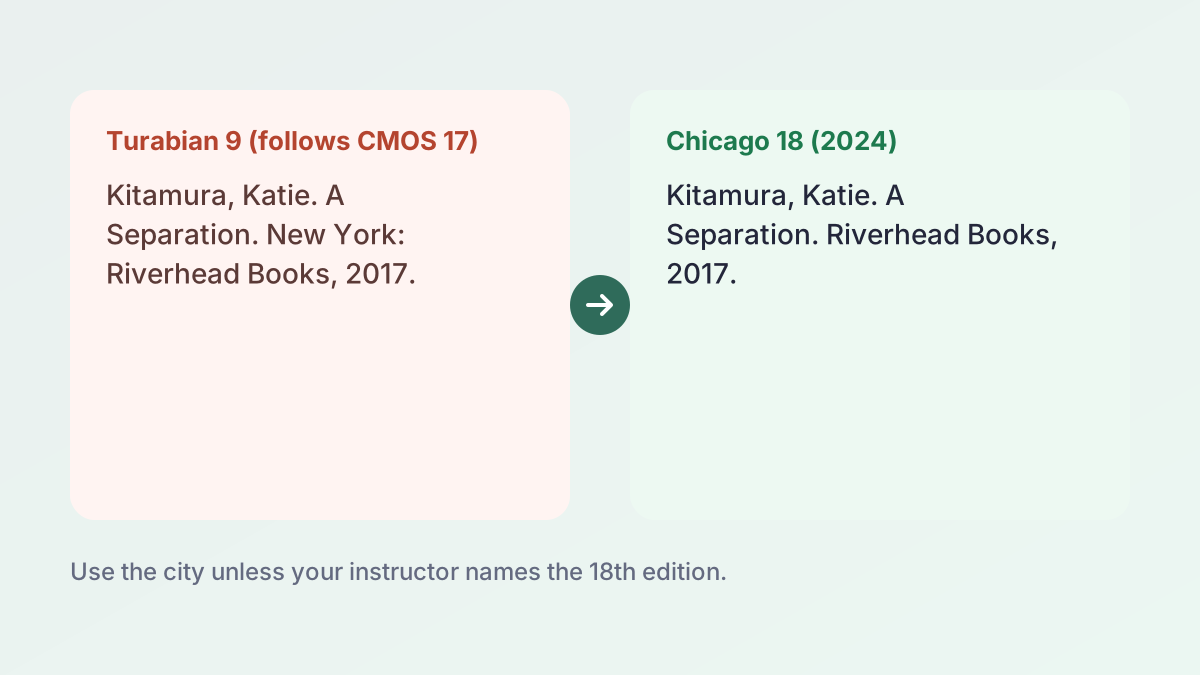
Turabian 9 keeps the city before the publisher. Every book example in the official quick guide has one, such as New York: Riverhead Books.
What Chicago 18 changed
The 18th edition of The Chicago Manual of Style, published in 2024, no longer requires the place of publication for books published since 1900, according to the University of Portland's summary of what is new. So Chicago 18 reads Riverhead Books, 2017, and Turabian 9 reads New York: Riverhead Books, 2017.
Use the city unless your instructor names the 18th edition. A school guide always outranks the manual.
Turabian Bible Citation: Notes, Not the Bibliography
A Turabian Bible citation is shorter than a book citation. You cite a passage by book, chapter and verse, and the Bible usually does not go in the bibliography. Every Turabian Bible citation works the same way: cite the passage, name the version, skip the page.
Where the citation goes
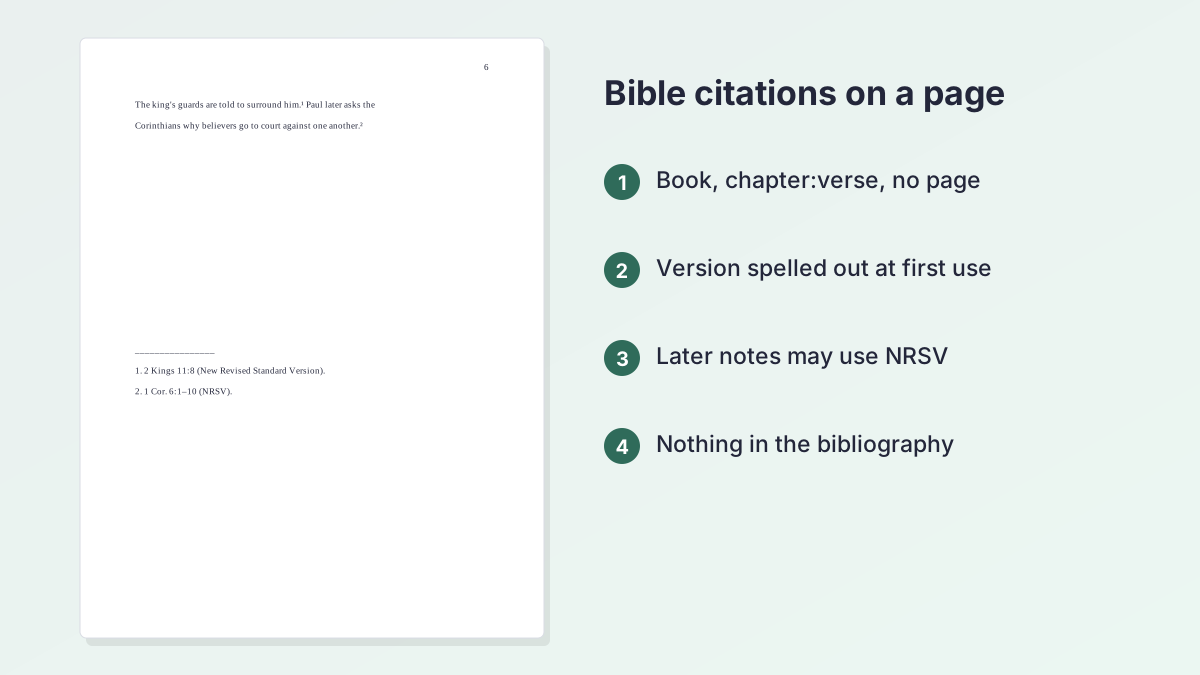
For a Turabian Bible citation, Princeton University Library's guide to citing sacred texts, which follows Chicago, says Bible references usually appear in text citations or notes, not in bibliographies. Grace College's Turabian Bible guide agrees: cite passages in footnotes or in parentheses in the body, and leave them out of the bibliography. A Bible note has no page number.
When a Bible does need an entry
Only the Bible's own text is exempt. If you cite a study note from a study Bible, you are citing its author. Hope International University's Chicago guide says that note needs a full footnote and bibliography entry. Cite it like a chapter in an edited work.
A School Rule Can Change a Turabian Bible Citation
Liberty University's Turabian quick guide says the Bible is cited only in parentheses in the body and is not listed in the bibliography. That is a school rule on top of the manual, so check your syllabus. Our Turabian format guide covers Liberty's other house rules.
How to Cite the Bible in Turabian: Books, Verses and Versions
How to cite the Bible in Turabian comes down to three choices: how to abbreviate the book, how to write the chapter and verse, and how to name the version.
| Element | Rule | Example |
|---|---|---|
| Book name | Roman type, usually abbreviated, in a note or parentheses | 1 Cor. |
| Chapter and verse | Separated by a colon; never a page number | 6:1–10 |
| Traditional abbreviations | Take periods | 1 Thess. 4:11; Heb. 13:8 |
| Shorter abbreviations | No periods | 2 Sm 11:1–17; Mt 26:2–5 |
| Version, first use | Spell it out in parentheses | 2 Kings 11:8 (New Revised Standard Version) |
| Version, later | Abbreviate it | 1 Cor. 6:1–10 (NRSV) |
Book abbreviations
Examples are from Princeton University Library's Chicago-based guide. Pick traditional or shorter abbreviations and use one system throughout. Grace College's guide says not to italicize book or version names.
Naming the version
Books and numbering differ between versions. For general readers, spell it out the first time: 2 Kings 11:8 (New Revised Standard Version). After that, an abbreviation is fine: 1 Cor. 6:1–10 (NRSV). If you quote more than one version, name each when it first appears.
Turabian Book Citation in Author-Date Style
Some social science courses use Turabian's author-date system instead of notes. The details stay the same, but the year moves after the author and a parenthetical citation replaces the footnote.
- In text: (Kitamura 2017, 25)
- Reference list: Kitamura, Katie. 2017. A Separation. New York: Riverhead Books.
Two authors: (Sassler and Miller 2017, 114). Four or more: (Booth et al. 2016, 45). A chapter in an edited book: (Rowlandson 2016, 19–20), listed as Rowlandson, Mary. 2016. “The Narrative of My Captivity.” In The Making of the American Essay, edited by John D’Agata, 19–56. Minneapolis: Graywolf Press.
The official author-date quick guide shows these forms. For the system's parenthetical rules, see our Chicago in-text citation guide.
Common Turabian Book Citation Mistakes
Check each entry against this list.
| Mistake | Fix |
|---|---|
| Bibliography punctuation in a note | Notes use commas and parentheses; entries use periods |
| Dropping the city in a Turabian 9 paper | Keep the city unless told to follow Chicago 18 |
| All five authors in a note | First author and et al. for four or more |
| Bible entry in the bibliography | Cite scripture in notes or parentheses only |
A final check
Every Turabian book citation in your notes should appear once in your bibliography, and the reverse. The Turabian Title Page Generator sets up the first page of the same paper, and every guide is on our student writing guides page. When you're ready to cite, let the free Turabian citation generator format each note and entry from an ISBN.
Turabian Book Citation FAQ
How do you cite a book in Turabian?
A note reads First Last, Title (City: Publisher, Year), page. The bibliography reads Last, First. Title. City: Publisher, Year.
How do you cite the Bible in Turabian?
Cite it in a note or parentheses with book, chapter and verse, such as 1 Cor. 6:1–10, and name the version at first use. It usually has no bibliography entry.
Does the Bible go in a Turabian bibliography?
Usually not. Chicago-based guides cite scripture in notes or parentheses only. Cite a study Bible's own notes like an edited chapter.
How do you cite an edited book in Turabian?
Put the editor in the author's place, followed by ed. For one chapter, start with the chapter author and title, then in, the book title and the editor.
How do you cite four or more authors in Turabian?
In the note, give the first author and et al. In the bibliography, list up to ten.
Does Turabian include the city of publication?
Yes, in the 9th edition. Chicago 18 no longer requires it.
How do you cite an ebook or Kindle book in Turabian?
Format it like a print book and add Kindle, a database or a URL at the end. With no fixed pages, cite a chapter.
More free guides
- Turabian BibliographyEntry format, order and spacing for a Turabian 9 bibliography, with examples.
- Turabian FootnotesFull notes, short notes, ibid. and endnotes in Turabian 9.
- Turabian vs ChicagoHow Turabian and Chicago relate, what differs, and which one your paper needs.
- Turabian FormatMargins, spacing, headings and page numbers for a Turabian 9 class paper.
- MLA In-Text CitationsAuthor-page citations for every kind of source, with examples.
- How to Cite a Website in MLAWorks Cited entries and in-text citations for web pages.
See all 80 free tools for students
Related tools
Last updated by The Study Corp editorial team.