Turabian Bibliography Example for Each Source Type
Each entry below was formatted by our citation engine under Turabian 9 notes-bibliography rules, using real sources (most appear in the official Turabian quick guide, shown here in print form). One entry was adjusted by hand: “Last modified” was added to the Google page to match the quick guide. Italicize book, journal, newspaper and film titles in your paper.
SourceKatie Kitamura's novel A Separation, Riverhead Books, New York, 2017.
Bibliography entryKitamura, Katie. A Separation. New York: Riverhead Books, 2017.
Last name, first name. Title. Place: Publisher, Year.
SourceThe anthology The Making of the American Essay, edited by John D’Agata, Graywolf Press, 2016.
Bibliography entryD’Agata, John, ed. The Making of the American Essay. Minneapolis: Graywolf Press, 2016.
The editor takes the author's place, followed by “ed.”
SourceMary Rowlandson's “The Narrative of My Captivity,” pages 19–56 of the D’Agata anthology.
Bibliography entryRowlandson, Mary. “The Narrative of My Captivity.” In The Making of the American Essay, edited by John D’Agata, 19–56. Minneapolis: Graywolf Press, 2016.
The chapter's page range comes after the editor's name.
SourceLynn White Jr.'s article in Science, volume 155, issue 3767, March 1967.
Bibliography entryWhite, Lynn, Jr. “The Historical Roots of Our Ecologic Crisis.” Science 155, no. 3767 (March 1967): 1203–7. https://doi.org/10.1126/science.155.3767.1203.
Use the DOI instead of a URL when the article has one.
SourceGoogle's Privacy Policy page, last modified April 17, 2017.
Bibliography entryGoogle. “Privacy Policy.” Privacy & Terms. Last modified April 17, 2017. https://www.google.com/policies/privacy/.
With no person as author, the organization that owns the site goes first.
SourceRob Pegoraro's iPhone review in the Washington Post, July 5, 2007.
Bibliography entryPegoraro, Rob. “Apple’s iPhone Is Sleek, Smart and Simple.” Washington Post, July 5, 2007.
Give the full date; add a URL or database name if you read it online.
SourceSelma, directed by Ava DuVernay, Paramount Pictures, 2014.
Bibliography entryDuVernay, Ava, dir. Selma. Paramount Pictures, 2014.
The director goes in the author slot, followed by “dir.”
SourceMark Noll's 1994 book listed right after his 2002 book.
Bibliography entry———. The Scandal of the Evangelical Mind. Grand Rapids, MI: Eerdmans, 1994.
A 3-em dash replaces the repeated name; titles run in alphabetical order.
How to Make a Bibliography in Turabian Format
These steps build the page from a blank document in Microsoft Word or Google Docs.
- Start a new page. Insert a page break after the last page of text (and after any endnotes). Keep the page number in the same corner as the rest of the paper.
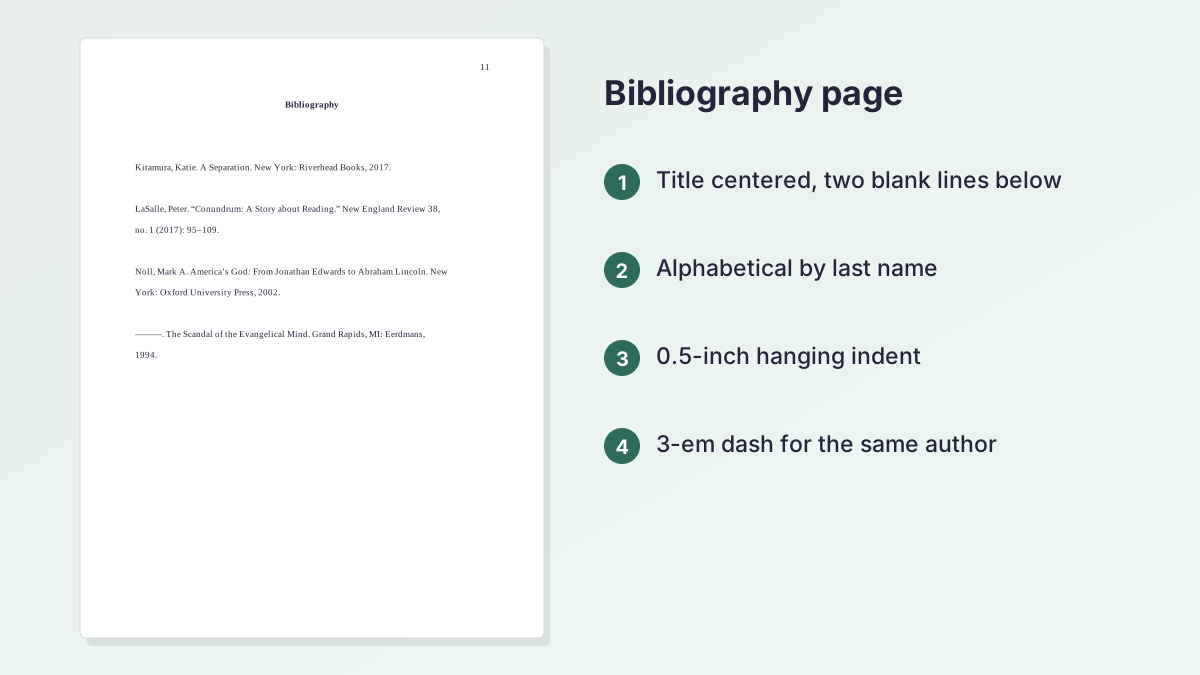
- Center the title. Type Bibliography, centered, at the top of the page. Leave two blank lines before the first entry.
- Format each entry. Write each source in bibliography form: inverted name, periods between parts, publication facts without parentheses. Our Turabian citation tool can draft each entry for you.
- Sort alphabetically. Order entries by the first author's last name, letter by letter. Use a 3-em dash for a repeated author.
- Set spacing and indents. Single-space each entry and leave a blank line between entries. In Word, use Paragraph > Indentation > Special > Hanging, 0.5 inch; in Google Docs, Format > Align & indent > Indentation options > Hanging.
- Check against your notes. Make sure every source in your notes appears once in the bibliography, spelled the same way.
What Is a Turabian Style Bibliography?
A Turabian style bibliography is the last part of a paper that uses the notes-bibliography system from Kate L. Turabian's A Manual for Writers of Research Papers, Theses, and Dissertations (9th edition, 2018). Your footnotes point readers to exact pages; the bibliography gives them one alphabetical list of every source, so they can find any work quickly.
Because Turabian adapts The Chicago Manual of Style, you'll also see it called a Chicago Turabian bibliography. The entry patterns match Chicago's notes-bibliography style. For margins, fonts, headings and the rest of the paper, see our full guide to Turabian format; this page covers only the bibliography.
What goes in it
List every source you cite in your notes. Turabian also allows works you consulted but didn't cite, and some instructors want those left out, so check the assignment. Paste a source into the citation tool above to see its note, short note and entry side by side, or open the full Turabian Citation Machine to build a whole list.
Which edition
Every rule here follows the 9th edition. The University of Chicago Press is releasing a 10th edition in late 2026; until your school adopts it, the 9th remains the standard for high school and college courses alike.
Turabian Bibliography Format: 7 Page Rules
The Turabian bibliography format comes down to seven settings. Get them right once and every entry falls into place.
| Rule | What to do |
|---|---|
| 1. New page | Start the bibliography on its own page after the text |
| 2. Title | Center the word Bibliography at the top; leave two blank lines below it |
| 3. Spacing | Single-space each entry |
| 4. Blank lines | Leave one blank line between entries |
| 5. Hanging indent | First line flush left; every later line indented 0.5 inch |
| 6. Order | Alphabetical by the first author's last name |
| 7. Repeated author | Replace the name with a 3-em dash (———) after the first entry |
Spacing and the title
Turabian single-spaces bibliography entries even though the body of the paper is double-spaced. CMOS Shop Talk's guide to Turabian bibliographies, from the University of Chicago Press, says to center the title, single-space each entry, add a blank line between entries and leave two blank lines below the title. George Fox University's Turabian 9 guide confirms the single spacing and the 0.5-inch hanging indent.
Bold or plain title
The manual shows the title in plain type. Some schools, such as Liberty University, put it in bold. Follow your school's guide if it says otherwise.
Page numbers
The bibliography keeps the same page numbers as the rest of the paper, in the same corner. It does not restart at 1.
How to Alphabetize a Bibliography in Turabian Format
Sort a Turabian bibliography by the first word of each entry, which is usually the first author's last name.
Letter by letter
Alphabetize letter by letter up to the first comma: McCarthy comes before Moore, and Van Buren is filed under V because the particle is capitalized. If two authors share a last name, sort by first name.
Entries with no author
An entry without an author starts with its title. Ignore a leading A, An or The when you sort, so The Federalist files under F. An organization that publishes a page with no named writer, such as Google above, goes in the author slot and sorts by its name.
Several authors
Only the first author's name is inverted: Hatch, Nathan O., and Harry S. Stout. List up to ten authors in the bibliography; for more than ten, list the first seven followed by et al.
The 3-em dash for the same author
When you list two or more works by the same author, write the name in the first entry only. In each later entry, replace the name with a 3-em dash (three em dashes, ———) followed by a period. Order those works alphabetically by title, ignoring A, An and The. That's why Noll's America's God comes before The Scandal of the Evangelical Mind in the example page. The dash stands only for an identical name or group of names; a book Noll co-wrote with another author gets its full names.
Sort a long list fast
If you typed your list by hand, paste it into the Alphabetizer to sort it in one step, then add the dashes yourself.
Turabian Bibliography Entry Patterns
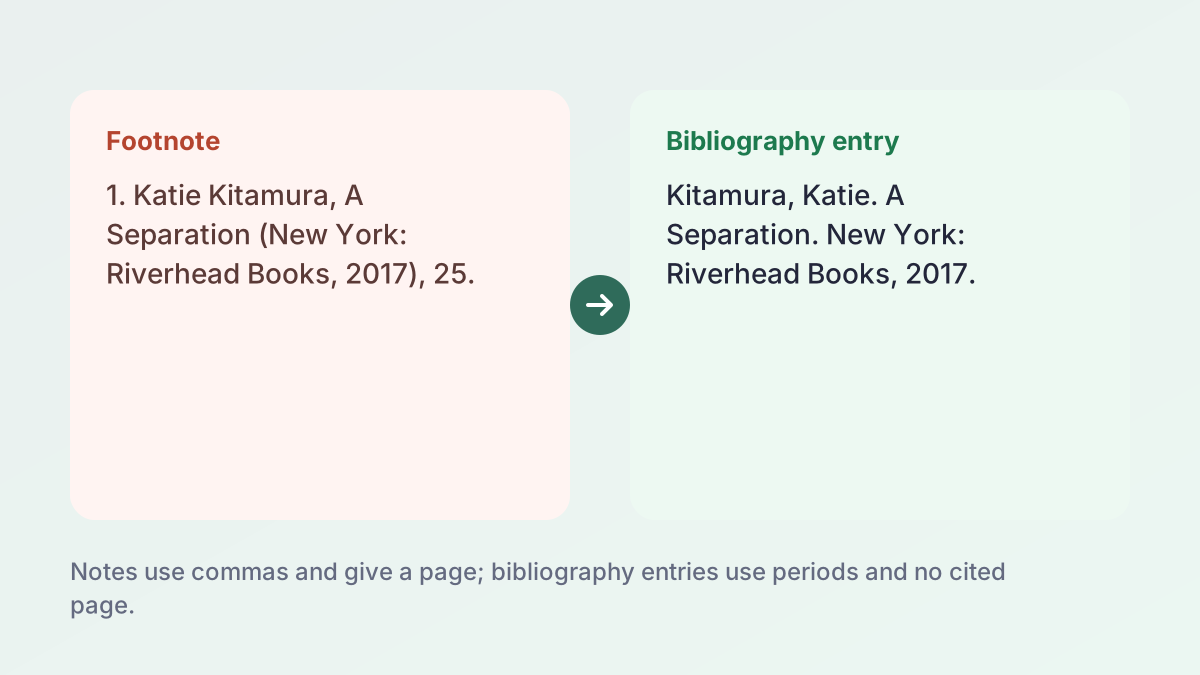
Each source type follows a pattern. Every entry inverts the first author's name and puts periods between its main parts. Notes, by contrast, use commas and parentheses; the picture above shows the same book both ways.
| Source | Pattern |
|---|---|
| Book | Last, First. Title. Place: Publisher, Year. |
| Edited book | Last, First, ed. Title. Place: Publisher, Year. |
| Chapter | Last, First. “Chapter.” In Book Title, edited by First Last, pages. Place: Publisher, Year. |
| Journal article | Last, First. “Article.” Journal Volume, no. Issue (Year): pages. DOI or URL. |
| Website | Owner or Author. “Page Title.” Site Name. Date or Last modified date. URL. |
| Newspaper | Last, First. “Headline.” Newspaper, Month Day, Year. URL if online. |
| Film | Last, First, dir. Title. Studio, Year. |
Books and chapters
For a book, the place of publication, a colon, the publisher and the year come last. An edition other than the first goes after the title (2nd ed.). For a chapter, give the chapter title in quotation marks, then “In” and the book title, the editor and the page range of the whole chapter.
Articles and websites
Journal entries give the volume, the issue as “no.” and the full page range. Add a DOI as a link when one exists; otherwise add the URL or the database name. For a web page, use the publication or revision date if the page shows one. If it shows none, Turabian lets you add an access date.
Newspapers and films
Newspaper articles are often cited only in notes, but many instructors want them in the bibliography too, so include them unless told otherwise. A film entry names the director, the title and the studio; add the format (DVD, streaming service) if your instructor asks for it.
Bibliography vs. Reference List in Turabian
Turabian has two citation systems, and each ends with a different list.
Notes-bibliography
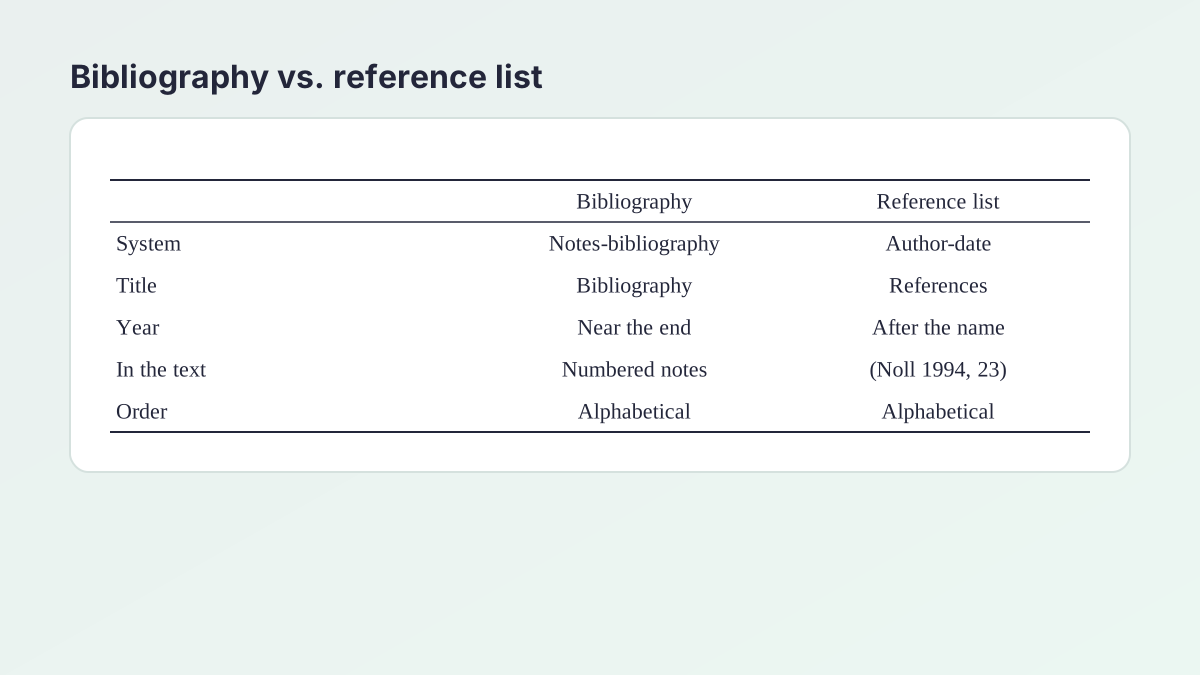
Used in history, religion, literature and the arts. You cite with footnotes or endnotes and end with a page titled Bibliography. The year sits near the end of each entry.
Author-date
Used more in the social and natural sciences. You cite in the text with the author and year in parentheses, such as (Noll 1994, 23), and end with a page titled References. The year moves up right after the name: Noll, Mark A. 1994. The Scandal of the Evangelical Mind. Grand Rapids, MI: Eerdmans.
What stays the same
A Turabian style bibliography and a reference list are both single-spaced with a blank line between entries, use hanging indents and sort alphabetically. In a reference list, works by the same author run in date order rather than title order, still with the 3-em dash. Our citation tool switches between the two systems with one click, so you can produce either list from the same sources.
Turabian Annotated Bibliography
A Turabian annotated bibliography adds a short paragraph, the annotation, after each entry. Instructors assign one before a research paper to check that you've found good sources and read them.
Format
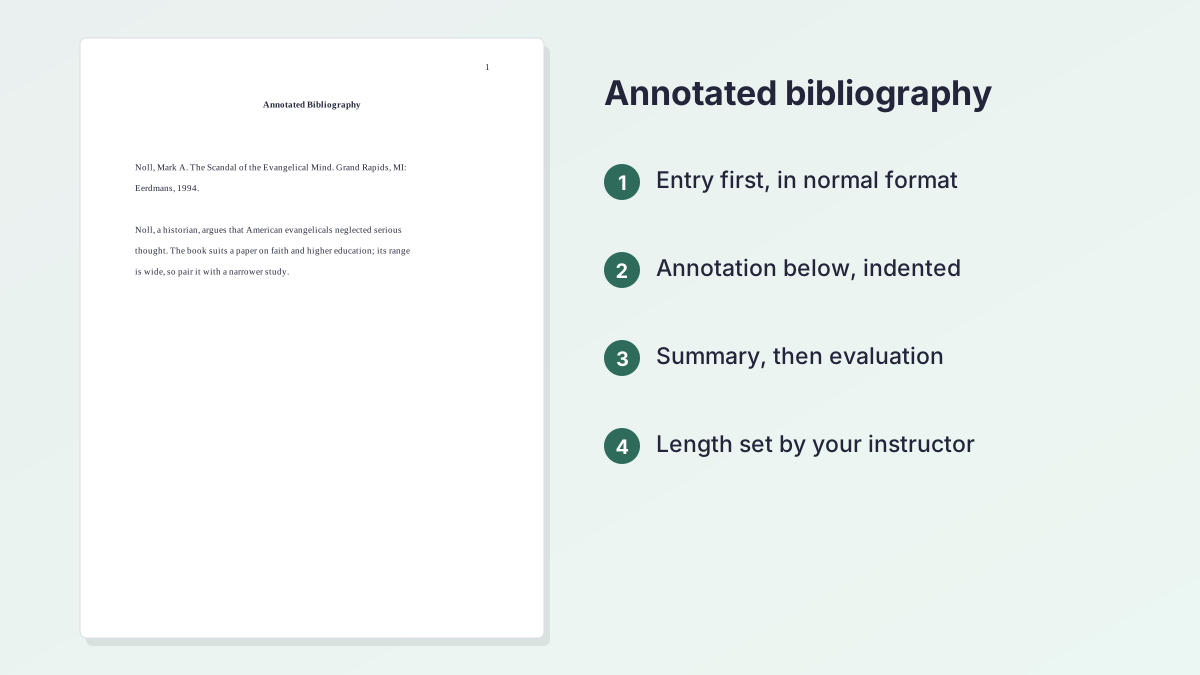
The manual gives little detail on annotated lists, so the following is common practice in US colleges. Format each entry exactly as you would in a normal Turabian bibliography. Start the annotation on the next line, indented as a block or with a paragraph indent, and single-space it. Leave a blank line before the next entry. Title the page Annotated Bibliography unless your instructor names it differently.
What to write
Most annotations summarize the source's main argument in two or three sentences, then evaluate it: the author's credentials, the evidence, and how the work fits your paper. Instructors usually set a length, often 100 to 200 words.
A Turabian annotated bibliography sample
Noll, Mark A. The Scandal of the Evangelical Mind. Grand Rapids, MI: Eerdmans, 1994.
Noll, a historian of American Christianity, argues that evangelical culture neglected rigorous thinking in science, politics and the arts. He traces the problem to revivalism and to the movement's habits of reading the Bible. The book is useful for a paper on faith and higher education, though its broad sweep means it should be paired with narrower studies. (Example annotation written for this guide.)
More help with annotations
Our guide to the MLA annotated bibliography explains descriptive and evaluative annotations in more depth; the writing advice carries over, even though the entry format differs.
Sample Turabian Bibliography: A Full Page
Here is a complete Turabian bibliography example for a short paper on American religion and culture, written for a sophomore seminar such as HIST 2010 at a state university. All entries come from the examples above.
Bibliography
D’Agata, John, ed. The Making of the American Essay. Minneapolis: Graywolf Press, 2016.
DuVernay, Ava, dir. Selma. Paramount Pictures, 2014.
Google. “Privacy Policy.” Privacy & Terms. Last modified April 17, 2017. https://www.google.com/policies/privacy/.
Kitamura, Katie. A Separation. New York: Riverhead Books, 2017.
LaSalle, Peter. “Conundrum: A Story about Reading.” New England Review 38, no. 1 (2017): 95–109.
Noll, Mark A. America’s God: From Jonathan Edwards to Abraham Lincoln. New York: Oxford University Press, 2002.
———. The Scandal of the Evangelical Mind. Grand Rapids, MI: Eerdmans, 1994.
Pegoraro, Rob. “Apple’s iPhone Is Sleek, Smart and Simple.” Washington Post, July 5, 2007.
Rowlandson, Mary. “The Narrative of My Captivity.” In The Making of the American Essay, edited by John D’Agata, 19–56. Minneapolis: Graywolf Press, 2016.
White, Lynn, Jr. “The Historical Roots of Our Ecologic Crisis.” Science 155, no. 3767 (March 1967): 1203–7. https://doi.org/10.1126/science.155.3767.1203.
What to notice in this Turabian bibliography sample
Google sorts under G because the company is the author. Noll's second book uses the dash. The D’Agata anthology and the Rowlandson chapter are both listed because the paper cited each. On your page, every line after the first in each entry would be indented 0.5 inch.
Common Turabian Bibliography Mistakes
Most lost points on a Turabian bibliography come from a few slips. Check your page against this list before you submit.
| Mistake | Fix |
|---|---|
| Entries double-spaced with no gaps | Single-space each entry; leave a blank line between entries |
| Entries numbered or in note order | Sort alphabetically; never number a bibliography |
| No hanging indent | Indent every line after the first by 0.5 inch |
| Footnote punctuation in the list | Use periods, not commas and parentheses |
| First name first | Invert only the first author's name |
| Cited page numbers in entries | Give pages only for chapters and articles (the full range) |
| Same author's name repeated | Use a 3-em dash after the first entry |
| Titled Works Cited or References | Use Bibliography for notes-bibliography papers |
A final check
Compare the list with your notes one more time. The guide to Turabian footnotes shows how each note matches its entry, and the MLA works cited page guide covers the double-spaced list your English classes may ask for instead. Every guide is on our student writing guides page. When you're ready to build the list, the free Turabian citation generator formats each entry from a link, DOI or ISBN.
Turabian Bibliography FAQ
How do you format a bibliography in Turabian?
Start a new page, center the title Bibliography, leave two blank lines, and list sources alphabetically. Single-space each entry, leave a blank line between entries, and use a 0.5-inch hanging indent.
Is a Turabian bibliography single spaced?
Yes. Each entry is single-spaced, with one blank line between entries, even though the body of the paper is double-spaced.
Is a Turabian bibliography alphabetical?
Yes, by the first author's last name, or by title when there is no author. Ignore A, An and The at the start of a title.
What is the 3-em dash in a Turabian bibliography?
Three em dashes (———) that replace a repeated author's name in every entry after the first. Order that author's works by title.
What is the difference between a bibliography and a reference list in Turabian?
A bibliography goes with footnotes and puts the year near the end. A reference list goes with author-date citations and puts the year right after the name.
How do you do a Turabian annotated bibliography?
Format each entry normally, then add a single-spaced annotation below it that summarizes and evaluates the source. Your instructor sets the length.
Is Chicago Turabian bibliography the same as Chicago style?
The entry patterns match Chicago's notes-bibliography style. Turabian adds student-focused rules on formatting papers.
Do you include websites in a Turabian bibliography?
Yes. List the author or site owner, the page title in quotation marks, the site name, a date and the URL.
More free guides
- Turabian FootnotesFull notes, short notes, ibid. and endnotes in Turabian 9.
- Turabian Book CitationNotes and bibliography entries for books, editions, chapters and the Bible in Turabian 9.
- Turabian vs ChicagoHow Turabian and Chicago relate, what differs, and which one your paper needs.
- Turabian FormatMargins, spacing, headings and page numbers for a Turabian 9 class paper.
- MLA In-Text CitationsAuthor-page citations for every kind of source, with examples.
- How to Cite a Website in MLAWorks Cited entries and in-text citations for web pages.
See all 80 free tools for students
Related tools
Last updated by The Study Corp editorial team.