Turabian Footnote Example for Each Source Type
Full notes and most short notes come from our citation engine under Turabian 9 rules, using real sources from the official Turabian quick guide. Added by hand: the shortened titles “Historical Roots” and “Apple’s iPhone,” the website note (written in the quick guide's form), the ibid. note and the quoted-in pattern. Page numbers are illustrative.
SourcePage 25 of Katie Kitamura's A Separation (Riverhead Books, 2017).
Turabian note1. Katie Kitamura, A Separation (New York: Riverhead Books, 2017), 25.
Name in normal order; place, publisher and year in parentheses; then the page.
SourceThe same book, cited again later.
Turabian note4. Kitamura, Separation, 91.
Last name, short title, page. The leading A is dropped.
SourceMary Rowlandson's chapter in The Making of the American Essay, page 20.
Turabian note2. Mary Rowlandson, “The Narrative of My Captivity,” in The Making of the American Essay, ed. John D’Agata (Minneapolis: Graywolf Press, 2016), 20.
Short form: Rowlandson, “Narrative of My Captivity,” 20.
SourceLynn White Jr.'s article in Science, page 1205.
Turabian note3. Lynn White Jr., “The Historical Roots of Our Ecologic Crisis,” Science 155, no. 3767 (March 1967): 1205, https://doi.org/10.1126/science.155.3767.1203.
Short form: White, “Historical Roots,” 1205.
SourceGoogle's Privacy Policy page, last modified April 17, 2017.
Turabian note5. “Privacy Policy,” Privacy & Terms, Google, last modified April 17, 2017, https://www.google.com/policies/privacy/.
Short form: Google, “Privacy Policy.” No page number for a web page.
SourceRob Pegoraro's iPhone review in the Washington Post, July 5, 2007.
Turabian note6. Rob Pegoraro, “Apple’s iPhone Is Sleek, Smart and Simple,” Washington Post, July 5, 2007.
Short form: Pegoraro, “Apple’s iPhone.”
SourceThe very next note cites Kitamura again, at page 27.
Turabian note5. Ibid., 27.
Turabian 9 prefers a short note here (Kitamura, Separation, 27.).
SourceYou read a quotation inside a book but never saw the original.
Turabian note1. Original Author, Original Title (Place: Publisher, Year), page, quoted in Second Author, Book You Read (Place: Publisher, Year), page.
Cite the original as fully as you can, then “quoted in” and the work you used.
How to Add Turabian Footnotes in Word and Google Docs
These steps work in current versions of Microsoft Word and Google Docs.
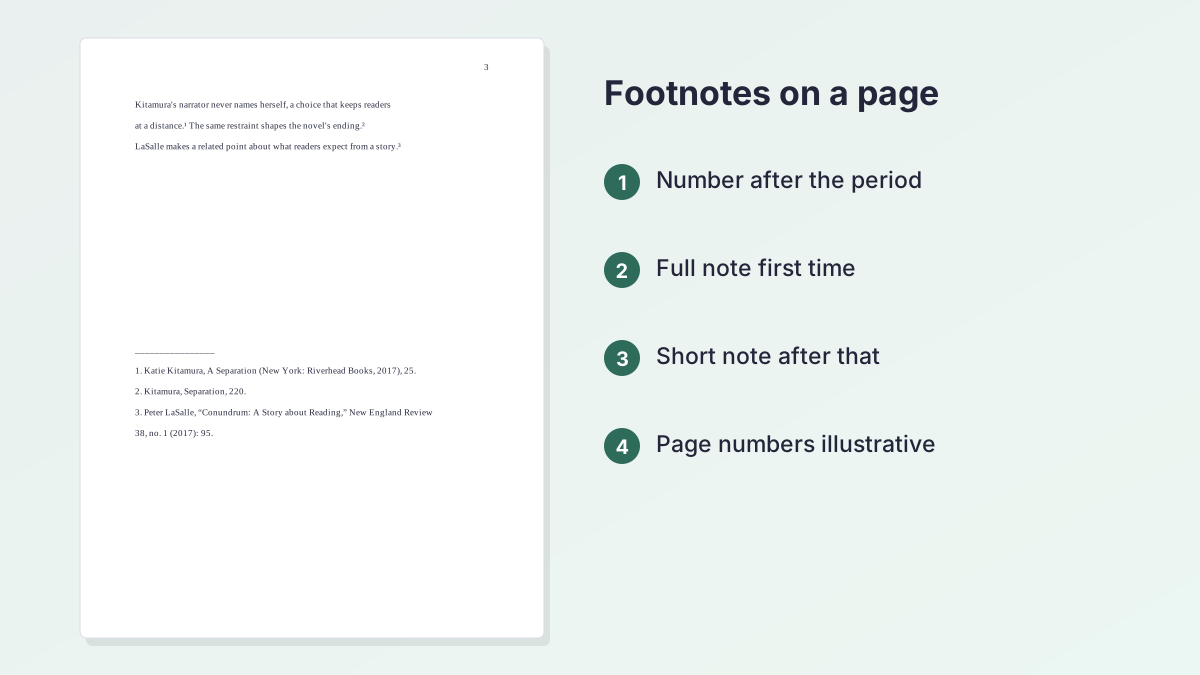
- Place the cursor. Click right after the punctuation at the end of the clause or sentence that uses the source, and after any closing quotation mark.
- Insert the footnote. In Word, choose References > Insert Footnote. In Google Docs, choose Insert > Page elements > Footnote. The program adds the superscript number and jumps to the bottom of the page.
- Type the note. Write a full note the first time you cite the source and a short note after that. Our Turabian citation tool gives you both forms.
- Format the notes. Select the notes, set single spacing, indent the first line 0.5 inch, and leave a blank line (or 12 points of space) between notes. Use the same font as the text.
- Switch to endnotes if asked. In Word, choose References > Insert Endnote, or open the Footnotes dialog and choose Convert. Google Docs has no endnote command, so type a Notes page by hand if you need one.
How Turabian Footnotes Work
Turabian footnotes belong to the notes-bibliography system in Kate L. Turabian's A Manual for Writers of Research Papers, Theses, and Dissertations (9th edition). Each time you quote, paraphrase or use an idea from a source, you add a numbered note. The number in your sentence points to a note with the source details and the exact page.
Most history, religion, theology and humanities courses use this system, and a bibliography at the end lists every source alphabetically. Our guide to the Turabian bibliography covers that page; the full guide to Turabian format covers margins, headings and spacing for the rest of the paper.
Try a source now
Paste a link, DOI or ISBN into the citation tool above to see a full note, a short note and the bibliography entry together. For a longer list, the Turabian Citation Machine formats every source in one place.
Turabian Footnote Format: 9 Rules
The Turabian footnote format comes down to nine rules. They apply to endnotes as well, except where the notes sit.
| Rule | What to do |
|---|---|
| 1. Number in the text | Superscript Arabic numeral, after the punctuation (except a dash) |
| 2. Order | Number notes consecutively through the paper: 1, 2, 3 |
| 3. Placement | At the end of the clause or sentence, after any closing quotation mark |
| 4. Number in the note | A full-size number and a period, or a superscript; the default your program inserts is fine |
| 5. Spacing | Single-space each note; leave a blank line between notes |
| 6. Indent | Indent the first line of each note 0.5 inch |
| 7. First citation | A full note with complete publication details and the page |
| 8. Later citations | A short note: last name, short title, page |
| 9. One number per spot | Put several sources for one sentence in a single note, separated by semicolons |
Where the number goes
Put the note number at the end of a clause or sentence, not after the author's name in mid-sentence. It follows a period, comma or closing quotation mark, but comes before a dash. If a sentence draws on two sources at different points, you may place two numbers, but never two numbers side by side.
How a note differs from a bibliography entry
A note gives the name in normal order and separates parts with commas, with the publication facts in parentheses. A bibliography entry inverts the name and uses periods. Union University's guide to notes-bibliography citations adds that page numbers are required in notes but not in bibliography entries.
Full Notes vs. Short Notes
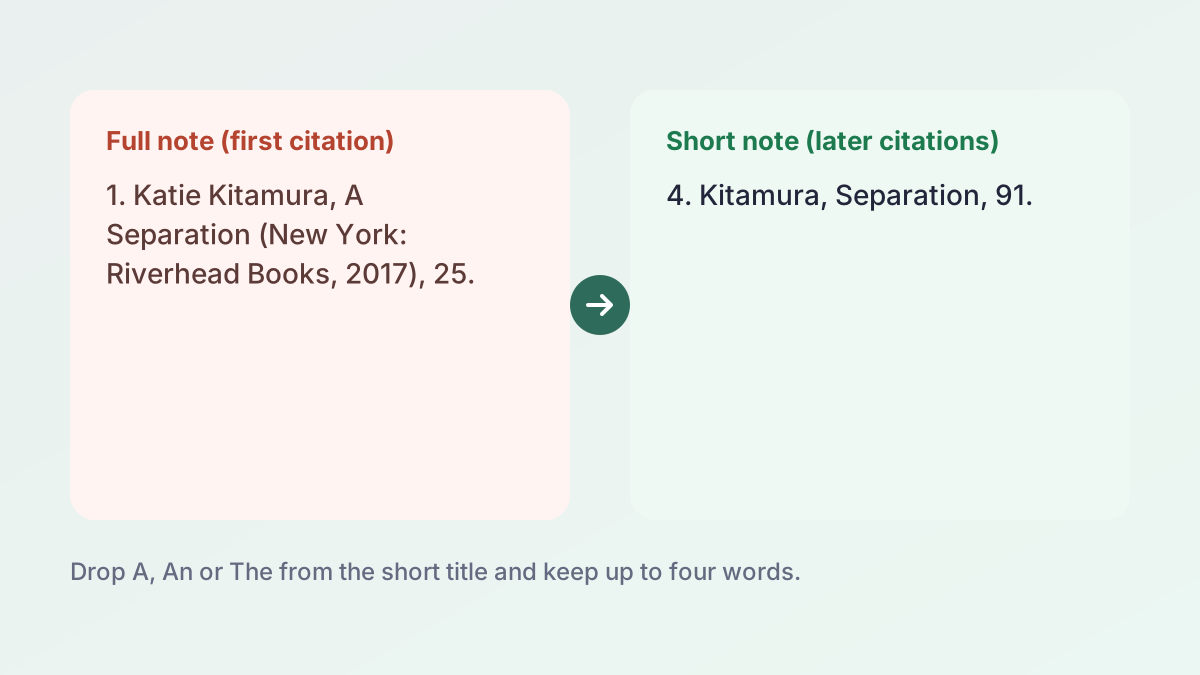
Turabian 9 uses a full note the first time you cite a source and a short note every time after that.
The short note
A short note has the author's last name, a shortened title and the page. The official Turabian notes-bibliography quick guide shows "Kitamura, Separation, 91–92." The quick guide's companion guides describe the short title as up to four key words from the full title. Drop a leading A, An or The, keep italics or quotation marks as in the full note, and don't change the word order.
Author-only short notes
If you cite only one work by an author, Turabian allows a note with just the last name and page, such as "Kitamura, 91." Most instructors still expect the short title, so use it unless told otherwise.
When to start fresh
In a class paper, one full note for each source is enough. In a long thesis with chapters, give a full note again the first time a source appears in each new chapter.
What our tool does
The citation engine behind our Turabian citation tool drops a leading article and any subtitle in short notes, but it doesn't cut titles to four words. Check each one and trim long titles by hand, as with White's "Historical Roots" above. Check each one; for a very long title you may want to trim it further by hand, as with White's "Historical Roots" above.
Ibid. in Turabian Footnotes
Ibid., short for the Latin ibidem ("in the same place"), points to the source in the note just before.
What the 9th edition says
Turabian 9 discourages ibid. and prefers a short note instead, even for two notes in a row to the same source. Ibid. is still allowed if you use it consistently.
When your school requires it
Some schools keep ibid. as a house rule. Liberty University's Turabian quick guide requires it for consecutive notes to the same source on the same page and notes that this differs from the 9th edition. Follow your school's guide over the manual when the two differ.
How to write it
Write "Ibid." with a capital I and a period, followed by a comma and the page if it changed: 5. Ibid., 27. If the page is the same, write just "Ibid." Never use ibid. after a note that cites more than one source.
Turabian Endnotes vs. Footnotes
Turabian endnotes use exactly the same note format as Turabian footnotes. Only the location changes, so every rule and Turabian footnote example on this page works for either.
Where endnotes go
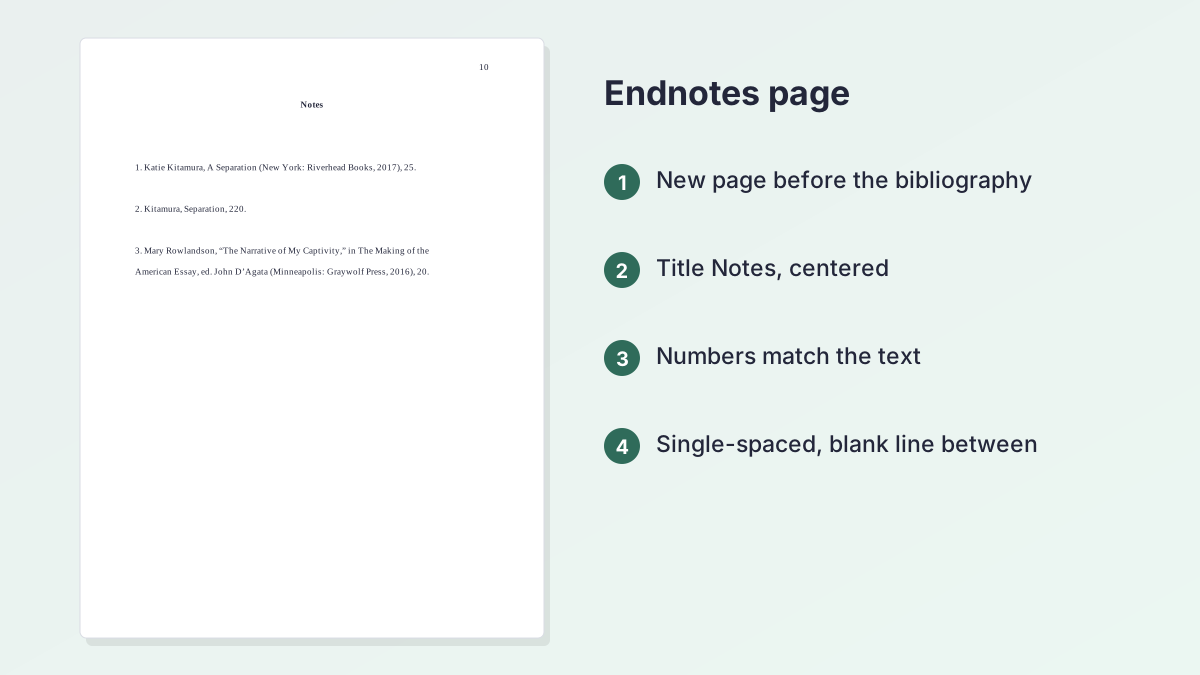
Endnotes collect every note on a separate page after the text, titled Notes and centered at the top. The Notes page comes after any appendixes and before the bibliography. The numbers in the text still run 1, 2, 3 through the paper.
Which to choose
Footnotes are the usual choice for class papers because readers see the source without flipping pages. Some instructors allow Turabian style endnotes for papers with many long discursive notes, and some schools, such as Liberty University, don't allow endnotes at all. When the assignment says "Chicago Turabian endnotes," it means this Notes-page format, not a different citation style.
A Turabian endnotes example
-
Katie Kitamura, A Separation (New York: Riverhead Books, 2017), 25.
-
Kitamura, Separation, 220.
-
Mary Rowlandson, "The Narrative of My Captivity," in The Making of the American Essay, ed. John D’Agata (Minneapolis: Graywolf Press, 2016), 20.
On the page, these notes sit under the centered title Notes, single-spaced with a blank line between them (page numbers illustrative).
Page Numbers and Sources Without Pages
Every note that points to a specific passage ends with the page number, with no "p." or "pp." before it.
Ranges and other locators
For a passage across pages, give a range with an en dash: 91–92. For a source with no pages, such as a web page or an ebook without fixed pages, give a chapter or section name if it helps readers find the passage, or leave the locator out. Don't use the page number your e-reader shows unless it matches the print edition.
Notes for a source quoted in another
If you found a quotation in a book but never saw the original, cite both. Give the original as fully as you can, then "quoted in" and the source you actually read, with its page. Only the source you read goes in the bibliography, unless your instructor says otherwise. Whenever you can, find and cite the original instead.
Turabian In-Text Citation: Notes or Parentheses?
Students often search for the Turabian in-text citation rules, but in the notes-bibliography system there is no parenthetical citation at all: the superscript number in your sentence is the in-text part, and the note holds the details.
Author-date: the parenthetical option
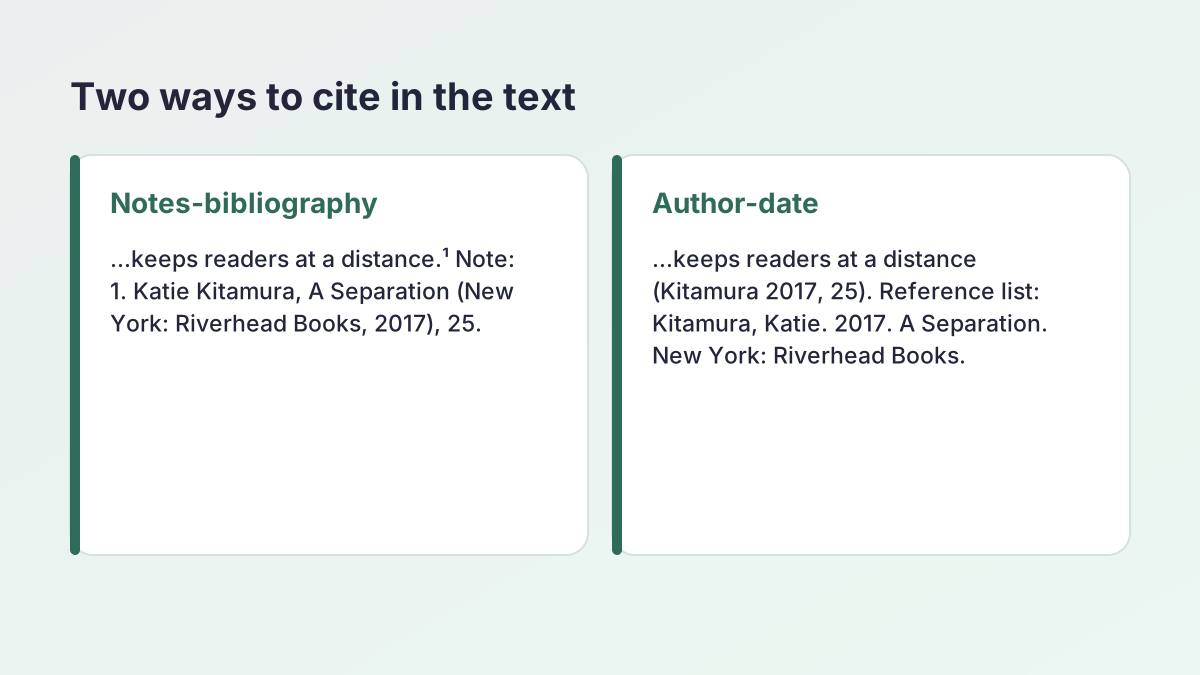
Turabian's second system, author-date, does put citations in the text. You write the author's last name, the year and the page in parentheses, such as (Kitamura 2017, 25), and end with a reference list instead of a bibliography. This system is more common in the social sciences.
Which one to use
Use the system your instructor names, and check whether the syllabus says anything about a Turabian in-text citation or a parenthetical one. If the assignment just says "Turabian," it almost always means footnotes and a bibliography. Don't mix the two systems in one paper. Our Turabian citation tool switches between notes-bibliography and author-date with one click.
Turabian in-text citations compared
In notes-bibliography style, a sentence reads: …keeps readers at a distance.¹ In author-date style, the same sentence reads: …keeps readers at a distance (Kitamura 2017, 25). If your English class uses MLA instead, see our guide to the MLA in-text citation, which uses author-page parentheses with no year.
Discursive Notes
A discursive note adds a comment, explanation or side point instead of, or in addition to, a citation. Use one when a detail matters but would break the flow of your paragraph.
How to write one
A discursive note follows the same Turabian footnote format as any other note: single-spaced, first line indented. Write the comment as a normal sentence. If it also cites a source, put the citation first or work it in naturally. For example: 7. The narrator is never named, which keeps readers at a distance; see Kitamura, Separation, 3–5. (Example note, page numbers illustrative.)
Keep them short
A few discursive notes help; a page with more notes than text distracts. If a comment runs longer than a few lines, it probably belongs in the body of the paper.
Common Turabian Footnote Mistakes
Check your sample Turabian footnotes against this list before you hand in the paper.
| Mistake | Fix |
|---|---|
| Number before the period | Put it after the punctuation and any closing quotation mark |
| Full note every time | Use a short note after the first citation |
| Bibliography form in the note | Use commas and parentheses; give the name in normal order |
| Notes double-spaced | Single-space each note, with a blank line between notes |
| Missing page number | End every note to a specific passage with the page |
| Ibid. everywhere | Use short notes unless your school requires ibid. |
| Numbers restarting on each page | Number consecutively through the whole paper |
| Parenthetical citations mixed with notes | Pick one system for the whole paper |
A final check
Every source in your notes should appear once in your bibliography. The Turabian Title Page Generator sets up the first page of the same paper, and every guide, including the MLA works cited page, is on our student writing guides page. When you're ready to cite, let the free Turabian citation generator format each full note, short note and entry for you.
Turabian Footnotes FAQ
How do you do footnotes in Turabian format?
Place a superscript number after the punctuation at the end of the clause, then write a matching note at the bottom of the page: a full note the first time, a short note after that.
What is the Turabian footnote format for a book?
First name Last name, Title (Place: Publisher, Year), page. For example: 1. Katie Kitamura, A Separation (New York: Riverhead Books, 2017), 25.
Does Turabian use ibid.?
The 9th edition discourages ibid. and prefers short notes, but allows it if used consistently. Some schools, such as Liberty University, require it.
What is a Turabian in-text citation?
In notes-bibliography style it's the superscript note number. In author-date style it's a parenthetical citation with the author, year and page, such as (Kitamura 2017, 25).
What is the difference between Turabian footnotes and endnotes?
The note format is the same. Footnotes sit at the bottom of each page; endnotes are gathered on a Notes page after the text and before the bibliography.
Are Turabian footnotes single spaced?
Yes. Each note is single-spaced with the first line indented 0.5 inch and a blank line between notes.
How do you add endnotes in Google Docs?
Google Docs has no endnote command. Add footnotes with Insert > Page elements > Footnote, or type a Notes page by hand if your instructor wants endnotes.
Do Turabian footnotes need page numbers?
Yes, whenever you cite a specific passage. Give the number alone, with no p. or pp.
More free guides
- Turabian BibliographyEntry format, order and spacing for a Turabian 9 bibliography, with examples.
- Turabian Book CitationNotes and bibliography entries for books, editions, chapters and the Bible in Turabian 9.
- Turabian vs ChicagoHow Turabian and Chicago relate, what differs, and which one your paper needs.
- Turabian FormatMargins, spacing, headings and page numbers for a Turabian 9 class paper.
- MLA In-Text CitationsAuthor-page citations for every kind of source, with examples.
- How to Cite a Website in MLAWorks Cited entries and in-text citations for web pages.
See all 80 free tools for students
Related tools
Last updated by The Study Corp editorial team.