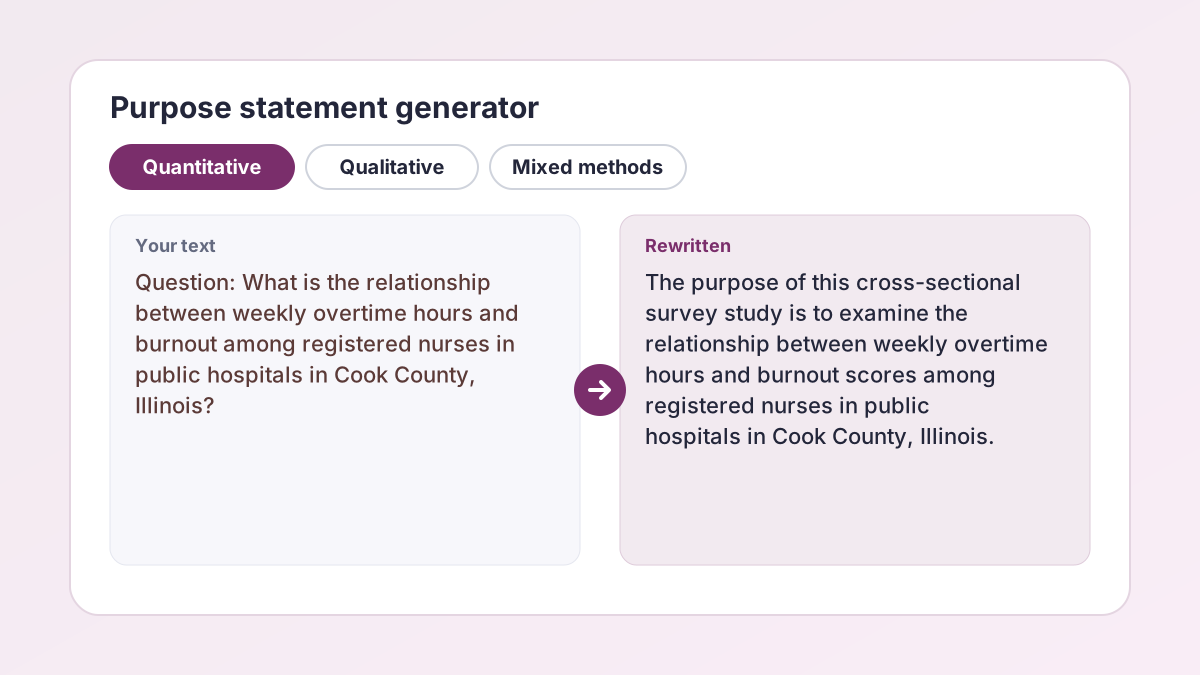
Purpose statement generator examples
Invented questions a US student might type, with the kind of purpose statement the tool returns. These are illustrations: wording changes on every run and the tool never adds a variable, population or method you didn't give it.
What you typeYour research question: What is the relationship between weekly overtime hours and burnout among registered nurses in public hospitals in Cook County, Illinois? Research approach: Quantitative. Research design: cross-sectional survey.
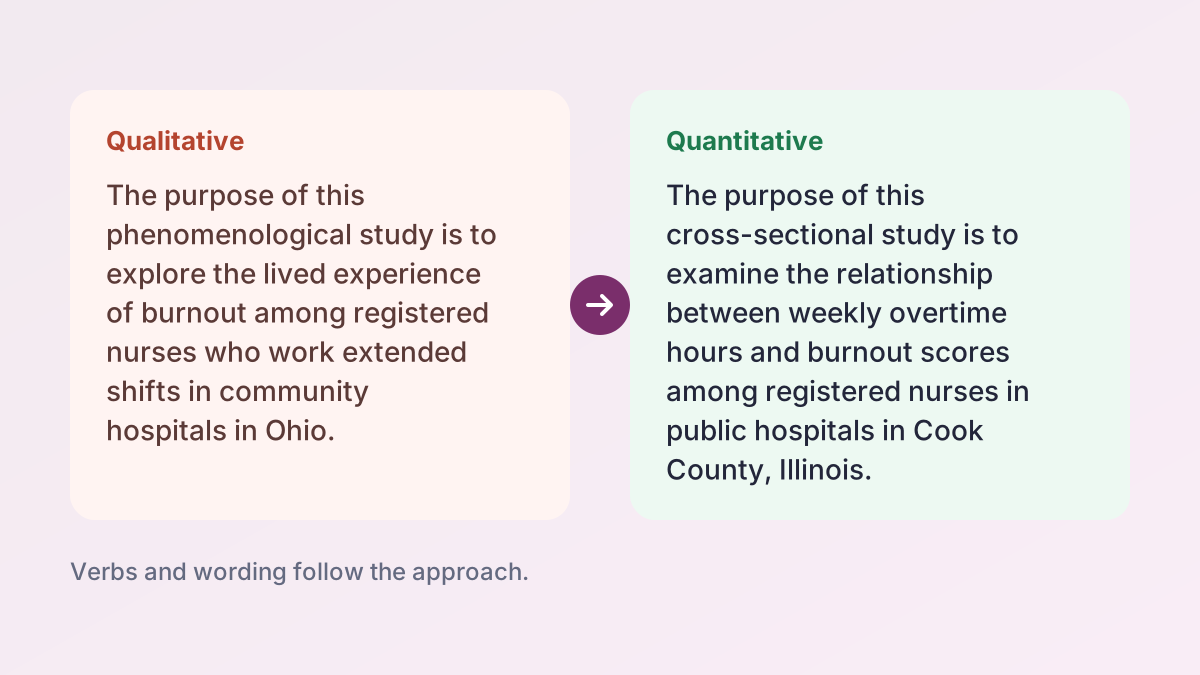
Concise statement (illustrative)The purpose of this cross-sectional survey study is to examine the relationship between weekly overtime hours and burnout scores among registered nurses in public hospitals in Cook County, Illinois.
Two named variables, a purpose verb that doesn't claim cause, a design, a population and a setting.
What you typeYour research question: How do registered nurses on extended shifts at community hospitals in Ohio experience burnout? Research approach: Qualitative. Research design: phenomenological study.
Concise statement (illustrative)The purpose of this phenomenological study is to explore how registered nurses who work extended shifts in community hospitals in Ohio experience burnout, understood here as emotional exhaustion and detachment arising from sustained work demands.
The qualitative form adds a short working definition of the phenomenon and uses an open verb, explore.
What you typeYour research question: To what extent does weekly retrieval practice predict unit test scores in 9th-grade biology at one suburban district in Illinois? Research design: correlational study.
Concise statement (illustrative)The purpose of this correlational study is to determine the extent to which weekly retrieval practice is associated with unit test scores among 9th-grade biology students in one suburban district in Illinois.
It says associated with, not improves, because a correlational design can't show cause.
What you typeYour research question: How does sleep duration relate to first-period attendance among 11th graders, and how do students explain their sleep habits? Research approach: Mixed methods. Research design: explanatory sequential. Setting or location: one public high school.
Concise statement (illustrative)The purpose of this explanatory sequential mixed-methods study is to examine the relationship between sleep duration and first-period attendance among 11th graders at one public high school, and then to explore through interviews how students explain their sleep habits, so that the interviews help explain the survey results.
Mixed methods states both strands and the reason for combining them.
What you typeYour research question: How do first-generation students at a community college in Arizona decide whether to take developmental math online or in person? Research design: qualitative case study. Academic level: Undergraduate.
Concise statement (illustrative)The purpose of this qualitative case study is to understand how first-generation students at one community college in Arizona decide between online and in-person developmental math courses.
A single central concept, a participant group and a site: enough for one semester.
What you typeConcise statement: The purpose of this correlational study is to determine the extent to which weekly retrieval practice is associated with unit test scores among 9th-grade biology students in one suburban district in Illinois.
Concise statement (illustrative)The purpose of my correlational study is to determine the extent to which weekly retrieval practice is associated with unit test scores among 9th-grade biology students in one suburban district in Illinois.
First person keeps every component and changes only the voice. Use it only if your instructor accepts first person.
How to use the purpose statement generator
Your research question is the only required field for the purpose statement generator. A design and a population make the sentence sharper.
- Enter your research question. Type or paste it into Your research question (up to 600 characters), or select Try an example.
- Add your design. Add a Research design such as cross-sectional survey or phenomenological study, and open More options to set Research approach, Main variables or phenomenon, Study population, Setting or location, General objective (if you have one) and Academic level.
- Select Write my purpose statement. You get a concise statement, a breakdown under What it contains, an Expanded version for a proposal and suggestions under To make it more specific.
- Refine it. Choose Shorter, More specific, More formal or First person, or select Edit to change the wording yourself.
- Copy or save it. Select Copy statement, or select Use this statement or Use this version to save it in your browser for the next tools.
What the purpose statement generator writes
Every run returns the same pieces.
The concise statement
One to two sentences in the form your approach calls for. The heading above it shows which template was used: Quantitative purpose statement, Qualitative purpose statement or Mixed-methods purpose statement. The parts are colored inside the sentence, with a legend underneath.
What it contains
Below the statement, a breakdown lists each component with the exact phrase the tool used: purpose verb, design, variables or phenomenon, population, setting and, for mixed methods, the reason for mixing. If you didn't supply something and the tool had to leave it general, that row says "you didn't supply this", so you know what to add.
The expanded version
A short paragraph that a proposal might use. It carries the same content as the concise statement, with the design and rationale spelled out. It has its own Copy, Edit and Use this version buttons.
To make it more specific
Suggestions that each point at a missing or vague component, such as naming the survey instrument or the recall window.
What it never does
The statement says what the study will do, not what it found, and the tool is told not to add a method, population or variable that isn't in your question or context.
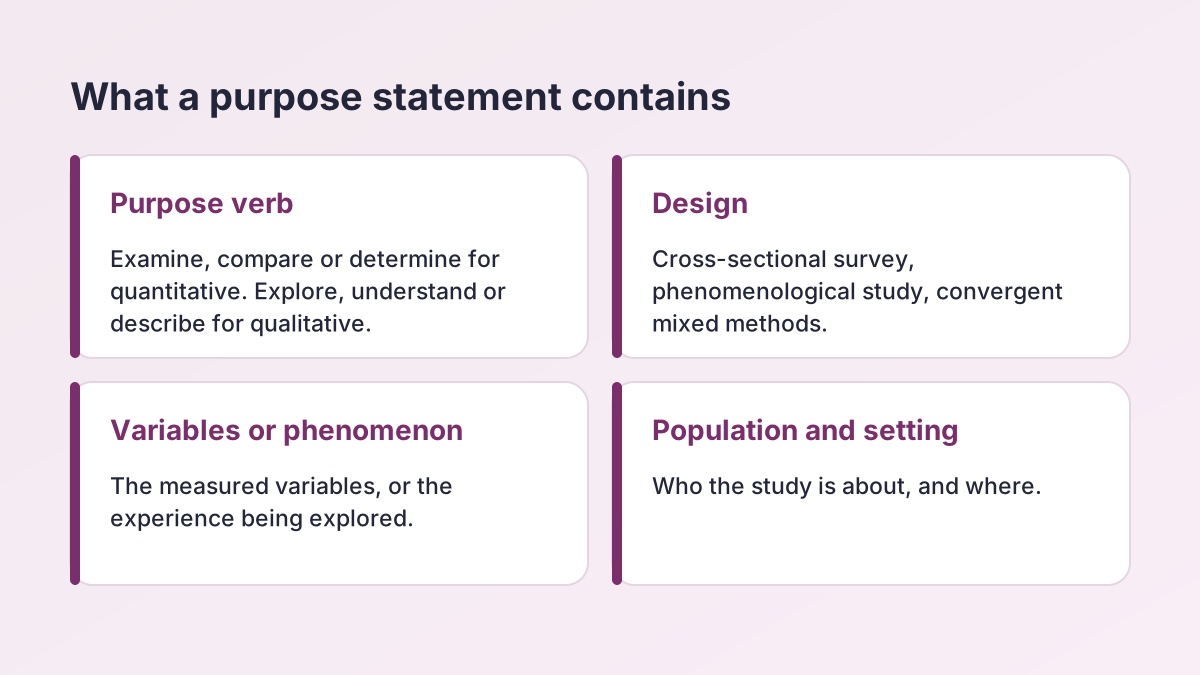
Quantitative purpose statement: template and verbs
A quantitative purpose statement names variables and how they relate. The purpose statement generator's template reads:
The purpose of this [design] study is to [test / examine / determine / compare] the [relationship / association / difference] between [variables] for [population] in [setting].
Manhattanville University's doctoral library guide lists closed-ended verbs for quantitative statements, including determine, measure, compare, identify and examine, and asks you to name the variables and how they relate in its guide to writing a purpose statement. The wording of your own program may differ, so check your handbook.
Name the variables
"Overtime hours" and "burnout score" are variables. "Healthcare" isn't. If you leave Main variables or phenomenon blank, the tool works from the variables named in your question.
Avoid causal verbs unless the design is experimental
Verbs such as improves, reduces or causes claim more than a survey or correlational design can show, so the tool is told to avoid causal verbs unless the design is experimental. Examine, relate and compare are safer.
Quantitative examples
- Survey: The purpose of this cross-sectional survey study is to examine the relationship between social media use after 10 p.m. and self-reported sleep duration among 11th graders at two public high schools in Austin, Texas.
- Comparison: The purpose of this quasi-experimental study is to compare unit test scores between two sections of 10th-grade chemistry, one using weekly quizzes and one not, at one public high school in Georgia.
Both are invented, for illustration.
Qualitative purpose statement: template and verbs
A qualitative purpose statement names a central phenomenon, an experience, meaning or process, and uses open verbs. The purpose statement generator's template reads:
The purpose of this [design] study is to [explore / understand / describe] [the phenomenon / experience] for [population] in [setting].
It also adds a one-clause working definition of the phenomenon. The Manhattanville guide lists open-ended verbs such as explore, understand, discover and develop, and asks for non-directional wording that doesn't suggest an outcome.
One concept, broadly defined
"Burnout" is a concept, and "burnout and job satisfaction and sleep" is three. The Manhattanville guide says a purpose statement should focus on a single idea or concept, broadly defined. If your question names several, decide which one the study is really about.
Words to leave out
Prove, show, effect, impact and cause belong in other designs.
Designs you can name
Typical qualitative designs include phenomenological, case study, ethnographic, narrative and grounded theory. Type yours in Research design.
Qualitative examples
- The purpose of this phenomenological study is to explore how new graduate nurses in their first year at a rural Georgia hospital experience night-shift work.
- The purpose of this case study is to understand how a Louisiana coastal parish's residents describe decisions about relocating after repeated flooding.
Both are invented, for illustration.
Mixed-methods purpose statements
A mixed-methods statement names both strands and why you combine them. That reason is easy to leave out, so the tool's template asks for it directly and the breakdown lists it as the reason for mixing.
Common reasons
- Explain numbers with stories. Survey first, interviews second, to understand surprising results. This is often called explanatory sequential.
- Explore, then measure. Interviews first to learn what to ask, then a survey. This is often called exploratory sequential.
- Compare both at once. Collect both together and compare. This is often called convergent.
These labels are conventions from mixed-methods textbooks, and your course may use different names.
Example
The purpose of this explanatory sequential mixed-methods study is to examine the relationship between sleep duration and first-period attendance among 11th graders at one public high school, and then to explore through interviews how students explain their sleep habits, so that the interviews help explain the survey results. (Invented, for illustration.)
If you're not sure of the approach
Leave Research approach on Not sure yet. The tool infers one from your question: words such as experience, perceive or how do point to qualitative, while relationship, compare, extent or predict point to quantitative. The heading above the statement shows which form it used. If you have a design in mind, enter it in Research design.
Research purpose statement generator: what to enter
Here is what each field of the research purpose statement generator does.
- Your research question (required): the main input, up to 600 characters. The statement must match it.
- Research design: free text, up to 120 characters, such as cross-sectional survey, phenomenological study or convergent mixed methods. Naming it lets the statement name it.
- Research approach: Not sure yet, Quantitative, Qualitative or Mixed methods.
- Main variables or phenomenon: up to 200 characters. Leave it empty to let the tool take them from the question.
- Study population and Setting or location: up to 160 characters each, such as "registered nurses" and "community hospitals in Ohio".
- General objective (if you have one): if you have written one, the statement is aligned with it.
- Academic level: Any level, Undergraduate, Master's or Doctoral.
Using what you saved
If you saved a question in the Research Question Generator or objectives in the Research Objective Generator, the matching fields are pre-filled, with a note saying so, and you can change them. A saved topic or problem statement is listed at the top of the form with a remove link. Nothing is sent until you press the button.
What to do if something is missing
The tool is told not to fill a gap with a guess. A part you didn't supply is marked, and To make it more specific suggests what to add. Then select Write my purpose statement again.
Purpose of the study generator: where the sentence goes
This works as a purpose of the study generator for any proposal, thesis or capstone that asks for a statement announcing the study. Conventions vary by program, so your handbook has the final word.
Where it usually sits
In many proposals the statement comes near the end of the introduction, after the problem and before the research questions. The Manhattanville guide says it should be concise and flow directly from the problem statement.
How it differs from the problem
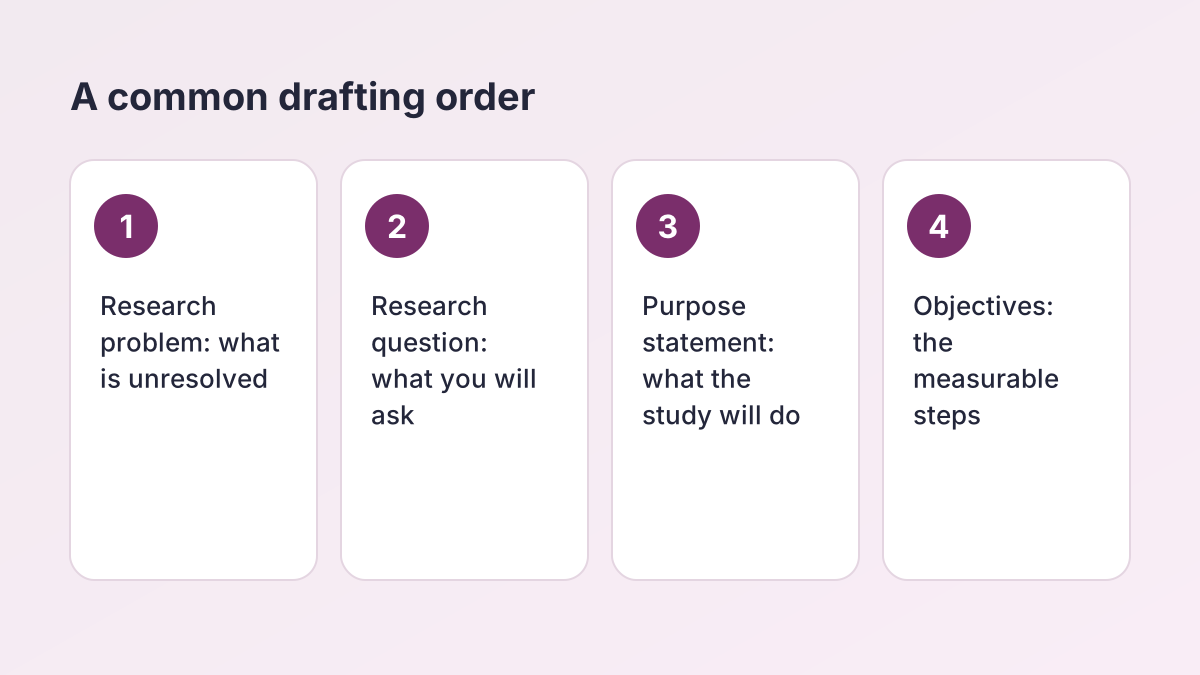
The problem says what is unresolved and why that matters. The purpose says what you will do about it. If your problem is that first-year students' experiences are not well described, your purpose should be to describe them, not to evaluate a program.
How it differs from objectives
The purpose is the overall aim. Objectives are the specific steps. Write the purpose first, then use the Research Objective Generator for a general objective and three to five specific ones.
Not the same as a speech purpose
Many speech classes ask for a "specific purpose" sentence for an oral presentation. This tool is for research purpose statements. For speeches and a wider set of samples, see our guide with purpose statement examples.
Keep the purpose, question and objectives aligned
Reviewers look for the same terms and population from problem to objectives. Any purpose statement generator output should be checked against them.
A quick alignment check
- Same population. If the question says "registered nurses in public hospitals", the purpose shouldn't say "healthcare workers".
- Same variables or phenomenon. Don't swap burnout for stress between sections.
- Same approach. An open how question belongs with an exploratory verb.
Tools that fit around it
- Research Question Generator: three to five questions you can choose from.
- Research Problem Generator: the problem that leads into the purpose.
- Research Objective Generator: objectives checked against your question.
- Research Paper Title Generator: titles that don't claim a result.
- Research Paper Introduction Generator: a draft introduction around your aim.
For a clinical question with an intervention and a comparison, try the PICOT Question Generator first.
Shorter, More specific, More formal or First person
Four buttons rewrite the result without adding anything new.
- Shorter: the concise statement becomes one sentence and the expanded version about half its length. Every component stays.
- More specific: makes the population, setting and variables or phenomenon more precise, using only what is in your question and context.
- More formal: raises the register to formal academic prose, as in a thesis proposal.
- First person: rewrites in the first person, for example "The purpose of my study is…". Check first whether your instructor allows it.
Select Edit to rewrite the statement yourself. The edit stays in the result on screen only, so copy it before you leave.
Saving it
Use this statement or Use this version saves your choice in your own browser. Other research tools can then pre-fill from it. The tool shows what it is using at the top of the form, and a Clear everything saved on this device link removes it.
When the tool flags something
Under Things to check you may see a generic opener, a figure you didn't supply, a citation-like string, or a claim that something works. Edit the sentence, then regenerate.
What the purpose statement generator will not invent
A purpose statement generator that adds a new method or population can mislead a reader, so the prompt is strict.
- It must not introduce a purpose, method, population or variable that is not in your question, objective or context.
- If something essential is missing, it marks the component as not supplied and suggests it, rather than inventing it.
- No statistics, no citations, no claims of effectiveness and no generic openers about the modern world.
Check it against your own plan
Automated checks scan the output for generic openers, claims that something works, figures that weren't in your input and citation-like strings. They cannot tell whether the design suits your question or whether your instructor will accept it.
Good habits
Read the statement next to your question, and replace any "assumed" design with the one you will actually use.
Is the purpose statement generator free and private?
Yes. The purpose statement generator is free, with no account or sign-up. To keep it fast for everyone, each visitor can make up to 20 generations and 60 refinements an hour.
Your question and any details you add, plus anything saved from other research tools that this one uses, are sent to our AI providers (Groq, with Google Gemini as a backup) only to generate the result. The Study Corp does not save them. When you select Use this statement or Use this version, it is stored in your own browser only.
Use it to study and to draft
Learn the form from the draft, then write the final version in your own words and follow your school's policy on AI tools.
Purpose statement generator FAQ
Is the purpose statement generator free?
Yes. It is free, with no account or sign-up. Each visitor can make up to 20 generations and 60 refinements an hour.
How do I write a quantitative purpose statement?
Name the design, a purpose verb such as examine or compare, the variables and how they relate, the population and the setting. Avoid causal verbs unless the design is experimental.
How do I write a qualitative purpose statement?
Name the design, an open verb such as explore, understand or describe, one central phenomenon with a short working definition, the participants and the site. Avoid wording that suggests an outcome.
How long should a purpose of the study statement be?
Many instructors expect one or two sentences, while some programs, often doctoral ones, ask for a short paragraph. The tool gives both a concise statement and an expanded version. Check your assignment.
Do I need a research design to use the purpose statement generator?
No. Only your research question is required. If you leave the design blank, the tool marks it as not supplied and may assume a common one, which you should replace with yours.
What is the difference between a purpose statement and a research question?
The purpose says what the study will do, and the question is what it asks. They should use the same population and variables, and the purpose is usually a statement, not a question.
Can the research purpose statement generator write a mixed-methods statement?
Yes. Choose Mixed methods under Research approach. The statement describes both strands and the reason for combining them.
Can I use the result in my thesis or paper?
Use it as a draft. Rewrite it in your own words, check it against your plan and follow your school's AI policy.
Is my question saved?
The Study Corp does not save it. It is sent to our AI providers only to generate the result. A statement you choose with Use this statement is kept in your own browser.
More free research tools
- PICOT Question GeneratorA well-formed PICOT question with each element labeled and a ready PubMed search.
- Research Question GeneratorThree to five answerable research questions from your topic.
- Abstract GeneratorA structured abstract built only from the findings you give it.
- Research Paper Title GeneratorFive accurate titles for your paper from its question and method.
- Research Paper Introduction GeneratorA paragraph-by-paragraph introduction draft built from your question and sources.
- Research Objective GeneratorA general objective and specific objectives that match your question.
- Research Problem GeneratorA problem statement built from your topic and the evidence you have.
See all 80 free tools for students
Free guides
Related tools
Last updated by The Study Corp editorial team.