Chicago Style Citation Book Examples for Every Type
Our citation engine formatted each Chicago book citation below under Chicago 18th edition notes-bibliography rules, using real books (several come from the official Chicago quick guide). Hand-adjusted: Liu Xinwu's name order, the “Vol. 1 of” wording for Caro, the chapter number in the Kindle note, the EBSCOhost label, and the trimmed short title for the Ding book. Page numbers are illustrative. Italicize book titles in your paper.
BookMichael Pollan, The Omnivore’s Dilemma: A Natural History of Four Meals, Penguin Press, 2006, page 99.
Full note, then bibliography entryNote: Michael Pollan, The Omnivore’s Dilemma: A Natural History of Four Meals (Penguin Press, 2006), 99. Bibliography: Pollan, Michael. The Omnivore’s Dilemma: A Natural History of Four Meals. Penguin Press, 2006.
Notes use commas and parentheses; bibliography entries use periods.
BookAmy J. Binder and Jeffrey L. Kidder, The Channels of Student Activism, University of Chicago Press, 2022.
Full note, then bibliography entryNote: Amy J. Binder and Jeffrey L. Kidder, The Channels of Student Activism: How the Left and Right Are Winning (and Losing) in Campus Politics Today (University of Chicago Press, 2022), 117. Bibliography: Binder, Amy J., and Jeffrey L. Kidder. The Channels of Student Activism: How the Left and Right Are Winning (and Losing) in Campus Politics Today. University of Chicago Press, 2022.
Only the first author's name is inverted in the bibliography.
BookCormen, Leiserson, Rivest and Stein, Introduction to Algorithms, 4th edition, MIT Press, 2022.
Full note, then bibliography entryNote: Thomas H. Cormen et al., Introduction to Algorithms, 4th ed. (MIT Press, 2022), 45. Bibliography: Cormen, Thomas H., Charles E. Leiserson, Ronald L. Rivest, and Clifford Stein. Introduction to Algorithms. 4th ed. MIT Press, 2022.
Notes shorten three or more authors to et al.; the bibliography lists up to six.
BookP. J. M. Marks and Stephen Parkin, editors, The Book by Design, University of Chicago Press, 2023.
Full note, then bibliography entryNote: P. J. M. Marks and Stephen Parkin, eds., The Book by Design: The Remarkable Story of the World’s Greatest Invention (University of Chicago Press, 2023). Bibliography: Marks, P. J. M., and Stephen Parkin, eds. The Book by Design: The Remarkable Story of the World’s Greatest Invention. University of Chicago Press, 2023.
Add ed. or eds. after the names.
BookKathleen Doyle's chapter “The Queen Mary Psalter” in The Book by Design.
Full note, then bibliography entryNote: Kathleen Doyle, “The Queen Mary Psalter,” in The Book by Design: The Remarkable Story of the World’s Greatest Invention, ed. P. J. M. Marks and Stephen Parkin (University of Chicago Press, 2023), 65. Bibliography: Doyle, Kathleen. “The Queen Mary Psalter.” In The Book by Design: The Remarkable Story of the World’s Greatest Invention, edited by P. J. M. Marks and Stephen Parkin. University of Chicago Press, 2023.
Chapter title in quotation marks; “ed.” in the note, “edited by” in the bibliography.
BookLiu Xinwu, The Wedding Party, translated by Jeremy Tiang, Amazon Crossing, 2021.
Full note, then bibliography entryNote: Liu Xinwu, The Wedding Party, trans. Jeremy Tiang (Amazon Crossing, 2021), 279. Bibliography: Liu Xinwu. The Wedding Party. Translated by Jeremy Tiang. Amazon Crossing, 2021.
Chinese names keep family-name-first order with no comma.
BookArundhati Roy, The God of Small Things, Random House, 2008, read on a Kindle.
Full note, then bibliography entryNote: Arundhati Roy, The God of Small Things (Random House, 2008), chap. 6, Kindle. Bibliography: Roy, Arundhati. The God of Small Things. Random House, 2008. Kindle.
With no fixed page numbers, cite a chapter or section instead.
BookRobert A. Caro, The Path to Power, volume 1 of The Years of Lyndon Johnson, Knopf, 1982.
Full note, then bibliography entryNote: Robert A. Caro, The Path to Power, vol. 1 of The Years of Lyndon Johnson (Knopf, 1982), 120. Bibliography: Caro, Robert A. The Path to Power. Vol. 1 of The Years of Lyndon Johnson. Knopf, 1982.
Name the volume and the series it belongs to.
How to Cite a Book in Chicago Style, Step by Step
To write a Chicago book citation, work from the book's title page and copyright page, not the cover or a store listing.
- Find the book's details. Copy the authors or editors, the full title and subtitle, the edition, the publisher and the year from the title page and the copyright page.
- Write the full note. On the first mention, give First Last, Title (Publisher, Year), page. Put the note number after the sentence's punctuation.
- Shorten later notes. After the first note, use Last name, Short Title, page. Cut the title to four words or fewer and drop the subtitle.
- Write the bibliography entry. Invert the first author's name, separate parts with periods, and drop the page number. Our Chicago citation generator builds both forms from an ISBN.
- Format the list. Alphabetize by last name, single-space each entry with a blank line between, and use a 0.5-inch hanging indent.
Chicago Book Citation Basics (18th Edition)
A Chicago book citation follows The Chicago Manual of Style, 18th edition, published in 2024. Most history, art history, music and religion courses use its notes-bibliography system: a superscript number in your sentence points to a footnote, and a bibliography at the end lists every book alphabetically.
Each book appears in up to three forms:
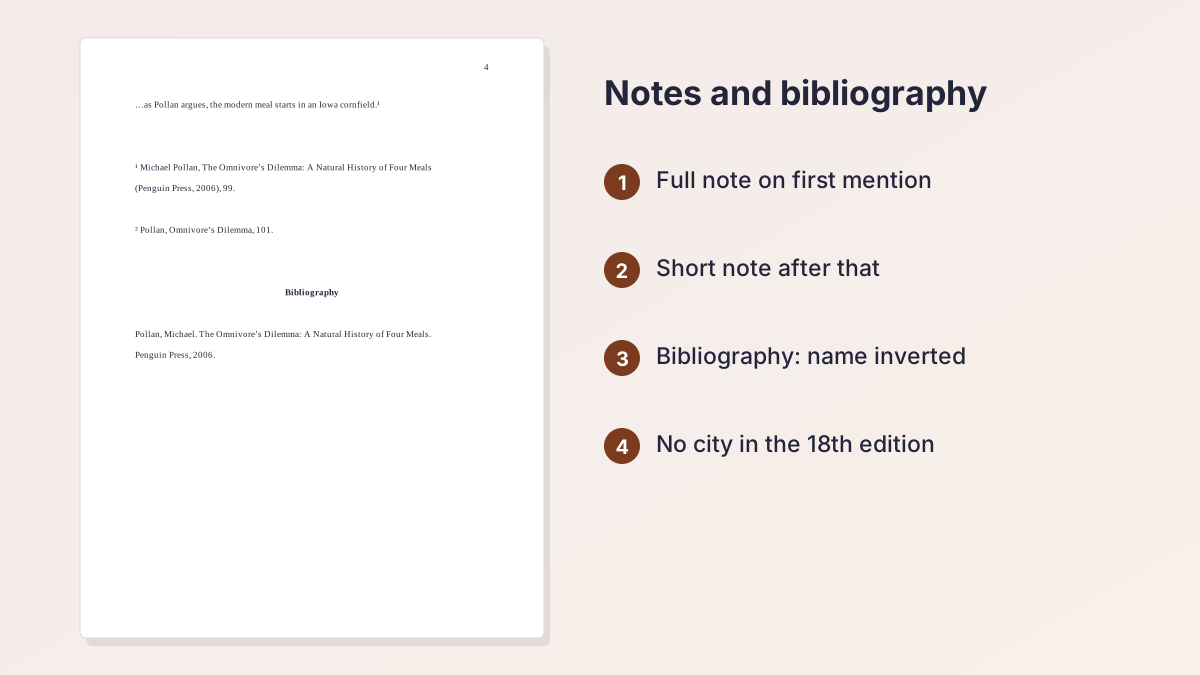
- Full note on the first mention: Michael Pollan, The Omnivore’s Dilemma: A Natural History of Four Meals (Penguin Press, 2006), 99.
- Short note after that: Pollan, Omnivore’s Dilemma, 101.
- Bibliography entry: Pollan, Michael. The Omnivore’s Dilemma: A Natural History of Four Meals. Penguin Press, 2006.
Paste a title or ISBN into the citation tool above to see all three, or open the full Chicago citation generator to build a whole bibliography. For the note numbers themselves, see our guide to Chicago in-text citation.
What changed in the 18th edition
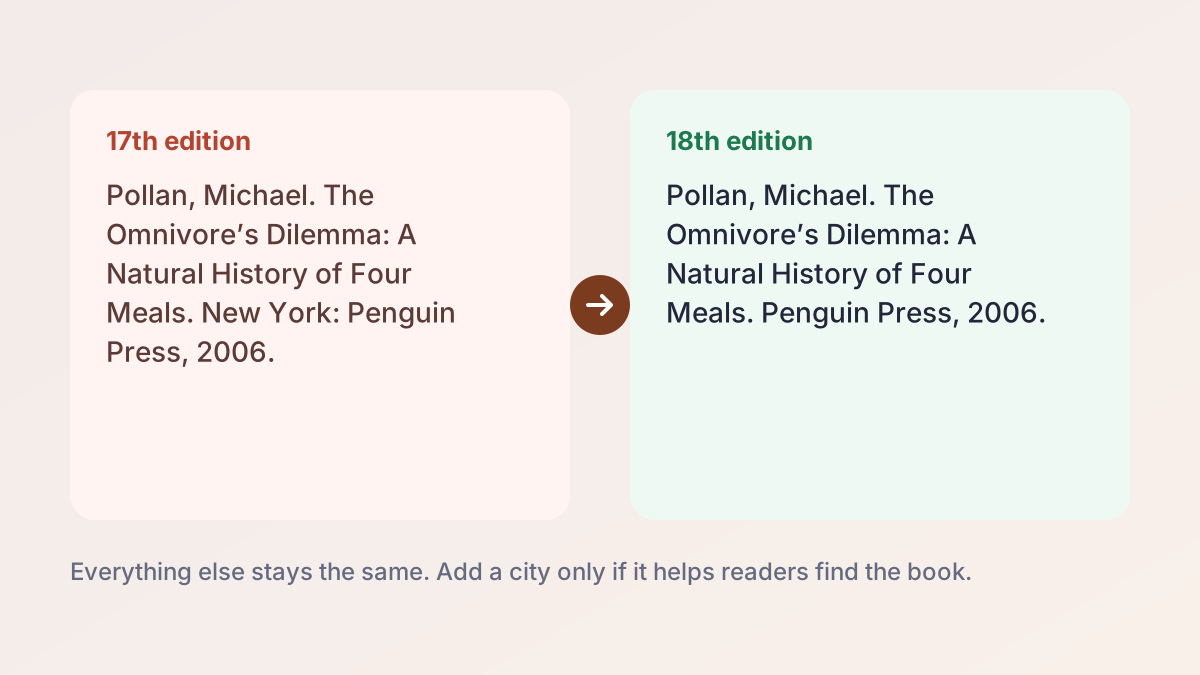
The biggest change for a Chicago style citation for a book is that the place of publication is gone. The 17th edition wrote (New York: Penguin Press, 2006); the 18th writes (Penguin Press, 2006). Purdue OWL's CMOS 18 book citation page confirms that a city is no longer required unless it helps readers. The et al. rules changed too, as the table below shows.
Chicago Style Citation for a Book: The Basic Pattern
Here is the Chicago style citation for a book with one author, broken into its parts. Every other book citation in Chicago style builds on it.
| Form | Pattern |
|---|---|
| Full note | First Last, Title: Subtitle (Publisher, Year), page. |
| Short note | Last, Short Title, page. |
| Bibliography | Last, First. Title: Subtitle. Publisher, Year. |
| Author-date reference | Last, First. Year. Title: Subtitle. Publisher. |
| Author-date in text | (Last Year, page) |
Titles
In a Chicago book citation, italicize book titles and use headline-style capitalization: capitalize the first and last words and all major words. Separate a title and subtitle with a colon. In short notes, drop the subtitle and an opening A, An or The, and cut longer titles to four words or fewer, as in Channels of Student Activism.
Publisher and year
Copy the publisher's name as it appears on the title page. You may drop "Inc." and "Co." The year is the copyright year for the edition you used, not a later printing.
Page numbers
Notes end with the exact page you cite. A Chicago style citation for a book in the bibliography never takes page numbers. The Chicago quick guide from the University of Chicago Press shows this pattern for every book type here.
Book Citation in Chicago Style With Several Authors
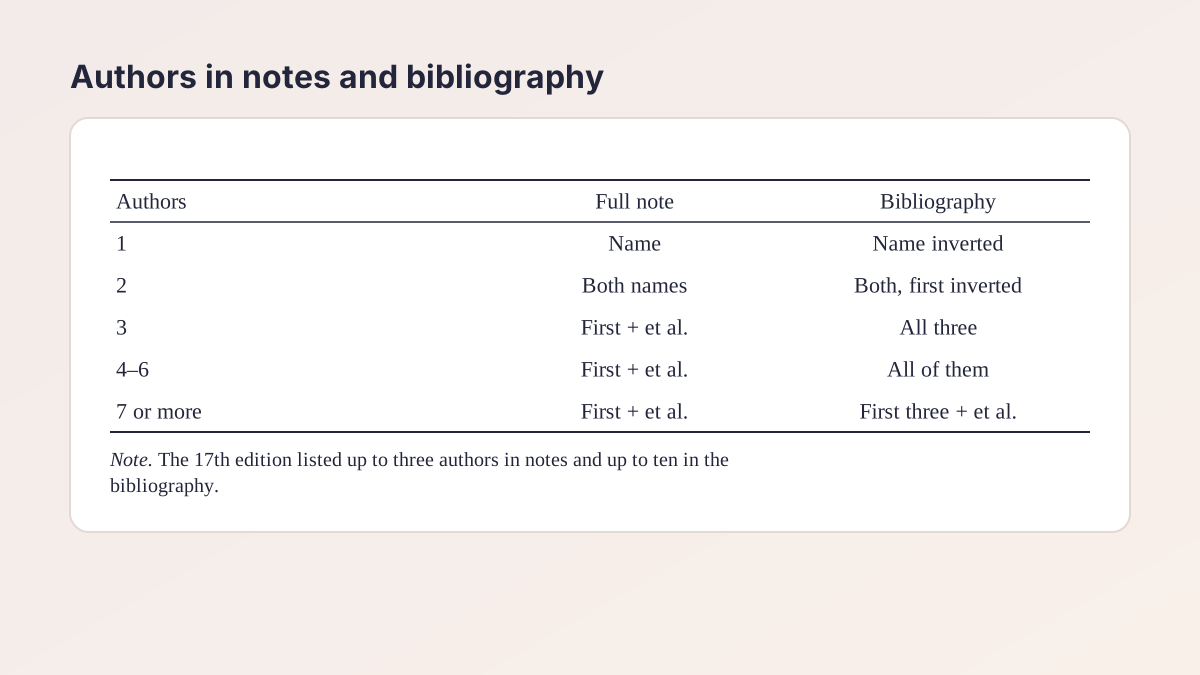
The number of authors changes a book citation in Chicago style more than anything else, and the 18th edition changed the rules.
Two authors
A Chicago book citation with two authors lists both in every form. Only the first name is inverted in the bibliography, and a comma comes before "and": Binder, Amy J., and Jeffrey L. Kidder.
Three to six authors
In a note, give only the first author followed by et al.: Wei Ding et al., Information Architecture and UX Design: The Integration of Information Spaces (Springer, 2025), 29. In the bibliography, list all of them: Ding, Wei, Xia Lin, and Michael Zarro. The short note is Ding et al., Information Architecture, 29 (we trimmed the short title by hand).
Seven or more authors
In the bibliography, list the first three followed by et al. The note still uses the first author and et al.
The 17th edition rule
If your class still uses the 17th edition, list up to three authors in a note and use et al. for four or more. In the bibliography, list up to ten; for more than ten, list seven and et al. Ask your instructor which edition the course follows, and see our Turabian footnotes guide if your syllabus names Turabian, the student version of Chicago.
Chicago Citation for an Edited Book and a Chapter
A Chicago citation for an edited book works like a normal entry, with the editors in the author slot followed by ed. or eds.
- Note: P. J. M. Marks and Stephen Parkin, eds., The Book by Design (University of Chicago Press, 2023).
- Bibliography: Marks, P. J. M., and Stephen Parkin, eds. The Book by Design. University of Chicago Press, 2023.
A chapter in an edited book
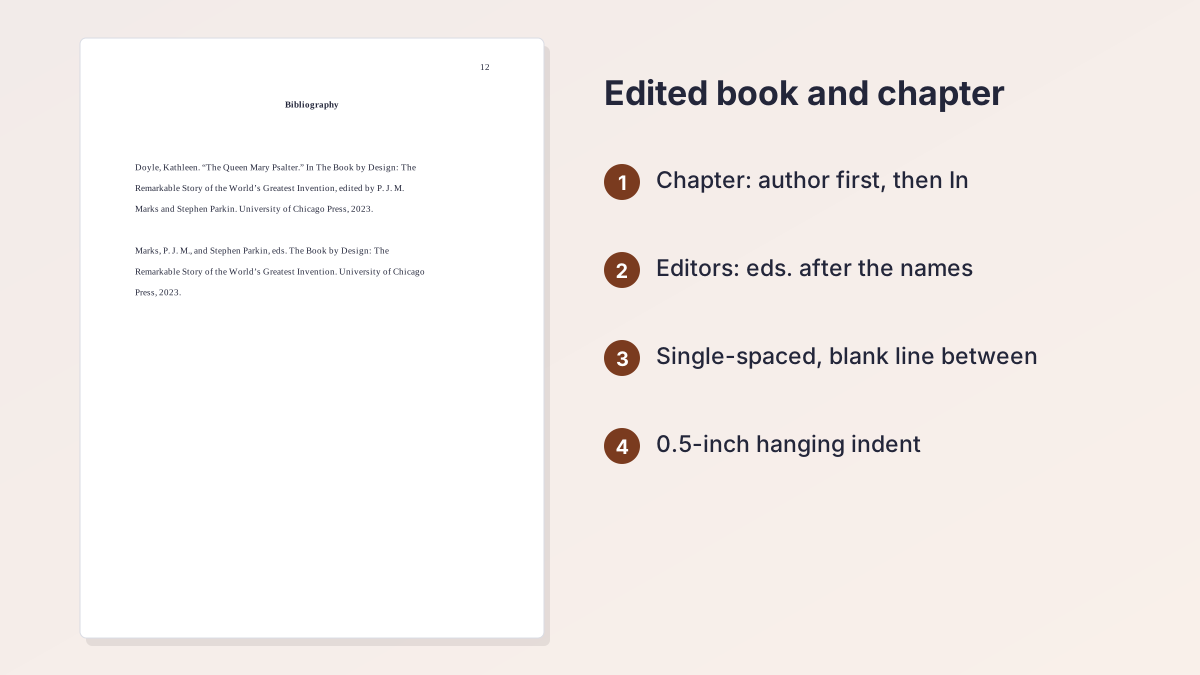
Most of the time a Chicago citation for an edited book names one chapter, not the whole collection. Start with the chapter's author and its title in quotation marks, then "in" and the book. In the note, write ed. before the editors' names; in the bibliography, spell out edited by. The 18th edition no longer requires the chapter's page range in the bibliography, so the Doyle entry above ends with the publisher and year.
When to cite the whole collection
Use the editors' entry only when you discuss the book as a whole. Otherwise, a Chicago citation for an edited book should name the chapter you quote.
Chicago Style Textbook Citation
A Chicago style textbook citation follows the book pattern, with two details that textbooks often have: an edition and several authors.
Editions
Put the edition after the title, abbreviated: 2nd ed., 4th ed., rev. ed. Don't mention a first edition. In a note, the edition goes before the parentheses: Thomas H. Cormen et al., Introduction to Algorithms, 4th ed. (MIT Press, 2022), 45. In the bibliography, it gets its own sentence: Introduction to Algorithms. 4th ed. MIT Press, 2022.
Online textbooks and courseware
For a Chicago style textbook citation of an ebook from a publisher's platform, cite the textbook itself, then add the platform or a URL at the end, as with other ebooks below. If the platform shows no stable page numbers, cite a chapter or section.
Chicago Citation of Book Types: Translations, Ebooks, Volumes
Each of these book types adds one element to the basic Chicago book citation. The table shows what to add and where, and the examples above show complete entries.
| Book type | What to add | Bibliography example |
|---|---|---|
| Translation | Translated by Name | Liu Xinwu. The Wedding Party. Translated by Jeremy Tiang. Amazon Crossing, 2021. |
| Kindle ebook | Kindle at the end; chapter in notes | Roy, Arundhati. The God of Small Things. Random House, 2008. Kindle. |
| Library database ebook | Database name at the end | Borel, Brooke. The Chicago Guide to Fact-Checking. 2nd ed. University of Chicago Press, 2023. EBSCOhost. |
| Ebook at a URL | URL at the end | Title. Publisher, Year. https://... |
| One volume | Vol. 1 of Series | Caro, Robert A. The Path to Power. Vol. 1 of The Years of Lyndon Johnson. Knopf, 1982. |
| No author | Begin with the title | Beowulf: A New Verse Translation. Translated by Seamus Heaney. Farrar, Straus and Giroux, 2000. |
Ebooks with no page numbers
Kindle locations change with font size, so Chicago doesn't use them. In a note, cite a chapter (chap. 6) or a section heading instead. If the ebook shows the print page numbers, use those.
Multivolume works
When you cite one volume with its own title, name the volume and the set, as in the Caro entry. When you cite the whole set, give the number of volumes (4 vols.) after the title. In a note to a set, put the volume number before the page with a colon: 2:45.
No author
Begin the entry with the title and alphabetize it under the first word other than A, An or The. Don't write "Anonymous" unless the title page does. The Beowulf entry was written by hand: our engine puts the translator in the author slot, which some instructors accept but Chicago doesn't require.
Chicago Citation Style Book Entries in Author-Date
Science and social science courses often use Chicago's author-date system instead of notes. A book citation in Chicago style keeps the same details; only the order and the in-text form change.
- In text: (Pollan 2006, 99)
- Reference list: Pollan, Michael. 2006. The Omnivore’s Dilemma: A Natural History of Four Meals. Penguin Press.
Several authors in author-date
Two authors: (Binder and Kidder 2022, 117). Three or more: (Cormen et al. 2022, 45). The reference list follows the same up-to-six rule as the bibliography.
For the full system, including how to cite a paraphrase and the n.d. rule, see our Chicago author-date citation guide. Our citation tool switches between the two systems with one click.
Common Mistakes in a Chicago Style Citation for Books
Most lost points come from a few slips in punctuation and order. Check each Chicago style citation for a book against this list.
| Mistake | Fix |
|---|---|
| Bibliography punctuation in a note | Notes use commas and parentheses; entries use periods |
| New York: before the publisher | Drop the city in the 18th edition |
| All four authors in a note | First author + et al. for three or more |
| Kindle location numbers | Cite a chapter or section |
| Page number in a book's entry | Pages go in notes, not the bibliography |
| Ed. in the bibliography for a chapter | Spell out edited by |
| Full note repeated every time | Use the short note after the first |
Formatting the bibliography page
Start the bibliography on a new page, center the title Bibliography, single-space each entry with a blank line between entries, and use a 0.5-inch hanging indent. Our Turabian bibliography guide walks through the page setup, and the Chicago title page generator handles the cover page.
Other sources
For films, videos and artwork, see our Chicago movie and image citation guide. Every guide is listed on our student writing guides page. When you're ready to build your list, the free Chicago footnote generator formats each Chicago book citation from an ISBN or title.
Chicago Book Citation FAQ
How do you cite a book in Chicago style?
A Chicago book citation in a note: First Last, Title (Publisher, Year), page. In the bibliography: Last, First. Title. Publisher, Year. Italicize the title.
Does Chicago style still include the city of publication?
Not in the 18th edition (2024), unless the city helps readers find the book. The 17th edition put the city and a colon before the publisher.
How do you cite a book with three or more authors in Chicago?
In a note, give the first author and et al. In the bibliography, list up to six authors; for seven or more, list the first three and et al.
How do you cite a textbook in Chicago style?
A Chicago style textbook citation works like any book, with the edition after the title (4th ed.) and the authors following the et al. rules. Add the platform or URL if you used an ebook version.
How do you cite an edited book in Chicago?
A Chicago citation for an edited book puts the editors in the author slot followed by eds. To cite one chapter, start with the chapter author and title, then In, the book title and edited by.
How do you cite a Kindle book in Chicago style?
Add Kindle at the end of the note and the entry. Kindle locations aren't used, so cite a chapter or section in the note.
What is a short note for a book in Chicago?
After the first full note, use the author's last name, a short title of up to four words, and the page: Pollan, Omnivore’s Dilemma, 101.
How do you cite a book with no author in Chicago?
Start with the title and alphabetize it under its first main word. Add an editor or translator after the title if there is one.
More free guides
- Chicago In-Text CitationsFootnotes and author-date parenthetical citations in Chicago 18, with examples.
- Chicago Movie and Image CitationFilms, streaming, YouTube videos, artwork and images in Chicago style.
- Chicago Author-Date CitationThe author-date system, its reference list, and how it differs from notes and bibliography.
- MLA In-Text CitationsAuthor-page citations for every kind of source, with examples.
- How to Cite a Website in MLAWorks Cited entries and in-text citations for web pages.
- MLA Works Cited PageFormat, order and hanging indents, with a full example page.
See all 80 free tools for students
Related tools
Last updated by The Study Corp editorial team.