Chicago Style Citation In-Text Example for Each Situation
Full notes, short notes and parenthetical citations come from our citation engine under Chicago 18 rules, using real books and articles. Added by hand: the shortened title “Historical Roots” (the engine keeps the whole main title), the two-source citations, the ibid. note and the no-author pattern. Page numbers are illustrative, not quotations from the books.
SituationPage 45 of Charles Yu's Interior Chinatown (Pantheon Books, 2020).
Chicago in-text form1. Charles Yu, Interior Chinatown (Pantheon Books, 2020), 45.
Name in normal order; publisher and year in parentheses; then the page.
SituationThe same book, cited again later in the paper.
Chicago in-text form2. Yu, Interior Chinatown, 48.
Last name, short title, page. Chicago 18 prefers this to ibid.
SituationThe same passage in a paper that uses author-date style.
Chicago in-text form(Yu 2020, 45)
No comma between name and year; a comma before the page.
SituationPage 6 of Nudge by Richard H. Thaler and Cass R. Sunstein (2008).
Chicago in-text form3. Richard H. Thaler and Cass R. Sunstein, Nudge: Improving Decisions about Health, Wealth, and Happiness (Yale University Press, 2008), 6.
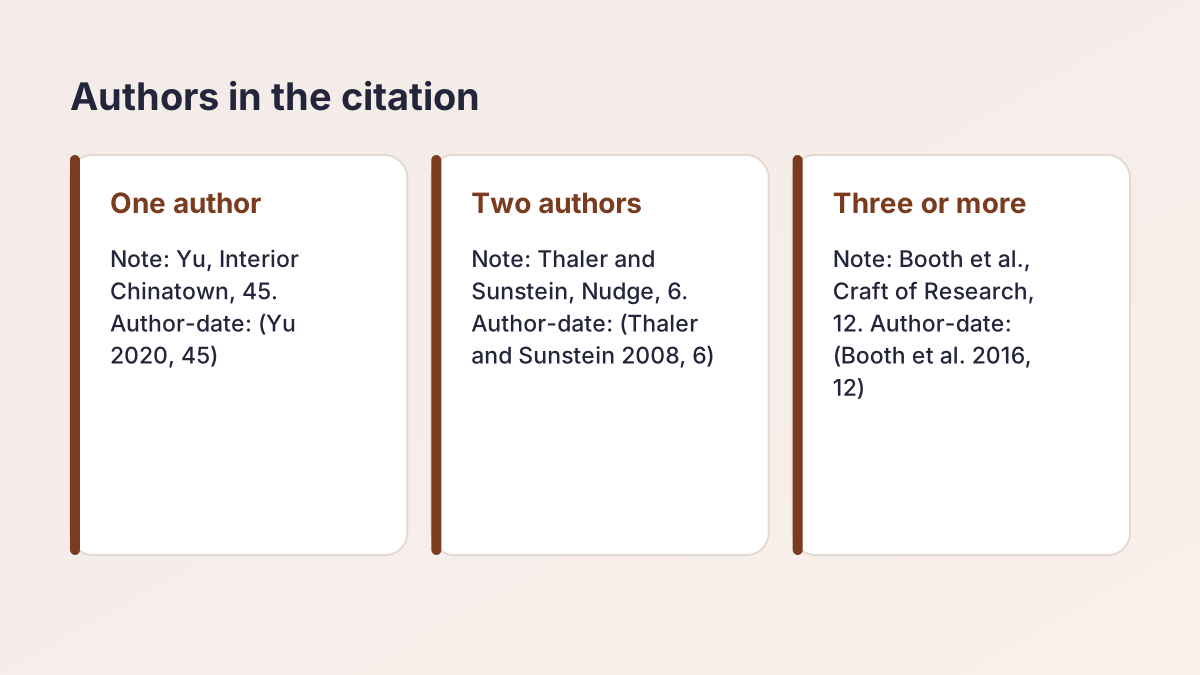
Short note: Thaler and Sunstein, Nudge, 6. Author-date: (Thaler and Sunstein 2008, 6).
SituationPage 12 of The Craft of Research, 4th edition (2016).
Chicago in-text form4. Wayne C. Booth et al., The Craft of Research, 4th ed. (University of Chicago Press, 2016), 12.
Three or more authors: first name plus et al. Author-date: (Booth et al. 2016, 12).
SituationLynn White Jr.'s 1967 article in Science, cited a second time.
Chicago in-text form6. White, “Historical Roots,” 1205.
Article titles stay in quotation marks in the short note; trimmed to four words or fewer.
SituationOne sentence that draws on both Yu and Putnam.
Chicago in-text form7. Yu, Interior Chinatown, 45; Putnam, Bowling Alone, 27.
One note, sources separated by semicolons. Author-date: (Yu 2020, 45; Putnam 2000, 27).
SituationThe very next note cites Yu again, at page 50.
Chicago in-text form8. Ibid., 50.
Allowed but discouraged in Chicago 18; the short note Yu, Interior Chinatown, 50 is preferred.
How to Do In-Text Citations in Chicago Style, Step by Step
These steps cover both Chicago systems. Ask your instructor which one the assignment uses before you start.
- Pick the system. History, literature, art and religion courses usually want notes-bibliography (footnotes). Science and social science courses often want author-date (parentheses). Use one system for the whole paper.
- Mark the spot. For a footnote, click after the punctuation at the end of the clause that uses the source. For author-date, place the citation just before the period or comma.
- Insert the citation. In Word, choose References > Insert Footnote. In Google Docs, choose Insert > Page elements > Footnote. For author-date, type (Author Year, page) in the sentence.
- Write full, then short. In notes, give a full note the first time and a short note (last name, short title, page) after that. Author-date citations look the same every time.
- Add the page. End each citation of a specific passage with the page number alone, with no p. or pp.
- Build the list. Add a bibliography for notes or a reference list for author-date, with every source you cited, in alphabetical order.
What Is a Chicago In-Text Citation?
The Chicago Manual of Style (18th edition, 2024) gives you two ways to show a source inside your paper. In the notes-bibliography system, the in-text part is a small superscript number, and the source details sit in a footnote at the bottom of the page or an endnote at the end. In the author-date system, the in-text part is a short parenthetical citation with the author, the year and the page.
Notes go with a bibliography; author-date goes with a reference list. Each Chicago in-text citation must match one entry in that list exactly.
Which system your class uses
Notes-bibliography is usual in history, literature, art and religion; author-date is common in the sciences and social sciences. If the syllabus just says "Chicago style," it usually means footnotes, but ask your instructor.
Try it with a real source
Paste a link, DOI or ISBN into the citation tool above, then switch between Notes & Bibliography and Author-Date to see each in-text form. For a longer list of sources, the free Chicago citation generator formats full notes, short notes and parenthetical citations together.
10 Rules for Chicago In-Text Citations
These ten rules cover almost every Chicago in-text citation you'll write in a class paper. Rules 1–5 apply to footnotes and endnotes; rules 6–8 apply to author-date; rules 9 and 10 apply to both.
| Rule | What to do |
|---|---|
| 1. Note number | Superscript Arabic numeral, after the punctuation and any closing quotation mark (but before a dash) |
| 2. Numbering | Number notes 1, 2, 3 through the whole paper; don't restart on each page |
| 3. First note | A full note: name in normal order, title, publication facts in parentheses, page |
| 4. Later notes | A short note: last name, short title (up to four words), page |
| 5. Ibid. | Discouraged in the 18th edition; use a short note instead |
| 6. Parenthetical form | (Author Year, page), with no comma between name and year |
| 7. Placement | Inside the sentence, before the period or comma; after a closing quotation mark |
| 8. Name in the sentence | Put only the year and page in parentheses: Yu (2020, 45) |
| 9. Three or more authors | First author plus et al. in notes and in parentheses |
| 10. Page numbers | Give the page for any quotation or specific passage, with no p. or pp. |
A Chicago style citation in-text example
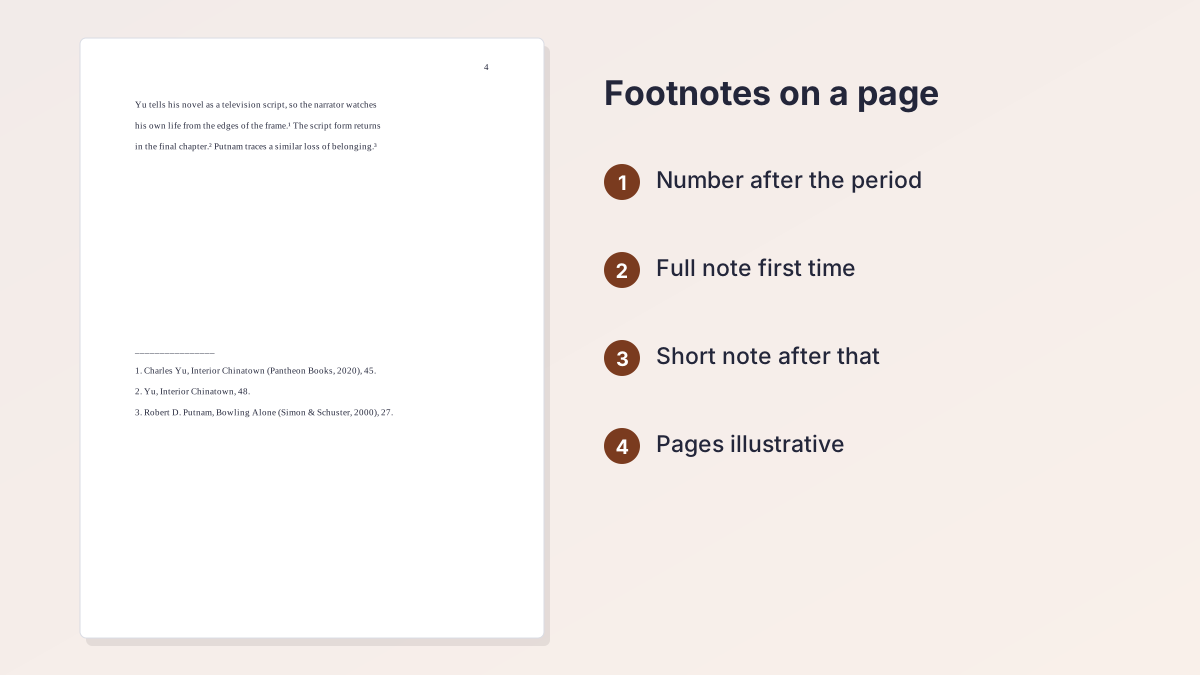
Notes-bibliography: Yu tells his novel as a television script.¹ Author-date: Yu tells his novel as a television script (Yu 2020, 45). Same sentence, same source, two forms. Every other Chicago style citation in-text example on this page follows one of these two patterns.
Chicago Citation Footnotes Example: Full and Short Notes
This Chicago citation footnotes example shows the pattern: a full note the first time you cite a source, and a short note after that.
The full note
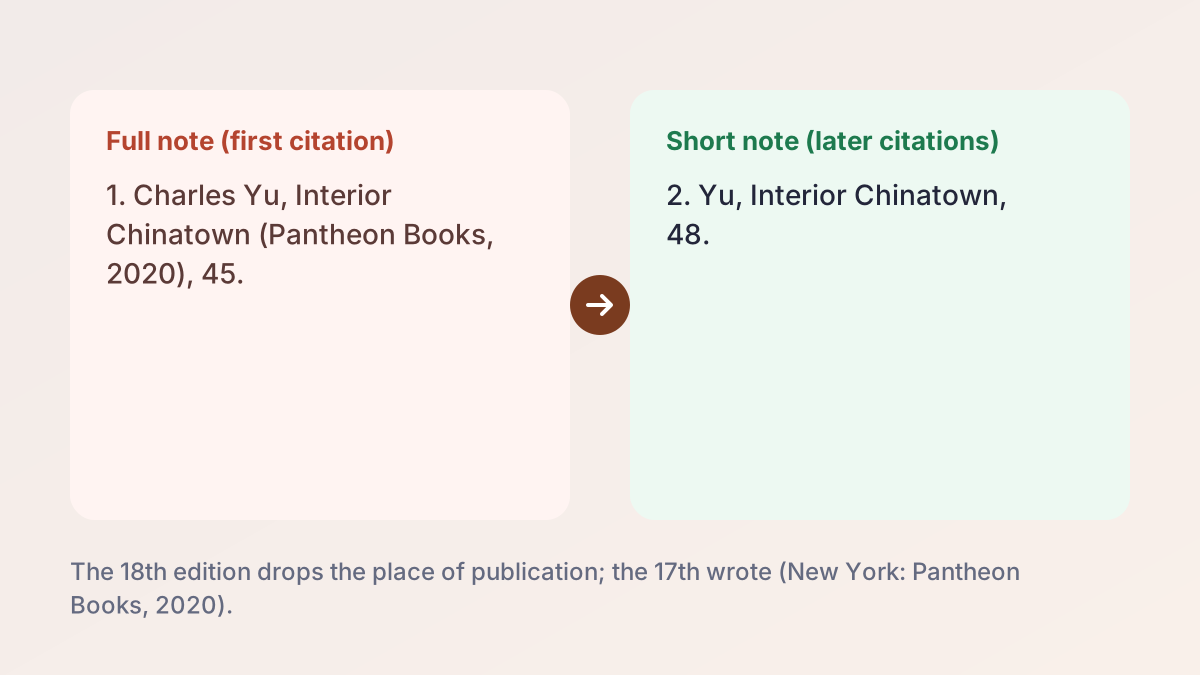
A full note lists the author's name in normal order, the title, the publication facts in parentheses and the page, all separated by commas. The CMOS notes and bibliography quick guide gives this footnote citation Chicago example for a book: 1. Charles Yu, Interior Chinatown (Pantheon Books, 2020), 45. Book titles are italic; article and chapter titles go in quotation marks.
The short note
Every later note to the same source is shortened to the last name, a short title and the page: 2. Yu, Interior Chinatown, 48. Keep a short title to four words or fewer, drop a leading A, An or The, and keep the italics or quotation marks. Chicago 18 also allows a short note at the first citation when the paper has a full bibliography, but many instructors still expect a full note.
What our tool does
Our citation tool drops a leading article and the subtitle in short notes but doesn't cut long titles to four words, so trim those by hand.
Footnotes or endnotes
The format is identical; endnotes simply sit on a Notes page before the bibliography. For Word and Google Docs setup, see our guide to Turabian footnotes, which follows the same rules.
Ibid. in Chicago 18
Ibid. (from the Latin ibidem, "in the same place") points to the source in the note just before. For decades it was the standard way to cite the same source twice in a row.
What changed
The 17th edition already discouraged ibid., and the 18th edition goes further in preferring a short note even for consecutive citations. A short note still makes sense when notes get moved during editing. Chicago 18 also asks you to repeat the page number in a short note, even when it matches the note before.
If your school still uses it
If your instructor requires it, write "Ibid." with a capital I and a period, add a comma and the page if it changed (Ibid., 50), and use it only when the previous note cites a single source. Use it consistently through the paper.
Chicago In-Text Citation Multiple Authors
The number of names you give depends on how many authors the source has and on which edition your class follows. The 18th edition made one big change: three authors now become "et al." in notes and in parenthetical citations, where the 17th edition listed all three.
| Authors | Chicago 18 (notes and parentheses) | Chicago 17 |
|---|---|---|
| One | Yu; (Yu 2020, 45) | Same |
| Two | Thaler and Sunstein; (Thaler and Sunstein 2008, 6) | Same |
| Three | First author et al. | All three names |
| Four or more | First author et al. | First author et al. |
In the bibliography or reference list
Et al. in the text doesn't shorten the list entry. Chicago 18 lists up to six authors in a bibliography or reference list; for seven or more, it lists the first three followed by et al. That's why the entry for The Craft of Research still names all five authors, even though the note says "Booth et al."
Names in your sentence
For a Chicago in-text citation with multiple authors named in the sentence, write "Thaler and Sunstein (2008, 6) argue…" or "Booth et al. (2016, 12) suggest…".
Chicago Author-Date Citation in Text
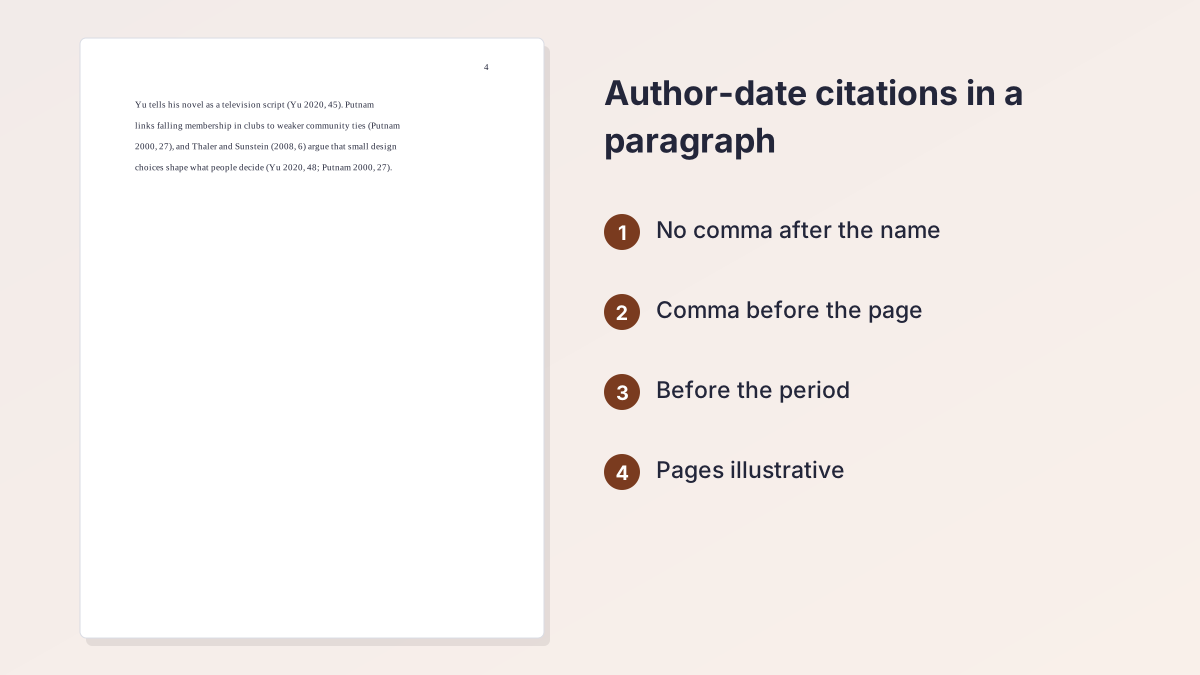
In author-date style, the citation sits inside the sentence: the author's last name, the year and the page, such as (Yu 2020, 45). There's no comma between the name and the year, and a comma separates the year from the page.
Placement
Put this Chicago in-text citation at the end of the clause, before the period or comma. With a quotation, it goes after the closing quotation mark and before the period. If you name the author in your sentence, put the year right after the name and the page at the end, or both together: Yu (2020, 45) describes…
Learn the whole system
Author-date has its own reference list, its own rules for undated sources and its own way of separating two works from the same year. Our full guide to Chicago author-date citation covers all of that, along with the comparison between the two systems and how to cite a paraphrase.
Sources With No Author
A Chicago in-text citation for a source with no named author starts with the title instead. Don't write "Anonymous" unless the work says so.
In a note
Start the note with the title: 1. "Title of Web Page," Name of Website, Month Day, Year, URL. The short note uses a shortened title. If an organization published the page, you can usually treat the organization as the author.
In author-date style
Use the organization as the author if there is one. Otherwise, put a short form of the title where the name would go, followed by the year: (Short Title 2019, 12). Use italics or quotation marks as the title has them in the reference list. (Pattern only; the title and page are placeholders.)
Citing More Than One Source in One Place
When one sentence draws on two or three sources, a single Chicago in-text citation can hold them all. Don't stack note numbers side by side (¹²).
In notes
Put all the sources in a single note, separated by semicolons, in the order that makes sense to your reader: 7. Yu, Interior Chinatown, 45; Putnam, Bowling Alone, 27.
In author-date style
List the citations in one set of parentheses, separated by semicolons: (Yu 2020, 45; Putnam 2000, 27). Page numbers in these examples are illustrative.
Page Numbers and Other Locators
A Chicago in-text citation for a quotation or a specific passage, including a paraphrase of one, needs a page number. Write the number alone, with no "p." or "pp."
Use an en dash for a range, such as 117–18.
Sources without pages
For a web page, an ebook with reflowable text or an audiovisual source, leave the page out or use a locator that helps readers find the spot, such as a chapter or section name, or a time stamp for a video. Don't use the location numbers a Kindle shows. For whole-work citations with no specific passage, author-date style needs only the name and year: (Putnam 2000).
In-Text Citation Chicago Turabian: What's the Difference?
Kate L. Turabian's A Manual for Writers of Research Papers, Theses, and Dissertations is the student version of Chicago, so the in-text citation Chicago Turabian answer is simple: the forms are the same. An in-text citation Chicago Turabian style still uses either notes or (Author Year, page). Both offer notes-bibliography and author-date, and both use the same note numbers, short notes and (Author Year, page) citations.
Where they differ
Turabian adds rules for student papers, such as title pages and margins. The current Turabian (9th edition, 2018) still follows Chicago 17, so a Chicago Turabian citation in text written to Turabian 9 lists three authors in full and keeps the place of publication in full notes.
If your assignment says "Turabian," see our guides to Turabian footnotes, the Turabian bibliography and Turabian format for the paper itself.
Chicago In-Text Citation: 17th vs. 18th Edition
Some classes still follow the 17th edition. These changes affect each Chicago in-text citation in your paper.
- Place of publication. The 18th drops it from book notes: (Pantheon Books, 2020) instead of (New York: Pantheon Books, 2020).
- Three authors. The 18th uses et al. for three or more; the 17th listed three in full.
- Ibid. Both discourage it; the 18th prefers short notes more firmly.
- Journal months. The 18th drops the month or season when a journal has volume and issue numbers.
Use the edition your instructor names; our citation tool has an edition switch for both systems.
Common Chicago In-Text Citation Mistakes
Check every Chicago in-text citation in your paper against this list.
| Mistake | Fix |
|---|---|
| Note number before the period | Put it after the punctuation and any closing quotation mark |
| Full note every time | Use a short note after the first citation |
| Comma after the name: (Yu, 2020) | Write (Yu 2020, 45); that comma is APA style |
| p. before the page | Give the number alone |
| Three names in Chicago 18 | Use the first author plus et al. |
| Footnotes and parentheses mixed | Pick one system for the whole paper |
| Two numbers side by side | Combine the sources in one note with semicolons |
| Citation missing from the list | Every cited source needs a bibliography or reference list entry |
Keep going
For English classes that use MLA instead, our MLA in-text citation guide covers author-page citations, and the APA format guidelines cover APA's author-year style. Every guide is on our student writing guides page. When you're ready, let the Chicago footnote generator build each full note, short note and bibliography entry for you.
Chicago In-Text Citation FAQ
How do you do an in-text citation in Chicago style?
In notes-bibliography style, add a superscript number after the punctuation and write a footnote. In author-date style, write the author's last name, the year and the page in parentheses, such as (Yu 2020, 45).
What is a Chicago citation footnote example?
A full note for a book: 1. Charles Yu, Interior Chinatown (Pantheon Books, 2020), 45. A later short note: 2. Yu, Interior Chinatown, 48.
Does Chicago style use in-text citations?
Yes. Notes-bibliography uses superscript note numbers in the text, and author-date uses parenthetical citations. Both point to a list of sources at the end.
How do you cite multiple authors in Chicago in-text?
Two authors: give both names joined by and. Three or more in Chicago 18: the first author plus et al., in notes and in parentheses. The 17th edition listed three authors in full.
Does Chicago 18 use ibid.?
It allows ibid. but discourages it. Use a short note (last name, short title, page) instead, unless your instructor requires ibid.
What is the Chicago author-date citation in text?
The author's last name, the year and the page in parentheses, with no comma after the name: (Thaler and Sunstein 2008, 6).
Is Turabian in-text citation the same as Chicago?
The forms are the same, since Turabian is the student version of Chicago. Turabian 9 follows Chicago 17, so a few details, such as three authors, differ from Chicago 18.
Do Chicago in-text citations need page numbers?
Yes, whenever you quote or point to a specific passage. Write the number alone, with no p. or pp.
More free guides
- Chicago Book CitationNotes and bibliography entries for books, editions, chapters and ebooks.
- Chicago Movie and Image CitationFilms, streaming, YouTube videos, artwork and images in Chicago style.
- Chicago Author-Date CitationThe author-date system, its reference list, and how it differs from notes and bibliography.
- MLA In-Text CitationsAuthor-page citations for every kind of source, with examples.
- How to Cite a Website in MLAWorks Cited entries and in-text citations for web pages.
- MLA Works Cited PageFormat, order and hanging indents, with a full example page.
See all 80 free tools for students
Related tools
Last updated by The Study Corp editorial team.