Comparison Essay Outline Mistakes and Fixes
Each pair shows a habit that weakens a comparison, and a better version. All sentences are invented for this guide; the subjects are ordinary school topics.
Common mistakeCats and dogs are both popular pets, but they are different.
Better versionCats suit small apartments and busy schedules, while dogs repay the time of owners who want daily exercise and company.
A thesis should say something the reader could disagree with and answer "So what?"
Common mistakeCompare the French Revolution with a smartphone.
Better versionCompare the French and American Revolutions on causes, leaders and results.
Pick subjects that share a category so the criteria apply to both.
Common mistakeBody 1: Library hours. Body 2: Bookstore prices.
Better versionBody 1: Cost (library and bookstore). Body 2: Hours (library and bookstore).
Every criterion needs a point about each subject.
Common mistakeII. Online classes. III. In-person classes. IV. Conclusion.
Better versionII. Online classes. III. In-person classes, answering the same criteria. IV. What the two formats together suggest.
In a block outline, the second half must refer back to the first.
Common mistakeBoth novels are set during wartime and both have young narrators.
Better versionBoth novels are set during wartime, but one narrator learns to hope while the other learns to doubt.
Strong comparisons weigh likenesses against differences.
Common mistakeAnother thing is the cost.
Better versionIn contrast, the bookstore charges for every title the library lends for free.
Use a cue word that tells the reader whether the next point is a likeness or a difference.
Common mistakeIn conclusion, I have compared the library and the bookstore.
Better versionTogether, the two show that access, not selection, is what separates a public service from a shop.
End on the judgment your comparison earned, not a summary.
How to Build a Comparison Essay Outline in Six Steps
Follow these steps in order the first time. Your instructor's prompt can change the details, so read it first.
- Choose two subjects. Pick two things in the same category, such as two novels, two policies or two historical figures, so shared criteria apply.
- Brainstorm criteria. Use a Venn diagram or a T-chart to list likenesses and differences, then keep three or four that matter.
- Write a judging thesis. State what the comparison shows, not just that two things differ.
- Choose a method. Use the block method for short essays with few points, or point-by-point for longer essays.
- Draft the outline. Write each section as a full sentence that names the criterion and both subjects.
- Add transitions. Note the cue word that opens each section, such as similarly, in contrast or however.
The Meaning of Compare and Contrast
To compare is to look at what two things share, and to contrast is to look at how they differ. The UNC Writing Center describes a comparison essay as one that examines "the ways in which certain things or ideas—usually two of them—are similar to" or different from each other, and notes that comparison usually covers similarities while contrast covers differences (UNC Writing Center).
Comparison vs contrast in assignments
Some prompts say "compare" or "contrast" outright. Others are subtler, asking you to "evaluate two theories" or "analyze two poems," where a comparison is one step toward a larger point. Whatever the wording, the meaning of compare and contrast in an essay is the same: a reader should finish knowing what the pairing reveals.
Where an outline helps
A comparison has two subjects to juggle, so it falls apart easily without a plan. A compare and contrast essay outline shows you in advance whether each criterion has a point for both subjects, and whether the ending says something new. If you want a draft built from your own two subjects, the free compare and contrast essay generator drafts a block or point-by-point essay and marks where your evidence belongs.
Choosing Two Subjects With a Real Basis for Comparison
The best comparison essay outline starts with good subjects. They should belong to the same category and give you something to say. The UNC Writing Center suggests narrowing a long list of similarities and differences by asking what is relevant to the assignment, what is interesting, and what supports your argument. It adds that an obvious shared trait is relevant but "not terribly interesting."
Things to compare and contrast
Strong pairs are close enough to share criteria and different enough to teach something. The table shows pairs that work and pairs that don't. The pairs are invented suggestions, not a list from any course.
| Pair | Basis for comparison | Works? |
|---|---|---|
| Two novels about immigration | Narrator, setting, ending | Yes |
| Online and in-person classes | Cost, flexibility, feedback | Yes |
| Two causes of a historical war | Timing, scale, evidence | Yes |
| A novel and a calculator | No shared category | No |
| Two almost identical products | Few differences to explain | Weak |
Pick criteria before you outline
A criterion is the feature on which you compare the subjects, such as cost, setting or effect. Choose three or four. Fewer than three leaves a thin essay; more than four usually needs a longer assignment. Each criterion must apply to both subjects.
Venn Diagram or T-Chart: Brainstorming Before the Outline
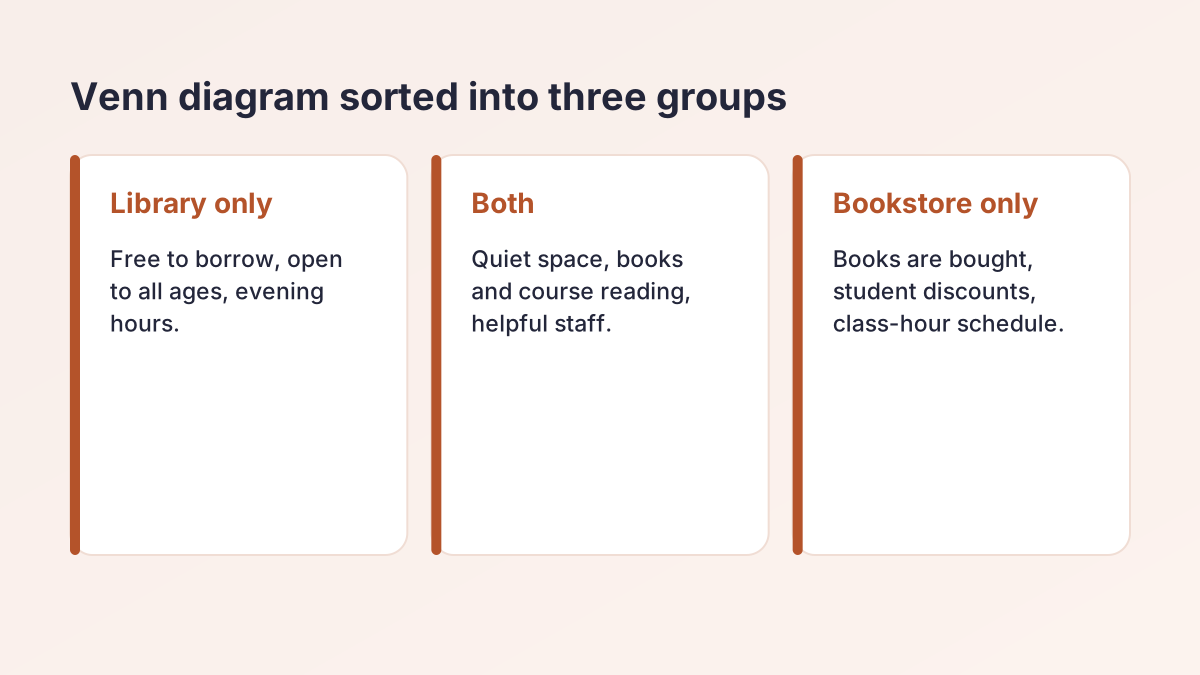
A graphic organizer gets your ideas on paper before you commit to a layout. The UNC Writing Center recommends a Venn diagram or a chart: in a Venn diagram the overlap holds shared traits, and in a chart the criteria run down the side while the subjects run across the top.
Venn diagram
Draw two overlapping circles, one per subject. Put differences in the outer parts and shared traits in the middle. Many of the facts you collect will fall away, so circle the ones that support your thesis. The cards above show a small Venn diagram for a library and a bookstore.
T-chart
Draw a T. Write one subject above each column and list the same criteria in the same order on both sides. Gaps show where you need more evidence. A T-chart turns into a comparison essay outline quickly: each row becomes a body section in a point-by-point layout.
Turn the notes into criteria
Look for the three or four rows that matter most for your thesis. Drop the rest; a comparison that tries to include everything reads like a list.
A Thesis for a Comparison Essay Outline
The thesis tells the reader what the comparison proves. The UNC Writing Center warns that a strong thesis should answer "So what?" and gives a model in which two restaurants have similar prices and ingredients but differ in atmosphere and willingness to deliver. A thesis built on those two halves is easy to outline.
A formula that works
Try "Although [Subject A] and [Subject B] share [likeness], they differ in [difference], which shows [claim]." The version below is invented for this guide.
Although the public library and the campus bookstore both put books in students' hands, only the library serves the whole town, which shows that access, not selection, separates a public service from a shop.
Check the thesis against the outline
Each body section should support one part of the thesis. If the thesis names cost and access, the outline needs sections on both. If a section proves nothing in the thesis, cut it or revise the thesis.
Block Method for Compare and Contrast: Outline and Sample
In the block method, you discuss everything about Subject A, then everything about Subject B. The UNC Writing Center cautions that this layout can read like a list, so it needs a strong analytical thesis and a paragraph that ties the two halves together. It often suits short essays with few criteria, or reading one subject through the lens of the other.
Block method outline, invented sample
Thesis: Online and in-person classes both teach the material,
but online classes reward self-discipline while in-person
classes reward participation.

I. Introduction: the two formats and the thesis
II. Online classes
    A. Cost: no commute, fewer campus fees
    B. Flexibility: work on your own schedule
    C. Feedback: written comments, delayed
III. In-person classes
    A. Cost: commute and campus fees
    B. Flexibility: fixed meeting times
    C. Feedback: live questions, immediate
IV. What the two formats suggest together
V. Conclusion: which student each format suits
Build in the link
Notice section IV. In a block outline, the second half has to answer the same criteria in the same order, and a linking section keeps the essay from becoming two separate reports.
Point-by-Point Method: Outline and Sample
In the point-by-point method, you take one criterion at a time and discuss both subjects within it. The UNC Writing Center notes that instructors usually want a direct comparison and advises ending with the point you most want the reader to remember. Many teachers prefer it for longer essays because the comparison happens in every section.
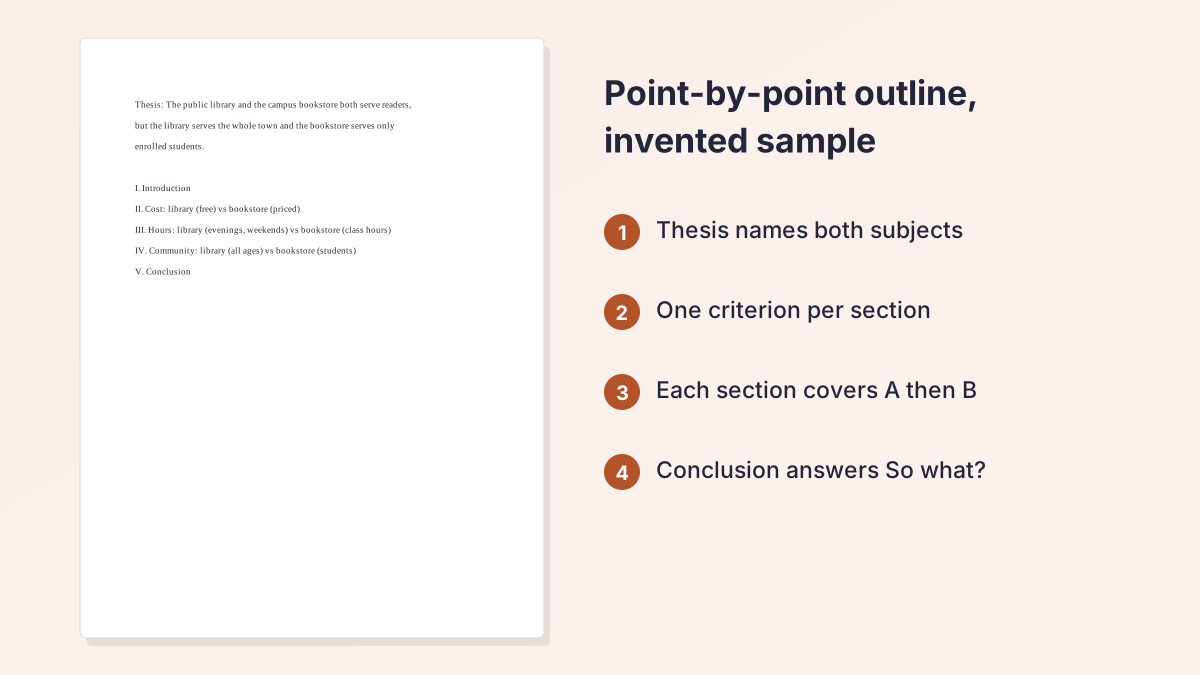
Point-by-point method outline, invented sample
Thesis: Online and in-person classes both teach the material,
but online classes reward self-discipline while in-person
classes reward participation.

I. Introduction: the two formats and the thesis
II. Cost
    A. Online: no commute, fewer campus fees
    B. In person: commute and campus fees
III. Flexibility
    A. Online: work on your own schedule
    B. In person: fixed meeting times
IV. Feedback (the point to remember)
    A. Online: written comments, delayed
    B. In person: live questions, immediate
V. Conclusion: which student each format suits
Which outline layout should you choose?
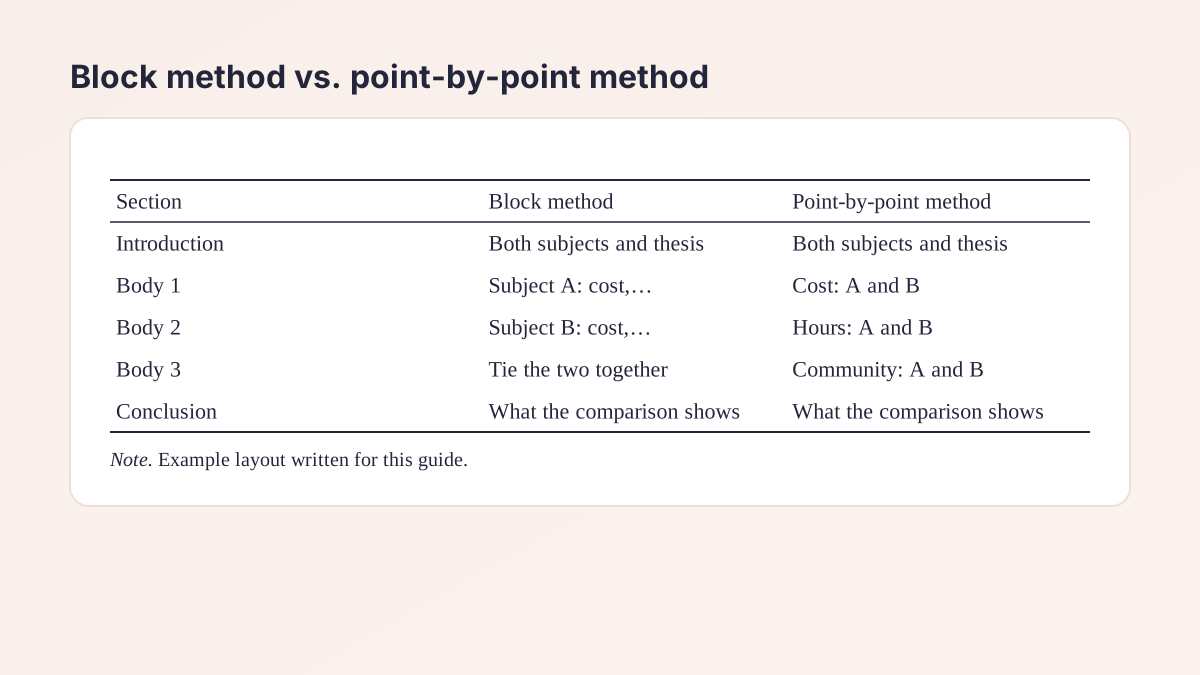
Use the table above. If your thesis is about one big contrast, block can feel natural. If it depends on three or four criteria, the point-by-point layout keeps both subjects side by side. This outline format also makes transitions easier to place.
Block Method vs Point-by-Point Method: Which One Fits?
Both layouts can work for the same material, so choose by purpose and length. The table compares the block method for compare and contrast with the point-by-point method on the features that usually decide the choice.
| Feature | Block method | Point-by-point method |
|---|---|---|
| Body sections | One per subject | One per criterion |
| Best length | Short essays | Medium and long essays |
| Direct comparison | Reader must remember Subject A | Built into every section |
| Risk | Reads like two reports | Can feel choppy if criteria are weak |
| Strength | Easy to draft | Easy to compare |
A quick rule of thumb
If you aren't sure, try the point-by-point layout. Most comparison essay outlines for college courses use it because the comparison runs through the whole paper. Ask your instructor if one method is required, and follow the assignment sheet if it says so.
Transition Words for a Compare and Contrast Essay Outline
Transitions tell the reader whether a sentence is about a likeness or a difference. The UNC Writing Center lists cue words such as "similarly," "in contrast," "however," and "on the one hand … on the other hand," and adds that strong topic sentences also help readers track your structure.
Words that signal likeness
Use similarly, likewise, in the same way, both and also. Place them at the start of the sentence where you move from Subject A to a trait Subject B shares.
Words that signal difference
Use in contrast, however, on the other hand, unlike, whereas and although. The block method for compare and contrast needs these most at the start of the second half, where you turn back to the criteria you already covered.
Where to note them in your outline
Add a short cue beside each section, for example "II. Cost (in contrast...)". The free transition words finder sorts transitions by purpose and shows how to punctuate each one, which helps when you revise.
Sample Body Paragraph From a Point-by-Point Outline
Here is one body paragraph from the point-by-point outline above, written for this guide. It follows the pattern of topic sentence, Subject A, Subject B, and a judging sentence.
Cost shows the biggest gap between the two formats. Online students save the commute and skip some campus fees, so the price of a class is mostly tuition. In contrast, in-person students add transportation and campus fees to every course, which can raise the real price well above the posted rate. The difference matters most for students who work, because for them an online class costs not only less money but also less time.
What makes it work
The first sentence names the criterion. The next two sentences cover each subject with a concrete point and a cue word. The last sentence says why the contrast matters, which ties the paragraph to the thesis.
How to End a Comparison and Contrast Essay
The conclusion should answer "So what?" instead of repeating your outline. State what the comparison shows, then widen the view by saying who should care or what follows.
Three moves for the last paragraph
First, restate the thesis in fresh words. Second, name the most important point, ideally the criterion you saved for last. Third, finish with an implication, such as which student each format suits.
What to skip
Skip "In conclusion, I compared..." and skip new evidence. If the last paragraph could be pasted onto any comparison, rewrite it with your own subjects.
Common Comparison Essay Outline Mistakes
Most weak comparisons fail in the outline stage. Look for these before you draft.
Only listing
An outline that lists likenesses and differences without a claim becomes a catalog. Give every section a purpose that supports the thesis.
Uneven treatment
If Subject A gets four points and Subject B gets one, the comparison tilts. Balance the outline so each criterion has a point for each subject.
Choosing the wrong layout
A long essay with only the block method forces the reader to remember too much. A very short essay with many tiny point-by-point sections feels choppy. Match the layout to the length.
Forgetting the format rules
A comparison essay still follows your class's page rules. Check whether your instructor wants MLA or APA, and see the guides to MLA heading and APA format guidelines. For another outline style, see the APA outline format guide.
Next steps
Once your compare and contrast essay outline is settled, draft one paragraph per section. The compare and contrast essay generator can turn your outline into a first draft, and you can browse every topic in the student writing guides.
Comparison Essay Questions Answered
What is the meaning of compare and contrast?
To compare is to examine what two subjects share, and to contrast is to examine how they differ. An essay usually does both and ends with a judgment about what the pairing shows.
How do you outline a compare and contrast essay?
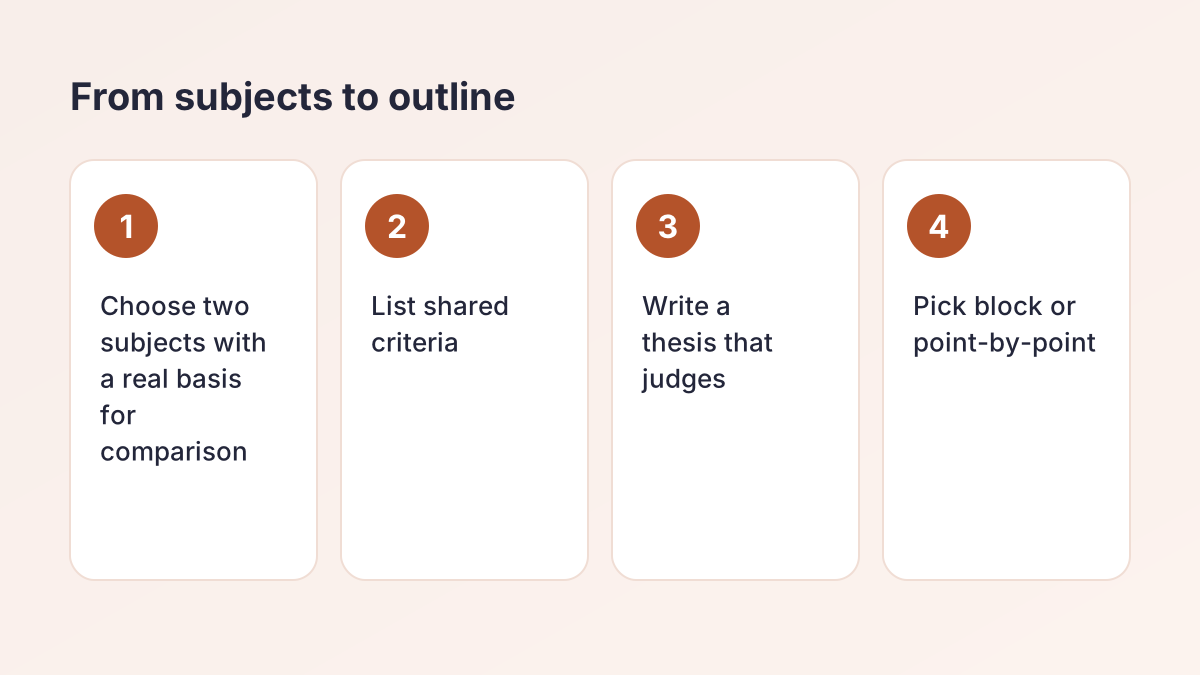
Choose two subjects, list shared criteria, write a thesis that judges, then use either the block method or the point-by-point method to arrange the body sections.
What is the block method for compare and contrast?
The block method covers all of Subject A first and then all of Subject B, using the same criteria for both. It suits short essays and needs a paragraph that ties the halves together.
What is the point-by-point method?
The point-by-point method discusses one criterion at a time and covers both subjects in each section. It makes direct comparison easier and suits longer essays.
What is the difference between compare and contrast?
Compare looks at similarities, while contrast looks at differences. In essay prompts, "compare" often means to look at both.
How many paragraphs does a comparison essay need?
It depends on the assignment. A common five-paragraph version has an introduction, three body paragraphs and a conclusion, but longer papers have more. Check your instructor's requirements.
How do you write a thesis for a comparison?
Name both subjects, their main likeness and their main difference, and say what the comparison shows. A thesis that only says the subjects are alike and different is too vague.
How do you end a comparison essay?
Restate the thesis in new words, name the most important point and finish with an implication. Don't simply summarize the body.
More free guides
- MLA In-Text CitationsAuthor-page citations for every kind of source, with examples.
- How to Cite a Website in MLAWorks Cited entries and in-text citations for web pages.
- MLA Works Cited PageFormat, order and hanging indents, with a full example page.
- MLA Annotated BibliographyFormat, annotation types and a complete example.
- APA Table FormatNumber, title, body and notes for APA 7 tables, with templates.
- MLA HeadingThe four-line first-page heading and the page header, with Word and Google Docs steps.
See all 80 free tools for students
Related tools
Last updated by The Study Corp editorial team.