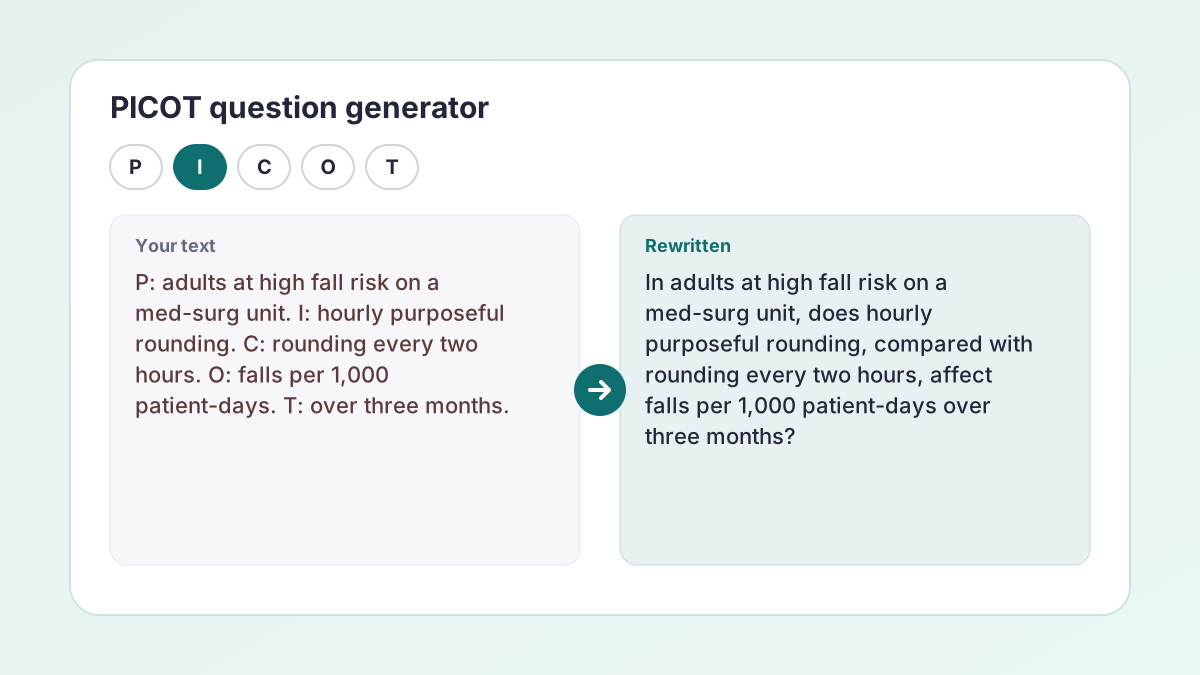
PICOT question examples from the generator
Invented inputs for US nursing courses and the kind of clinical question the tool assembles from them. Your wording, search terms and study design note will differ with what you type.
What you typeP: adults at high fall risk on a med-surg unit. I: hourly purposeful rounding. C: rounding every two hours. O: falls per 1,000 patient-days. T: over three months.
Assembled questionIn adults at high fall risk on a med-surg unit, does hourly purposeful rounding, compared with rounding every two hours, affect falls per 1,000 patient-days over three months?
All five parts. The tool labels this an intervention question and would usually point to a randomized or controlled before-and-after design.
What you typeP: ICU patients with indwelling urinary catheters. I: a nurse-driven catheter removal protocol. O: CAUTI rate.
Assembled questionIn ICU patients with indwelling urinary catheters, does a nurse-driven catheter removal protocol affect the CAUTI rate?
No C or T was given, so none is added. The tool never invents usual care as a comparison.
What you typeP: adults over 65 after hip surgery. I: Braden Scale score of 12 or lower on admission. C: score above 12. O: hospital-acquired pressure injury. T: during the hospital stay.
Assembled questionIn adults over 65 after hip surgery, are those with a Braden Scale score of 12 or lower on admission, compared with a score above 12, at greater risk of a hospital-acquired pressure injury during the hospital stay?
An exposure, not a treatment. Expect a note suggesting PEO as a closer fit and a cohort design.
What you typeP: adults arriving at the ED with suspected infection. I: qSOFA screening. C: SIRS criteria. O: accurate identification of sepsis.
Assembled questionIn adults arriving at the ED with suspected infection, is qSOFA screening, compared with SIRS criteria, more accurate in identifying sepsis?
A test-accuracy question. The design note would point toward a diagnostic accuracy study, not a trial.
What you typeP: first-time mothers in a Level III NICU. I: kangaroo care. O: their experience of bonding with a preterm infant.
Assembled questionHow do first-time mothers in a Level III NICU experience bonding with their preterm infant during kangaroo care?
No comparison and nothing to measure, so the tool flags PICo or SPIDER as a better fit and suggests an interview study.
What you typeP: adults newly diagnosed with heart failure. I: living alone. C: living with a caregiver. O: 30-day readmission.
Assembled questionIn adults newly diagnosed with heart failure, does living alone, compared with living with a caregiver, influence 30-day readmission?
A prediction question. The 30-day window sits inside the outcome, so a separate T is not needed.
How to use the PICOT question generator
Write each part as a short phrase, not a sentence. The more specific the outcome, the better the search you get back.
- Fill in P. Type the population, patient or problem: age group, condition and setting, such as adults with type 2 diabetes at a community clinic.
- Add I and O. Type the intervention or exposure you want to examine, then the outcome you would measure or explore. Both are required.
- Add C and T if needed. Fill in Comparison (optional) and Time frame (optional) only if your question has them. Blank is fine and nothing is invented to fill the gap.
- Build the question. Select Build my PICOT question. You get the question with each part highlighted, its type, the five parts, a plain-language version and a provisional study design.
- Refine it. Use Make it more specific, Plainer wording or Drop the comparison. Read the Still vague list and any note saying PICOT may not be the best fit.
- Search and save. Select Copy search to copy the ready-made PubMed search, or Search PubMed to run it; Copy everything copies the question, the five parts and the search. Use as my research question saves it on this device for the next research tool.
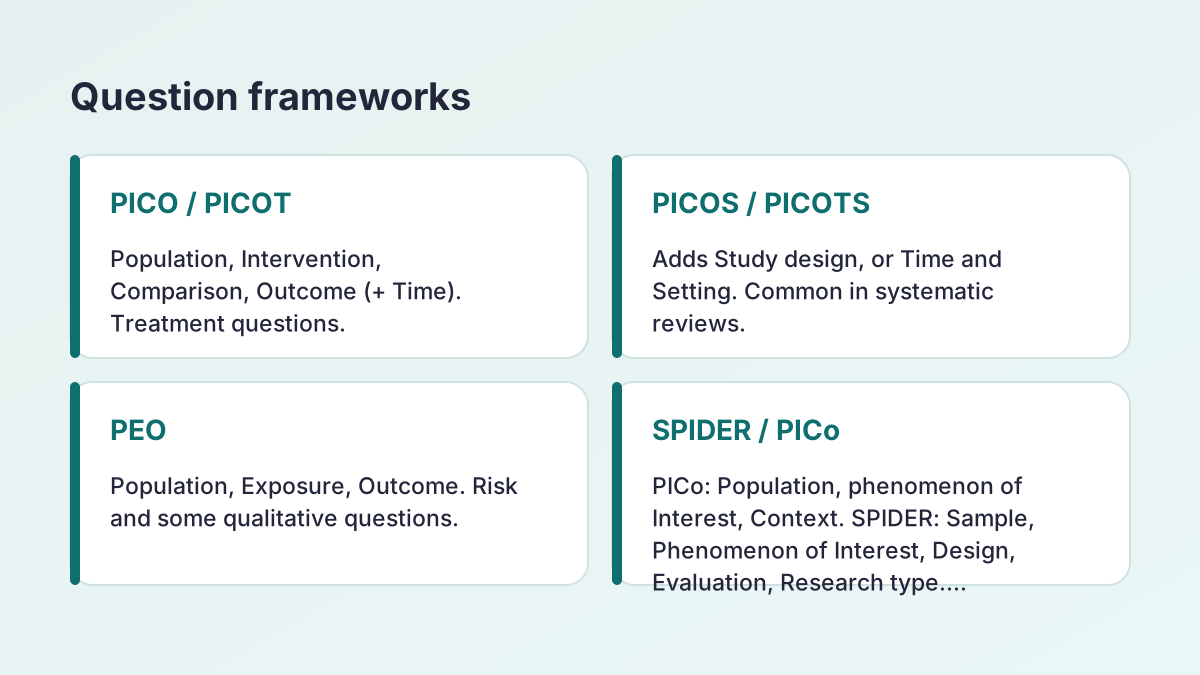
What does PICOT stand for?
PICOT is a way to break a clinical question into five parts so that it can be answered with research. Library guides spell the letters slightly differently, but this is the common nursing version.
P: Population, patient or problem
Who the question is about. Include the age group, condition and setting when they matter: adults over 65 on a med-surg unit, not patients.
I: Intervention or exposure
The treatment, program, test or experience you want to examine. In risk questions this is an exposure (smoking, living alone, a low Braden score) rather than something nurses do.
C: Comparison
The alternative: usual care, a different intervention, a placebo or no exposure. Many good questions have no C, and the generator leaves it blank rather than inventing one.
O: Outcome
What you would measure or explore: falls per 1,000 patient-days, HbA1c, length of stay, or how patients describe an experience.
T: Time
How long until the outcome is assessed, such as over six months or within 30 days of discharge. Optional, and often built into the outcome.
PICO, PICOT and "picost"
PICO is the original four-letter form; nursing programs often teach the PICOT question, with time added. "Picost" and "picots" are the versions with study design or setting, covered next.
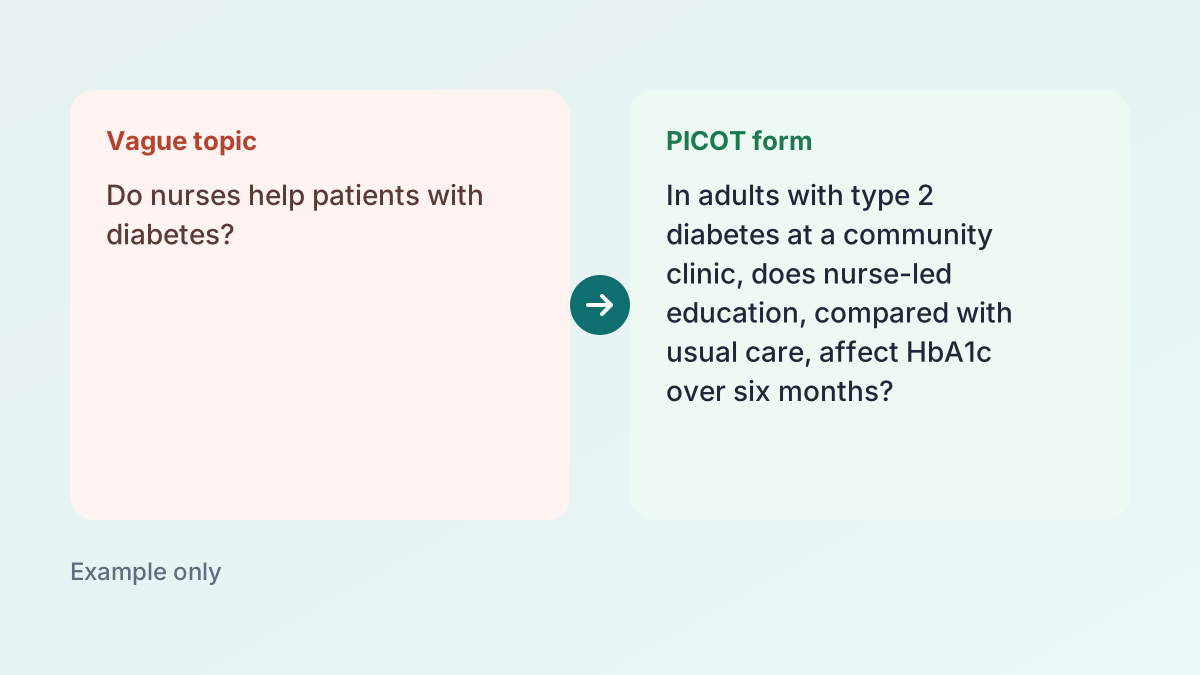
PICO vs PICOT vs PICOS vs PICOTS vs PEO and SPIDER
Different guides use different frameworks, and the letters vary a little from source to source. The table follows the Utah State University Libraries evidence synthesis guide and the Baylor University Libraries frameworks list. If your instructor uses a different definition, use theirs.
| Framework | Letters | Usually used for |
|---|---|---|
| PICO | Population/problem, Intervention, Comparison, Outcome | Treatment and intervention questions |
| PICOT | PICO + Time frame | Nursing EBP projects where timing matters |
| PICOS | PICO + Study design | Systematic reviews that limit by design |
| PICOTS | PICO + Time frame + Setting | Reviews where both timing and care setting matter |
| PEO | Population, Exposure, Outcome | Risk factors and some qualitative questions |
| PICo | Population, phenomenon of Interest, Context | Qualitative questions about experience |
| SPIDER | Sample, Phenomenon of Interest, Design, Evaluation, Research type | Qualitative and mixed-methods searches |
Which one should you use?
- Comparing two treatments? A PICO or PICOT question.
- Asking about a risk? PICOT works; PEO is often cleaner.
- Asking about experience? PICo or SPIDER.
- Writing a review protocol? Possibly PICOS or PICOTS.
The generator classifies each question and, when PICOT is not the natural shape, shows a note headed PICOT may not be the best fit with the question rewritten in a better framework.
PICOT question examples by question type
Most nursing courses sort each PICOT question into one of five types. Each type has its own sentence shape and is usually answered by a different kind of study. All PICOT question examples below are invented for practice.
Intervention (therapy)
In adults recovering from abdominal surgery on a surgical unit, does early ambulation within 24 hours, compared with ambulation after 48 hours, affect length of stay?
Usually answered by randomized controlled trials or controlled studies.
Etiology (harm or risk)
Are adolescents who vape daily, compared with those who do not vape, at greater risk of a first asthma exacerbation over one year?
Usually answered by cohort or case-control studies, since you cannot randomly assign a harm.
Diagnosis
In children presenting to a pediatric urgent care with a sore throat, is a rapid strep test, compared with throat culture, accurate in diagnosing group A strep pharyngitis?
Usually answered by diagnostic accuracy studies.
Prognosis (prediction)
In adults after a first stroke, does early dysphagia, compared with no dysphagia, influence the chance of pneumonia within 30 days?
Usually answered by cohort studies that follow patients forward.
Meaning (qualitative)
How do family caregivers of patients in home hospice in rural Kansas perceive the support they receive from visiting nurses?
Usually answered by interview or focus group studies. There is no C; the outcome is a perception.
Nursing PICOT questions by clinical topic
These nursing PICOT questions cover topics US students often choose for capstone and evidence-based practice (EBP) projects. Every one here is an invented example: see the shape, then write your own from a problem you saw on clinicals.
Falls
- In older adults on a medical unit at a community hospital, does bed-alarm use, compared with no bed alarm, affect the number of unassisted falls over three months?
- In patients with a Morse Fall Scale score of 45 or higher, does a bedside fall-risk sign and yellow socks program affect fall rates per 1,000 patient-days?
CAUTI
- In adult ICU patients with indwelling catheters, does a daily nurse-led necessity review, compared with physician-ordered removal, affect catheter days and CAUTI rates?
- In women after cesarean birth, does removing the catheter within 6 hours, compared with 12 to 24 hours, affect urinary tract infection rates?
Pressure injuries
- In ICU patients on mechanical ventilation, does a prophylactic sacral foam dressing, compared with standard skin care alone, affect hospital-acquired pressure injuries during the ICU stay?
- In nursing home residents with limited mobility, does a two-hour turning schedule, compared with a four-hour schedule on pressure-redistribution mattresses, affect new stage 2 or higher pressure injuries over eight weeks?
Sepsis
- In adults admitted to the ED, does a nurse-initiated sepsis screening tool, compared with physician-initiated screening, affect time to first antibiotic dose?
Diabetes
- In adults with type 2 diabetes at a federally qualified health center, does text-message coaching, compared with usual care, affect HbA1c over six months?
Pediatrics
- In school-age children having an IV started in a pediatric ED, does distraction with a tablet, compared with no distraction, affect self-reported pain scores?
- How do parents of children with newly diagnosed type 1 diabetes describe their first month of managing insulin at home?
Maternal health
- In postpartum women at a Texas teaching hospital, does a nurse phone call within 72 hours of discharge, compared with no call, affect postpartum depression screening scores (EPDS) at six weeks?
- In first-time mothers, does skin-to-skin contact in the first hour after birth affect exclusive breastfeeding at discharge?
Mental health
- In adults on an inpatient psychiatric unit, does structured de-escalation training for staff, compared with no training, affect the use of restraints over six months?
- In college students who screen positive on the PHQ-9 at a campus health center, does a nurse-led mindfulness group affect PHQ-9 scores after eight weeks?
Before you borrow one
Swap in your own unit and outcome, then search to check evidence exists. Having no comparison (10, 12) is normal.
PICOT question template for each question type
Pick the PICOT question template for your question type and fill in the blanks. These follow the widely used templates adapted from Melnyk and Fineout-Overholt and published in the NYU Health Sciences Library PICO guide; the time phrase in brackets is optional.
Intervention
In ______ (P), how does ______ (I) compared with ______ (C) affect ______ (O) [within ______ (T)]?
Etiology
Are ______ (P) who have ______ (I), compared with those without ______ (C), at increased risk for ______ (O) [over ______ (T)]?
Diagnosis
In ______ (P), is ______ (I) compared with ______ (C) more accurate in diagnosing ______ (O)?
Prognosis
In ______ (P), how does ______ (I) compared with ______ (C) influence ______ (O) [over ______ (T)]?
Meaning
How do ______ (P) with ______ (I) perceive ______ (O) [during ______ (T)]?
PICOT format tips
- Write each PICOT question as one sentence ending in a question mark.
- Put P first, as most rubrics expect.
- Keep it neutral: affect, never improve, which assumes the answer.
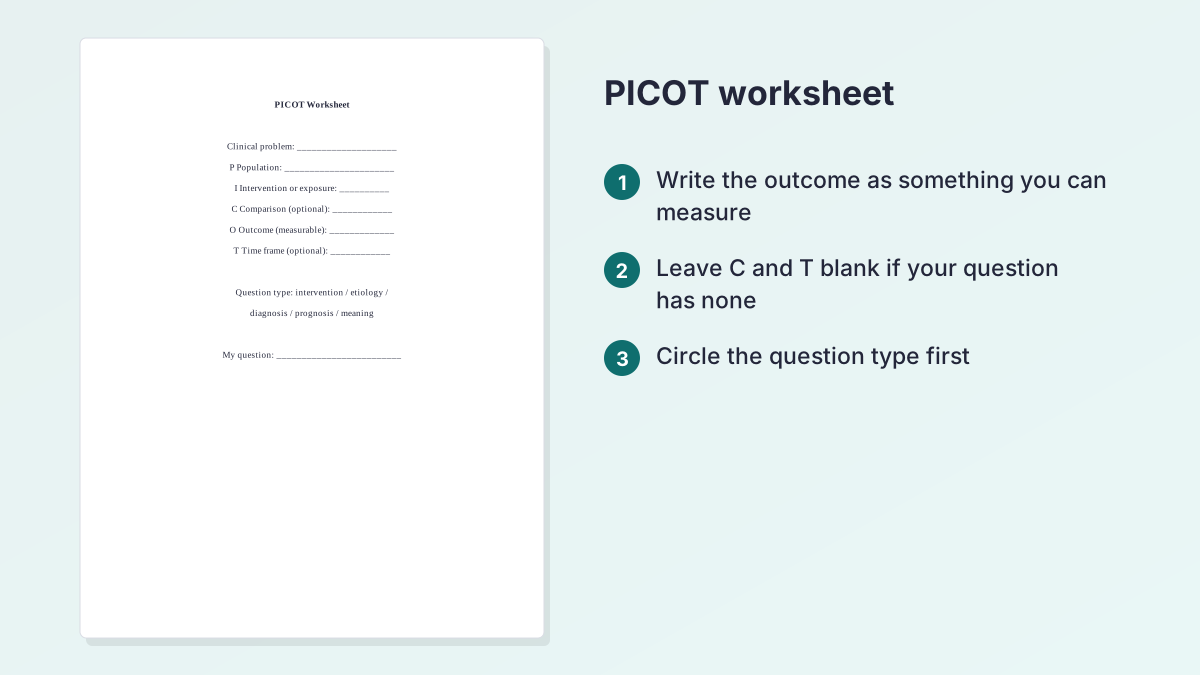
Turning your PICOT into a PubMed or CINAHL search
A finished PICOT question is the start of a literature search. The generator gives you search terms, synonyms and a Boolean string, but it helps to know how that string is built.
1. Pull out the concepts
Usually P, I and O. C and T rarely make good search terms, so leave them out at first.
2. List synonyms for each
Falls: accidental falls, fall prevention. Hourly rounding: purposeful rounding, intentional rounding. Include abbreviations such as CAUTI and HbA1c.
3. Combine with OR, then AND
Synonyms for one concept go together with OR in parentheses. Different concepts are joined with AND:
("accidental falls"[mh] OR falls) AND ("hourly rounding" OR "purposeful rounding") AND (hospital OR inpatient)
The PubMed User Guide says to type Boolean operators in uppercase, put exact phrases in double quotes and use parentheses to nest concepts. The [mh] tag searches MeSH, the National Library of Medicine's subject headings.
4. Run it in CINAHL too
CINAHL uses its own subject headings rather than MeSH, so take the same concepts and synonyms and check the headings in your library's CINAHL interface.
5. Narrow if needed
Too many results? Add a setting or date limit. Too few? Add synonyms.
When PICOT does not fit your question
Not every good question has an intervention and a measurable outcome. Forcing it into a PICOT question gives an awkward sentence and a poor search.
Signs you need another framework
- You are asking about experiences, feelings or perceptions: try PICo or SPIDER.
- The "intervention" is really an exposure or risk factor you cannot assign: try PEO.
- You are asking how accurate a test is: some guides use a diagnostic version of PICO with index test and reference test.
What the generator does
When your PICOT question is not an intervention question, the tool suggests a better framework and rewrites the question in it. Discuss that with your instructor; it is a suggestion, not a rule.
Common PICOT question mistakes
- Assuming the answer. "Does hourly rounding reduce falls?" presumes it does. Ask whether it affects falls. The generator is built never to state that an intervention works.
- A vague population. "Patients" or "nurses" is too broad to search. Add age, condition and setting.
- An outcome you cannot measure. "Better care" is not an outcome; "patient satisfaction scores on the HCAHPS survey" is.
- Inventing a comparison. Adding "compared with usual care" when you have no comparison in mind makes the question harder to answer. Leave C blank.
- Two questions in one. "Does rounding affect falls and satisfaction and length of stay?" Choose one primary outcome.
- Too narrow to have evidence. "Nurses on 4 West at one hospital" may have zero studies. Search the broader population; apply the findings locally.
- Treating T as your deadline. T is when the outcome is measured, not when your paper is due.
Check your question
After you build the PICOT question, read the Still vague list. It names any part that would weaken a search.
From a PICOT question to a finished EBP paper
Once your question is settled, it shapes everything else in an EBP paper or capstone.
Next research tools
- If you have a topic but no clinical angle yet, start with the Research Question Generator.
- Turn the question into aims with the Research Objective Generator and a problem statement with the Research Problem Generator.
- Write a title with the Research Paper Title Generator and a one-sentence aim with the Purpose Statement Generator.
- When the paper is written, summarize it with the Abstract Generator.
Formatting the paper
Most US nursing programs use APA Style. Cite every article you find with the APA Citation Generator, make the cover page with the APA Title Page Generator, and keep an eye on length with the Word Counter.
Saving between tools
Select Use as my research question to save the PICOT question on this device. The other research tools can pre-fill from it.
Is the PICOT question generator free and private?
Yes, it is free with no account. A fair hourly allowance per visitor keeps it fast for everyone; if you reach it, your inputs stay on the page and you can try again later.
What happens to what you type
Your P, I, C, O and T, plus anything you saved from other research tools, are sent to our AI providers (Groq, with Google Gemini as a backup) only to build the PICOT question. The Study Corp does not save them. Our logs record the tool name and timing, never your text.
Saved questions
Use as my research question stores the PICOT question in your browser, not on our servers.
Do not enter patient details
Describe populations, not people. Never type a patient's name, date of birth, record number or anything else that could identify them.
PICOT question generator FAQ
What is a PICOT question in nursing?
It is a clinical question written in five parts (population, intervention, comparison, outcome and time) so that it can be answered by searching the research. Nursing programs use it to start evidence-based practice projects.
Do I need all five parts?
No. P, I and O are required. Comparison and time frame are optional, and many questions, especially qualitative ones, have neither. The generator leaves them blank rather than inventing them.
What is the difference between a PICO and a PICOT question?
A PICOT question adds T, the time frame for measuring the outcome. PICOS adds study design; PICOTS adds time and setting.
Can a PICOT question be qualitative?
Yes. A meaning question asks how people experience something, such as kangaroo care in a NICU. With no comparison or number to measure, PICo or SPIDER may fit better, and the tool will say so.
Does the generator search PubMed for me?
It writes a PubMed search string and a Search PubMed link that opens it. It does not read or summarize articles.
Why does my question say affect instead of improve?
A clinical question asks whether something works; it should not assume the answer. Words like improve or reduce presume a result before you have reviewed any evidence.
How do I pick a good PICOT question topic?
Start with a problem you saw on clinicals, such as falls or CAUTI, and keep the population broad enough to find studies.
Can I use the generated question in my assignment?
Use the PICOT question as a draft. Check it against your rubric and follow your school's rules on AI tools.
More free research tools
- Research Question GeneratorThree to five answerable research questions from your topic.
- Abstract GeneratorA structured abstract built only from the findings you give it.
- Research Paper Title GeneratorFive accurate titles for your paper from its question and method.
- Research Paper Introduction GeneratorA paragraph-by-paragraph introduction draft built from your question and sources.
- Research Objective GeneratorA general objective and specific objectives that match your question.
- Research Problem GeneratorA problem statement built from your topic and the evidence you have.
- Purpose Statement GeneratorA purpose statement that matches your question, design and participants.
See all 80 free tools for students
Related tools
Last updated by The Study Corp editorial team.