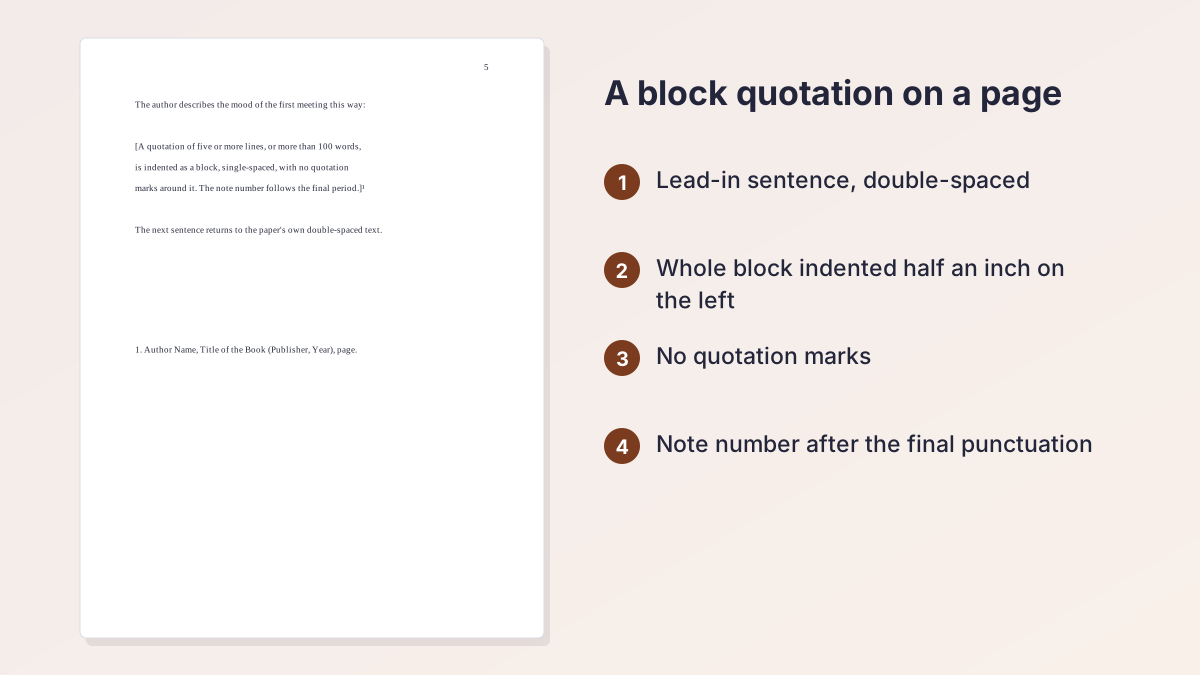
Chicago Style Block Quote Examples for Common Cases
Each pair shows a situation and how Chicago style handles it. The sample sentences were written for this guide; the book, poem and publisher details are real, and page numbers are illustrative.
SituationYou want to quote two lines of prose.
In Chicago styleAs the author argues, "the boycott depended on careful planning."²
Under five lines, keep it in your paragraph, in quotation marks.
SituationYou want to quote seven lines of prose.
In Chicago styleIntroduce it with a sentence, start a new line, indent the block half an inch and leave off the quotation marks.
The threshold is five or more lines, or more than 100 words, in the CMOS summary on Purdue OWL.
SituationThe original passage contains a quoted phrase.
In Chicago styleKeep the original's quotation marks inside the block, in standard double marks.
CMOS Shop Talk says to keep any quotation marks that appear in the original.
SituationYou quote two lines by Emily Dickinson.
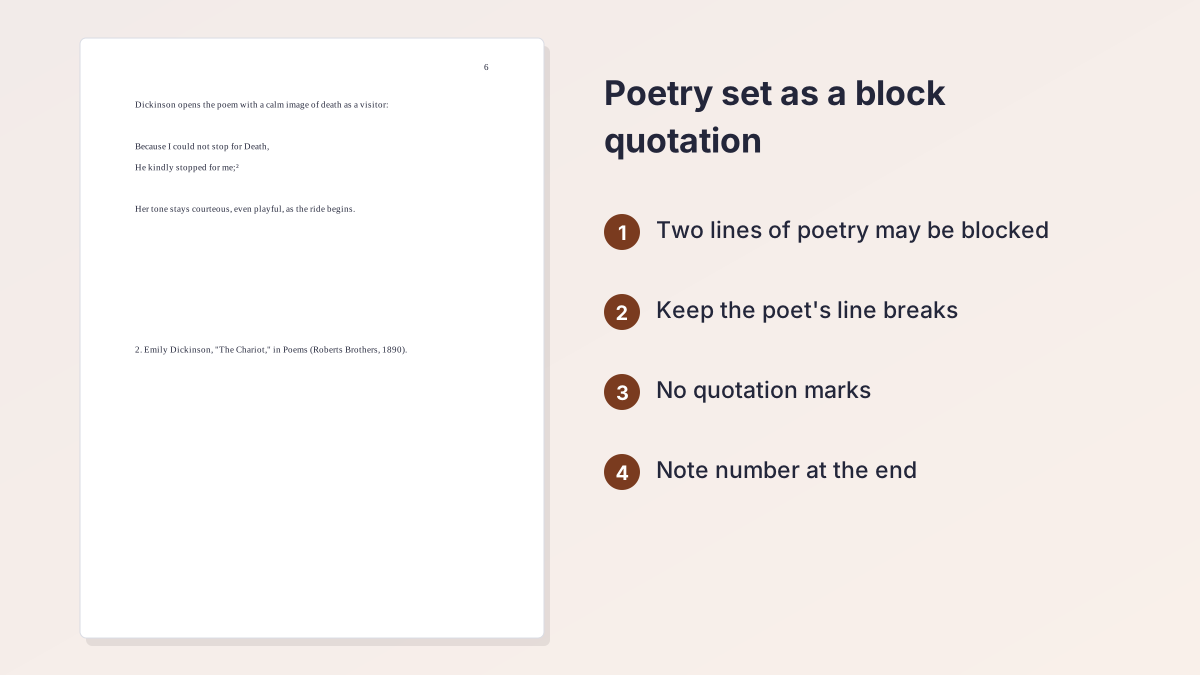
In Chicago styleBecause I could not stop for Death, / He kindly stopped for me;
Set as a block with the original line breaks; the slash only shows the line break here.
SituationA block quote dropped in with no introduction.
In Chicago styleBranch describes the mood of the first meeting:
A full-sentence lead-in usually ends with a colon, as in the Shop Talk and Turabian examples.
SituationThe block ends with a period, then the note number.
In Chicago style…the plan held.¹
The number follows the final punctuation, as Purdue OWL's rule for note numbers says; a dash is the exception.
SituationYou block a passage from page 143 of Taylor Branch's book.
In Chicago style1. Taylor Branch, Parting the Waters: America in the King Years, 1954–63 (Simon & Schuster, 1988), 143.
This is the 18th edition form; the 17th edition and Turabian 9 also give the city, New York.
SituationYou block another passage from the same book.
In Chicago style4. Branch, Parting the Waters, 149.
Author's last name, short title and page.
How to Format a Block Quote in Word or Google Docs
Menu names match current versions of Microsoft Word and Google Docs. Set the block off with the indent tool, never the space bar.
- Count the length. Check whether the passage runs five or more lines, or more than 100 words. If not, keep it in your paragraph in quotation marks.
- Lead in and start a new line. Write your own sentence that introduces the quotation, then press Enter so the quotation begins on its own line.
- Indent the whole block. Select the quotation. In Word, choose Layout and set Indent Left to 0.5". In Google Docs, choose Format > Align & indent > Indentation options and enter 0.5 inch under Left.
- Single-space and add gaps. In Word, choose Home > Line and Paragraph Spacing > 1.0. In Google Docs, choose Format > Line & paragraph spacing > Single. Leave a blank line above and below the block.
- Remove the quotation marks. Delete any quotation marks you added around the passage. Keep ones that were already inside the source.
- Insert the note. Put the cursor after the final punctuation of the block. In Word, choose References > Insert Footnote. In Google Docs, choose Insert > Page elements > Footnote. Then type the source.
What a Chicago Style Block Quote Is
A Chicago style block quote is a passage long enough that setting it inside your paragraph would swamp your own sentences. In The Chicago Manual of Style (CMOS), such quotations are indented as a block instead of being enclosed in quotation marks. Students are often told to follow Kate Turabian's student version of Chicago, so our guide to Turabian format is a good companion to this page.
CMOS block quotes and Turabian
Both CMOS block quotes and Turabian give the same basic format. CMOS is written for authors and publishers, and its exact indent can vary with a publisher's design. Turabian's tip sheet from the University of Chicago Press gives the student settings: a left indent of half an inch and single spacing. When your instructor's rules differ from either, the instructor wins.
Why Chicago style asks for blocks
Readers recognize an indented passage at a glance, so the block does the work that quotation marks do for a short quote. That is why the marks come off. It also keeps a long passage from burying your own sentences, which is the point of the length rule that follows in the next section.
Let a tool handle the note
The block is formatting, but the note is a citation. The free Chicago citation generator builds the footnote and bibliography entry from a link, DOI or ISBN, so you only need to check the page number.
When to Use Block Quotes in Chicago Style
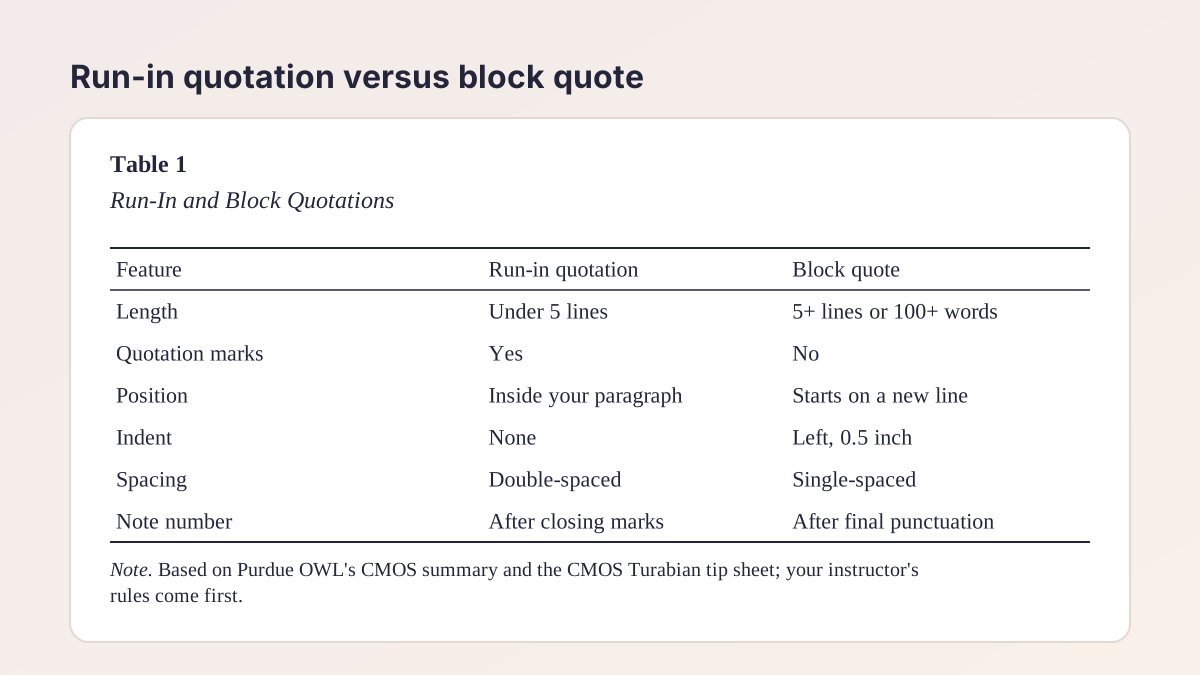
The length rule for a Chicago style block quote is the first test. Purdue OWL's summary of CMOS formatting says to block prose quotations of five or more lines or more than 100 words, and to block two or more lines of poetry. The Chicago Manual's own Turabian tip sheet states the line version: quotations of five or more lines should be indented as a block. Table 1 above sets run-in and block quotations side by side, and the table below gives the five rules in order.
| Rule | What to do | Where it comes from |
|---|---|---|
| 1. Length | Block prose of 5+ lines or 100+ words; poetry of 2+ lines | Purdue OWL, CMOS summary |
| 2. Position | Start the block on a new line after your own lead-in | Purdue OWL |
| 3. Indent | Indent the whole block 0.5 inch on the left | CMOS Turabian tip sheet |
| 4. Spacing | Single-space, with a blank line before and after | CMOS Turabian tip sheet |
| 5. Marks and note | No quotation marks; note number after the final punctuation | Purdue OWL; CMOS Shop Talk |
When a Chicago style block quote is too long
Length is a minimum, not a goal. Most writing teachers suggest shortening a long quotation before blocking it. If only one sentence carries your point, quote that sentence and paraphrase the rest. A paper built of block quotes shows the reader very little of your own thinking.
Long quotes in Chicago style and your instructor
Some instructors set their own threshold, such as eight lines. If your syllabus names one, follow it.
Block Quote Margins Chicago Style Uses
For a class paper, the block quote margins Chicago expects are simple: indent the entire block half an inch from the left margin. The Turabian tip sheet puts it as "apply a left indent of half an inch." Leave the right margin where it is. Purdue OWL says to make the indent with your word processor's indentation tool, which is more reliable than tabs or spaces.
Single spacing and blank lines
Your main text is double-spaced, but block quotations are exempt. Single-space the block and leave one blank line before and after it. CMOS Shop Talk gives the same rule when it explains how to format a paper. Because your paper settings are covered in our Chicago style paper format guide, check there for margins and page numbers.
Long quotes in Chicago style that run more than one paragraph
If the quotation runs across paragraphs, keep every paragraph in the block. CMOS Shop Talk says the first paragraph is not indented further but the next paragraph is, so the break is visible, with no blank line between the paragraphs.
No quotation marks
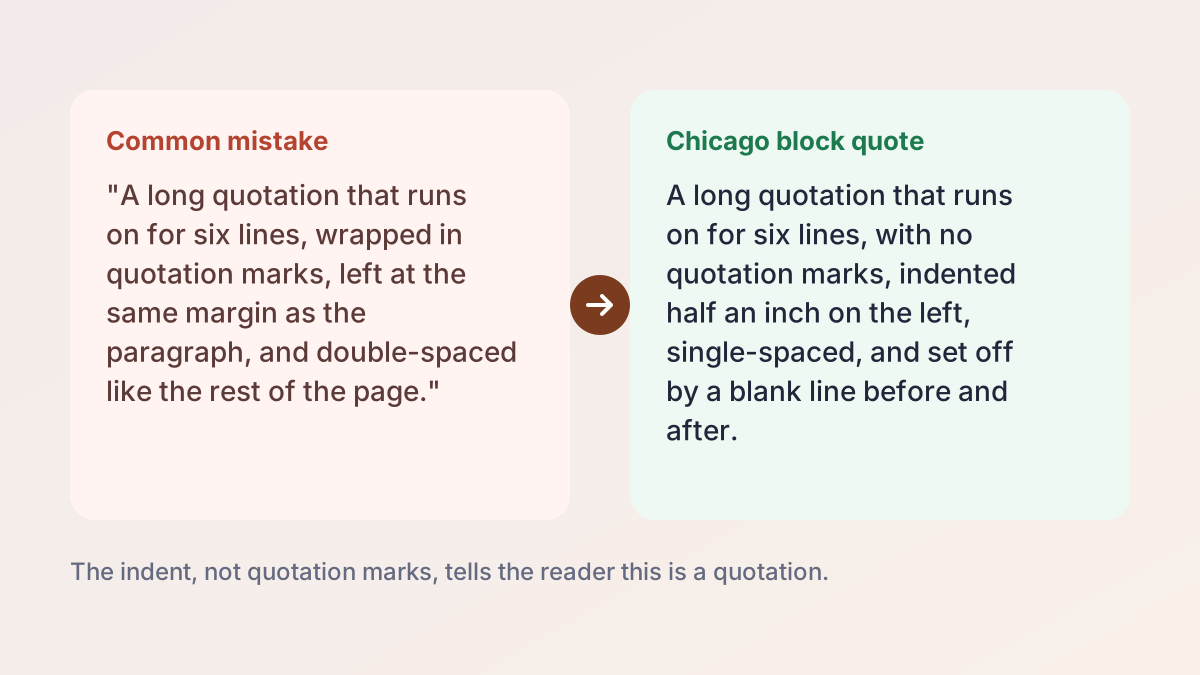
Do not enclose the block in quotation marks. Quotation marks that appear inside the original stay, as Shop Talk advises.
Chicago Block Quote Footnote: Where the Note Number Goes
A Chicago style block quote needs a source, and in the notes-bibliography system that means a footnote. Put the superscript note number at the end of the block, after the final punctuation. Purdue OWL's rule for note numbers is that they go after all punctuation except a dash, and that applies at the end of a block too.
What the Chicago block quote footnote says
The first note for a source gives full publication details; later notes use a short form with the author's last name, a short title and the page. Our Chicago in-text citation guide shows every pattern, and Turabian footnotes covers the student version. To build one fast, use the Chicago footnote generator.
Do you need the author's name in the lead-in?
Not for the citation. Even when your sentence names the author, the note still carries the full source. The lead-in just tells the reader who is speaking.
Block quotes in author-date papers
Author-date papers use a parenthetical citation instead of a note. Our Chicago author-date citation guide explains the format. Check where your instructor wants the parenthetical placed after a block quote in Chicago style, since the author-date placement is a detail some teachers specify.
Poetry and Special Cases
Block quotes in Chicago style for poetry follow a lower threshold. Purdue OWL's summary of CMOS says to block two or more lines. Keep the poet's line breaks and indentation as closely as you can, and do not add quotation marks.
Block quotes and the bibliography
The block itself never goes in the bibliography. Only the source does. Our Turabian bibliography guide shows entries. If you also write in MLA, the MLA block quote rules differ: MLA blocks prose of more than four lines and puts the citation after the final period.
A Sample Paragraph With a Chicago Style Block Quote
Here is how a Chicago style block quote sits in a paragraph. The text is invented for this guide, so the quotation is a placeholder rather than a real source. Notice that the lead-in sentence is double-spaced and indented like any other paragraph, and that the block begins on a new line.
The lead-in
In her study of the strike, the author describes how organizers kept the early meetings small and disciplined:
The block
The block that follows would be indented half an inch, single-spaced and written without quotation marks, ending with a superscript number after its final period. After it, your own sentence picks up at the normal paragraph indent and explains what the passage shows. That explanation is what turns a block quote in Chicago style from filler into evidence.
Explain it afterward
A good paragraph spends as many words on its own analysis as on the quotation. Say what the passage shows, point to the phrase that matters most and tie it back to your thesis. If you cannot say anything about the block beyond repeating it, shorten the quotation or cut it.
Cite it right away
Add the footnote as soon as you paste the passage. It is easy to forget a source later, and a Chicago style block quote with no note reads as unattributed text.
Turabian Block Quotes and Chicago: What Differs
Turabian block quotes and Chicago block quotes look the same on the page. The student book was written to simplify the Chicago manual for papers and theses, so a Turabian block quotation is indented, single-spaced and free of quotation marks, just as CMOS describes. What changes is the surrounding paper: Turabian adds guidance on title pages, headings and page numbers that the manual leaves to publishers.
Edition differences
Citation forms shift a little between editions. The 18th edition of CMOS no longer requires the city of publication in notes or the bibliography, while the 17th edition and Turabian 9 keep it. The block quotation itself is unaffected, so you can format one the same way in any edition and then adjust the note to the edition your class uses. Our Turabian format guide explains which edition most schools assign.
When your teacher is the tiebreaker
If your instructor says "blocks at four lines" or "indent one inch," follow that for the paper. A style guide cannot overrule a syllabus.
Common Block Quote Mistakes in Chicago Style
Most errors in a Chicago style block quote involve punctuation or spacing. Use this list to check a draft before you submit.
| Mistake | Fix |
|---|---|
| Quotation marks around the block | Remove them; the indent marks the quotation |
| Block left double-spaced | Single-space the block |
| Indent made with the space bar | Use the indent tool at 0.5 inch |
| No lead-in sentence | Introduce the quotation in your own words |
| Note number before the period | Put it after the final punctuation |
| Blocking four lines of prose | Under five lines, run it into your paragraph |
| No note for the block | Add a footnote with the source and page |
A last check
Before you submit, confirm that each Chicago style block quote has a lead-in, a half-inch indent, single spacing and a note. Then reread each block and ask whether you need all of it. Then check the note numbers run in order. If you are studying more than one style, see the student writing guides for the others, and for a last pass on notes, the Chicago citation generator can rebuild any footnote you typed by hand.
Chicago Style Block Quote FAQ
How do you do a block quote in Chicago style?
Start the quotation on a new line, indent the whole block half an inch on the left, single-space it, leave off the quotation marks and put the note number after the final punctuation.
How long does a quote have to be for a block quote in Chicago?
Purdue OWL's CMOS summary says five or more lines or more than 100 words for prose. The CMOS Turabian tip sheet gives five or more lines.
What are the margins for a block quote in Chicago style?
Indent the whole block half an inch from the left margin. The right margin stays the same, and the block is single-spaced with a blank line before and after.
Do you use quotation marks in a Chicago block quote?
No. The indent shows that the passage is a quotation. Keep any quotation marks that were already in the original.
Where does the footnote go in a block quote in Chicago?
Put the superscript note number at the end of the block, after the final punctuation, and type the footnote at the bottom of the page.
Is a Chicago block quote single or double spaced?
Single-spaced. The main text is double-spaced, but block quotations are an exception.
How do you block quote poetry in Chicago style?
Block two or more lines of poetry, keep the original line breaks and leave off the quotation marks.
Are Turabian block quotes different from Chicago?
For class papers they match: a half-inch left indent and single spacing, with the same note-number placement. Check your instructor's rules for any difference.
Do I need to introduce a block quote?
Usually. Lead in with your own sentence, which typically ends in a colon when it is a complete sentence, and explain the quotation afterward.
More free guides
- Chicago In-Text CitationsFootnotes and author-date parenthetical citations in Chicago 18, with examples.
- Chicago Book CitationNotes and bibliography entries for books, editions, chapters and ebooks.
- Chicago Movie and Image CitationFilms, streaming, YouTube videos, artwork and images in Chicago style.
- Chicago Author-Date CitationThe author-date system, its reference list, and how it differs from notes and bibliography.
- Chicago Style Paper FormatMargins, font, spacing, page numbers, headings and the first page of a Chicago paper.
- MLA In-Text CitationsAuthor-page citations for every kind of source, with examples.
See all 80 free tools for students
Related tools
Last updated by The Study Corp editorial team.