Chicago Author-Date Citation Examples by Source Type
Reference list entries and parenthetical citations come from our citation engine under Chicago 18 author-date rules, using real books and articles. Added by hand: the paraphrase sentences, the two-source citation, and the n.d. and 2020a/2020b patterns, which use placeholder names. Page numbers are illustrative.
Source or situationYu, Charles. 2020. Interior Chinatown. Pantheon Books.
Author-date citation(Yu 2020, 45)
Name, year, comma, page. No comma between name and year.
Source or situationThaler, Richard H., and Cass R. Sunstein. 2008. Nudge: Improving Decisions about Health, Wealth, and Happiness. Yale University Press.
Author-date citation(Thaler and Sunstein 2008, 6)
Join two names with and, never an ampersand.
Source or situationBooth, Wayne C., Gregory G. Colomb, Joseph M. Williams, Joseph Bizup, and William T. FitzGerald. 2016. The Craft of Research. 4th ed. University of Chicago Press.
Author-date citation(Booth et al. 2016, 12)
Three or more authors: first name plus et al. in the text; up to six names in the list.
Source or situationWhite, Lynn, Jr. 1967. “The Historical Roots of Our Ecologic Crisis.” Science 155 (3767): 1203–7. https://doi.org/10.1126/science.155.3767.1203.
Author-date citation(White 1967, 1205)
Cite the page you used, not the article's full range.
Source or situationYou name the authors in your own sentence.
Author-date citationThaler and Sunstein (2008, 6) argue…
Year (and page) in parentheses right after the names.
Source or situationYou restate Putnam's point about civic groups in your own words.
Author-date citationAmericans joined fewer civic groups in the late twentieth century (Putnam 2000, 27).
A paraphrase of a specific passage keeps the page number.
Source or situationA web page by an organization with no publication date.
Author-date citation(Organization Name, n.d.)
n.d. takes a comma before it; the access date goes in the reference list.
Source or situationTwo articles by one author, both from 2020.
Author-date citation(Author 2020a, 14; Author 2020b, 3)
Letters follow title order in the reference list. Pattern only; names are placeholders.
How to Write a Chicago Author-Date Citation, Step by Step
These steps follow the Chicago Manual of Style, 18th edition. They work for any source type.
- Find the author and year. Use the last name of the first author listed, or the organization if there's no person. Use the year of publication, or n.d. if there's none.
- Note the page. If you quote or paraphrase a specific passage, note the page. Leave it out when you refer to the work as a whole.
- Place the citation. Put (Author Year, page) at the end of the clause, before the period or comma. If you name the author in the sentence, put the year right after the name.
- Write the list entry. Add the source to the reference list: name inverted, year, title, publication details. Every citation needs a matching entry.
- Sort and format. Title the page References, sort entries by last name, and use a 0.5-inch hanging indent.
What Is a Chicago Author-Date Citation?
The Chicago Manual of Style has two citation systems. The Chicago author-date citation style is the one built for the sciences and social sciences: sociology, economics, political science, anthropology, psychology courses that don't use APA, and many science journals. The citation in your sentence gives just enough to find the source in the reference list: the author's last name, the year and, when needed, a page.
Why the year matters
In research fields, how recent a study is matters to the reader. Putting the year right in the sentence lets readers see at a glance whether you're citing a 1967 classic or a 2022 study. That's the main reason Chicago citation author-date style exists alongside footnotes.
Try it now
The citation tool above opens on the author-date system. Paste a link, DOI or ISBN to get the reference list entry and the in-text form together. For a whole list of sources, the free Chicago citation generator formats every entry in either system.
7 Rules for Chicago Author-Date Citations
Every Chicago author-date citation follows these seven rules from the 18th edition.
| Rule | What to do |
|---|---|
| 1. Basic form | (Author Year, page): (Yu 2020, 45) |
| 2. Punctuation | No comma between name and year; a comma before the page |
| 3. Placement | End of the clause, before the period or comma; after a closing quotation mark |
| 4. Authors | One or two names; three or more become first author plus et al. |
| 5. Pages | Give the page for quotations and specific passages, with no p. or pp. |
| 6. Missing date | Use n.d. with a comma before it: (Organization Name, n.d.) |
| 7. Matching entry | Every citation matches a reference list entry that starts with the same name and year |
The Chicago author-date citation in text, with the name in the sentence
When you name the author yourself, don't repeat the name in parentheses. Put the year right after the name, and the page either with it or at the end of the sentence: Thaler and Sunstein (2008, 6) argue… or Thaler and Sunstein (2008) argue that choice design matters (6).
Where the Parenthetical Citation Goes
Chicago puts the citation as close as possible to the material it supports, usually at the end of a clause or sentence.
Before the period
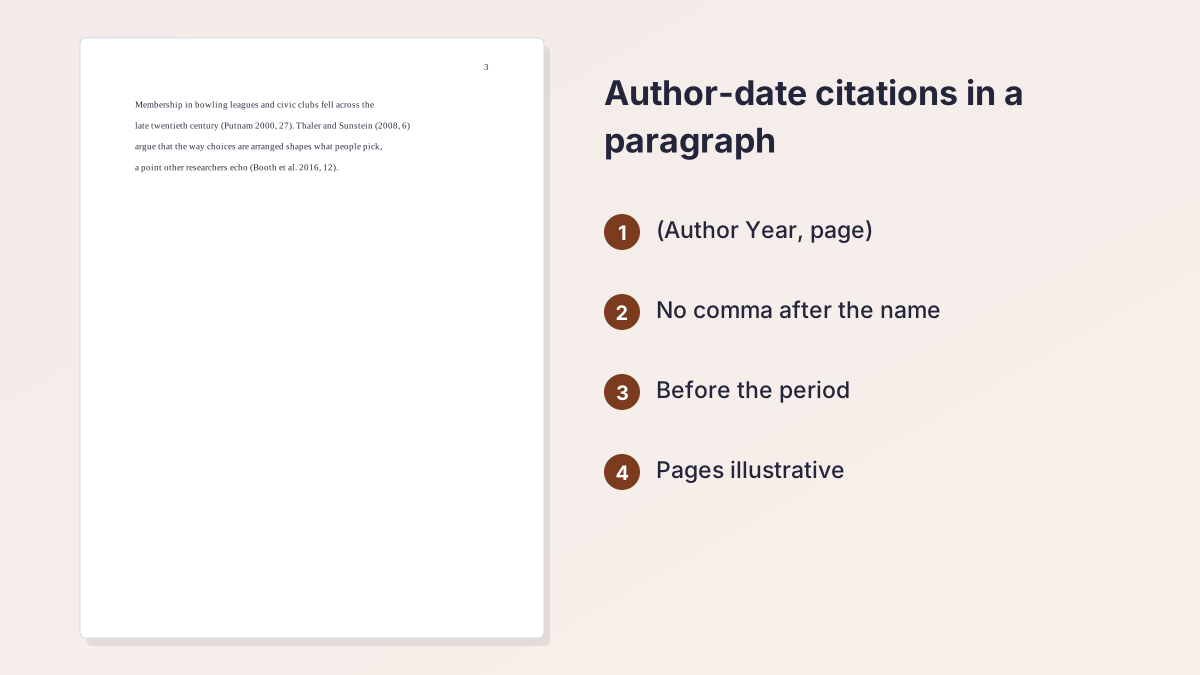
The citation goes inside the sentence, so the period comes after the closing parenthesis: …fell across the late twentieth century (Putnam 2000, 27). With a quotation, put the citation after the closing quotation mark and before the period.
Block quotations
A block quotation (usually 100 words or more) has no quotation marks, and its citation goes after the final punctuation, in parentheses, with no period after it.
Mid-sentence citations
If only part of a sentence comes from a source, cite right after that part, before a comma: Small design choices shape decisions (Thaler and Sunstein 2008, 6), a finding that marketers use every day. Example sentences on this page are student examples, not quotations.
The Chicago Author-Date Reference List
The Chicago author-date reference list is the full list of every source you cite. It goes at the end of the paper on a new page, titled References (or Reference List) and centered.
How entries are built
Each entry starts with the first author's name inverted, then the year, then the title and publication details, all separated by periods. Compare the CMOS author-date quick guide example: Yu, Charles. 2020. Interior Chinatown. Pantheon Books. The year sits right after the name, so it lines up with the (Yu 2020) citation in your text.
Formatting
- Alphabetize by the first author's last name, ignoring A, An and The for entries that start with a title.
- Use a hanging indent of 0.5 inch.
- Single-space each entry with a blank line between entries, or double-space throughout if your instructor prefers.
- List up to six authors; for seven or more, list the first three and et al.
Same author, several works
Chicago 18 repeats the author's name in every entry rather than using a long dash. Order an author's works by year, oldest first. Two works from the same year get letters, 2020a and 2020b, ordered by title, and your in-text citations use the same letters.
Chicago Author-Date vs Notes and Bibliography
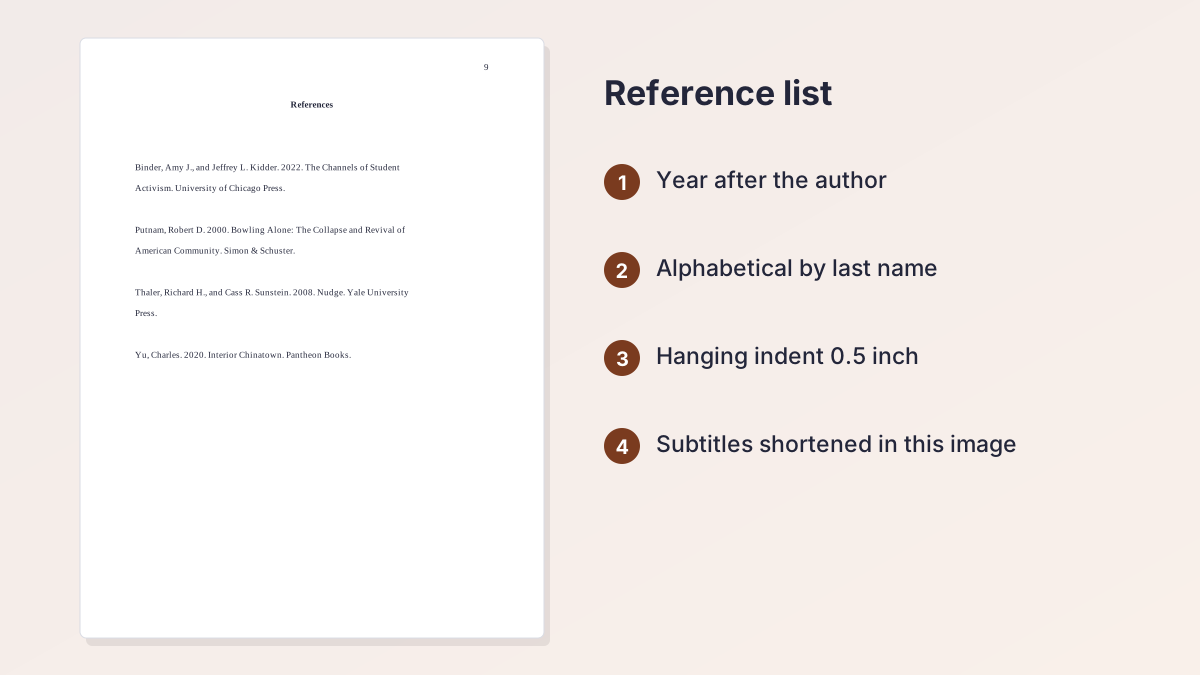
The two systems use the same source details in a different order and place. Here's Chicago author-date vs notes and bibliography for the same book.
| Author-date | Notes-bibliography | |
|---|---|---|
| In the text | (Yu 2020, 45) | Superscript number ¹ |
| First citation | (Yu 2020, 45) | 1. Charles Yu, Interior Chinatown (Pantheon Books, 2020), 45. |
| Later citations | (Yu 2020, 48) | 2. Yu, Interior Chinatown, 48. |
| List entry | Yu, Charles. 2020. Interior Chinatown. Pantheon Books. | Yu, Charles. Interior Chinatown. Pantheon Books, 2020. |
| List title | References | Bibliography |
| Used in | Sciences and social sciences | History, literature, arts, religion |
Which one to choose
Use the system your instructor or journal names, and never mix them in one paper. If an assignment says only "Chicago," most instructors mean notes-bibliography. For the footnote side of the comparison, including short notes, ibid. and et al. in notes, see our guide to the Chicago in-text citation in both systems.
Comments and asides
Author-date papers can still use footnotes for side comments that don't fit the text. Just keep source citations in parentheses.
Chicago Style Citation Bibliography vs Reference List
Students often search for a Chicago style citation bibliography when their assignment actually uses author-date. The two lists hold the same information, but the format differs.
The difference in one line
A bibliography (notes system) puts the year near the end: Yu, Charles. Interior Chinatown. Pantheon Books, 2020. A reference list (author-date) moves the year up: Yu, Charles. 2020. Interior Chinatown. Pantheon Books.
What stays the same
Both lists are alphabetical, use hanging indents and invert the first author's name. In both, Chicago 18 drops the place of publication for books, where the 17th edition wrote "New York: Pantheon Books." The Chicago bibliography citation format for notes papers is covered in depth in our Turabian bibliography guide, since Turabian follows the same pattern.
Is a Chicago citation style bibliography required?
In a notes paper, the bibliography is usually expected but can be optional when every note is a full note; ask your instructor. In an author-date paper, the reference list is always required, because the short citations mean nothing without it.
How to Do a Paraphrase Citation Chicago Style
A paraphrase restates a source's idea in your own words and sentence structure. It's still the source's idea, so it needs a citation every time. A paraphrase citation Chicago style looks exactly like a citation for a quotation, minus the quotation marks.
In author-date style
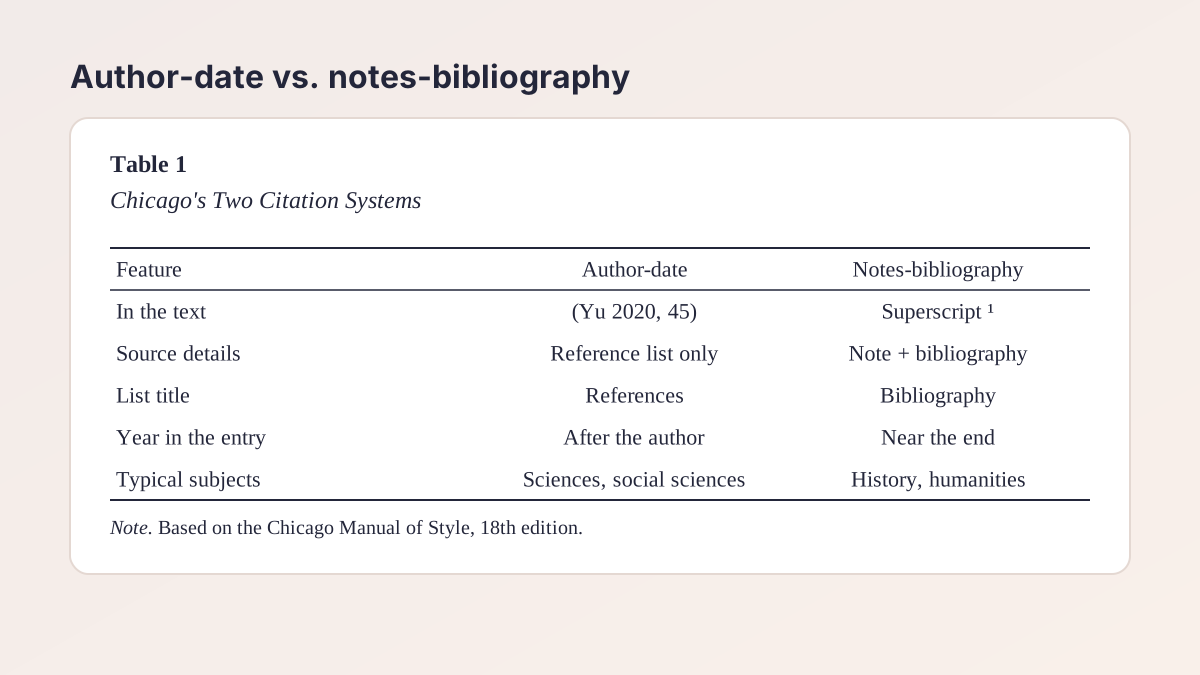
Put the author, year and page at the end of the paraphrased clause: Americans joined fewer civic groups in the late twentieth century (Putnam 2000, 27). If you summarize a whole book or a general argument rather than a specific passage, the page can go: (Putnam 2000).
In notes-bibliography style
Add a note number at the end of the paraphrased sentence and give the page in the note: 1. Robert D. Putnam, Bowling Alone: The Collapse and Revival of American Community (Simon & Schuster, 2000), 27.
When the paraphrase runs several sentences
Cite once where the paraphrase starts or ends, and make it clear in your wording where the source's ideas stop, for example by naming the author: "Putnam also links…". Readers should never have to guess which sentences are yours.
Paraphrase or quote?
Paraphrase when the idea matters more than the wording; quote when the exact wording matters. For a paraphrase citation Chicago style requires the same care as for a quote: change the words and the structure, not just a few synonyms.
No Date, No Author and Other Special Cases
A few situations need small changes to the basic Chicago author-date citation.
No date
Use n.d. ("no date") with a comma before it in the text: (Organization Name, n.d.). In the reference list, n.d. replaces the year, and an online source adds an access date. UQ Library's Chicago 18 guide shows the same pattern.
No author
Use the organization as the author if there is one. Otherwise, start the reference list entry with the title and use a short form of it in the text: (Short Title 2019). Pattern only.
Several sources at once
Separate citations with semicolons: (Yu 2020, 45; Putnam 2000, 27).
Same author, same year
Add a, b, c after the year in both the citation and the list: (Author 2020a). The letters follow the alphabetical order of the titles.
A source quoted in another
Cite the original if you can find it. If you can't, name the original author and cite the source you read: Original Author (1978) argues… (quoted in Second Author 2017, 44). Pattern only.
A Full Example Chicago Author-Date Reference List
Here is a complete Chicago author-date reference list for a short paper that cites six sources. Every entry was rendered with our citation engine under Chicago 18 rules. On the page, title it References, center the title, and give each entry a 0.5-inch hanging indent.
Binder, Amy J., and Jeffrey L. Kidder. 2022. The Channels of Student Activism: How the Left and Right Are Winning (and Losing) in Campus Politics Today. University of Chicago Press.
Booth, Wayne C., Gregory G. Colomb, Joseph M. Williams, Joseph Bizup, and William T. FitzGerald. 2016. The Craft of Research. 4th ed. University of Chicago Press.
Putnam, Robert D. 2000. Bowling Alone: The Collapse and Revival of American Community. Simon & Schuster.
Thaler, Richard H., and Cass R. Sunstein. 2008. Nudge: Improving Decisions about Health, Wealth, and Happiness. Yale University Press.
White, Lynn, Jr. 1967. "The Historical Roots of Our Ecologic Crisis." Science 155 (3767): 1203–7. https://doi.org/10.1126/science.155.3767.1203.
Yu, Charles. 2020. Interior Chinatown. Pantheon Books.
Matching citations
In the text, these become (Binder and Kidder 2022), (Booth et al. 2016), (Putnam 2000), (Thaler and Sunstein 2008), (White 1967) and (Yu 2020), each with a page when you cite a specific passage.
Chicago Author-Date Citation Style: 17th vs. 18th Edition
If your class still follows the 17th edition, three differences matter most.
- Three authors. The 18th uses et al. for three or more in the text; the 17th listed three names and used et al. from four.
- Place of publication. The 18th drops it: 2020. Interior Chinatown. Pantheon Books. The 17th wrote New York: Pantheon Books.
- Repeated authors. The 18th repeats the name in each entry; the 17th allowed a 3-em dash.
Use the edition your instructor names. The tool above has an edition switch for both.
Common Chicago Author-Date Citation Mistakes
Check each Chicago author-date citation in your paper against this list.
| Mistake | Fix |
|---|---|
| (Yu, 2020, 45) | No comma after the name: (Yu 2020, 45) |
| (Yu 2020, p. 45) | Drop p.: (Yu 2020, 45) |
| Year at the end of the list entry | Move it right after the author's name |
| Citation after the period | Put it before the period |
| Paraphrase with no citation | Cite every paraphrase, with the page for a specific passage |
| Footnote citations mixed in | Keep source citations in parentheses |
| List titled Bibliography | Title it References or Reference List |
Keep going
If your paper uses APA instead, the APA format guidelines cover its author-year style, and English classes using MLA can start with our MLA in-text citation guide. Browse every topic on our student writing guides page. When you're ready, let the Chicago citation generator or the Chicago footnote generator format every entry for you.
Chicago Author-Date Citation FAQ
What is Chicago author-date citation?
One of Chicago's two citation systems. You cite the author's last name, the year and the page in parentheses, such as (Yu 2020, 45), and list full details in a reference list.
How do you cite a paraphrase in Chicago style?
Cite it like a quotation without quotation marks. In author-date style, add (Author Year, page) at the end of the clause; in notes style, add a footnote with the page.
What is the difference between Chicago author-date and notes and bibliography?
Author-date uses parenthetical citations and a reference list with the year after the author. Notes-bibliography uses footnotes and a bibliography with the year near the end.
Is a Chicago reference list the same as a bibliography?
They hold the same sources, but a reference list puts the year right after the author, and a bibliography puts it near the end of the entry.
Does Chicago author-date use a comma between author and year?
No. Write (Yu 2020, 45). The only comma comes before the page, or before n.d. when there's no date.
How do you cite a source with no date in Chicago author-date?
Use n.d. with a comma before it in the text, such as (Organization Name, n.d.), and n.d. in place of the year in the reference list.
How do you cite two works by the same author from the same year?
Add a and b after the year, in both the citation and the reference list: (Author 2020a) and (Author 2020b), ordered by title.
Do paraphrases need page numbers in Chicago?
Yes, when you paraphrase a specific passage. When you summarize a whole work, the author and year are enough.
More free guides
- Chicago In-Text CitationsFootnotes and author-date parenthetical citations in Chicago 18, with examples.
- Chicago Book CitationNotes and bibliography entries for books, editions, chapters and ebooks.
- Chicago Movie and Image CitationFilms, streaming, YouTube videos, artwork and images in Chicago style.
- MLA In-Text CitationsAuthor-page citations for every kind of source, with examples.
- How to Cite a Website in MLAWorks Cited entries and in-text citations for web pages.
- MLA Works Cited PageFormat, order and hanging indents, with a full example page.
See all 80 free tools for students
Related tools
Last updated by The Study Corp editorial team.