MLA Block Quote Examples for Prose, Poetry and Plays
Each example shows a situation and how the long quotation should look in your paper. The Works Cited entries come from our citation engine (Hamlet's “Simon and Schuster” spelled out by hand). The citations were adjusted by hand: line numbers for the poem, act, scene and line for the play, and page numbers. Page numbers are illustrative.
Source and situationShelley, Mary. Frankenstein. Edited by Maurice Hindle, Penguin Books, 2003. You quote five lines from chapter 5.
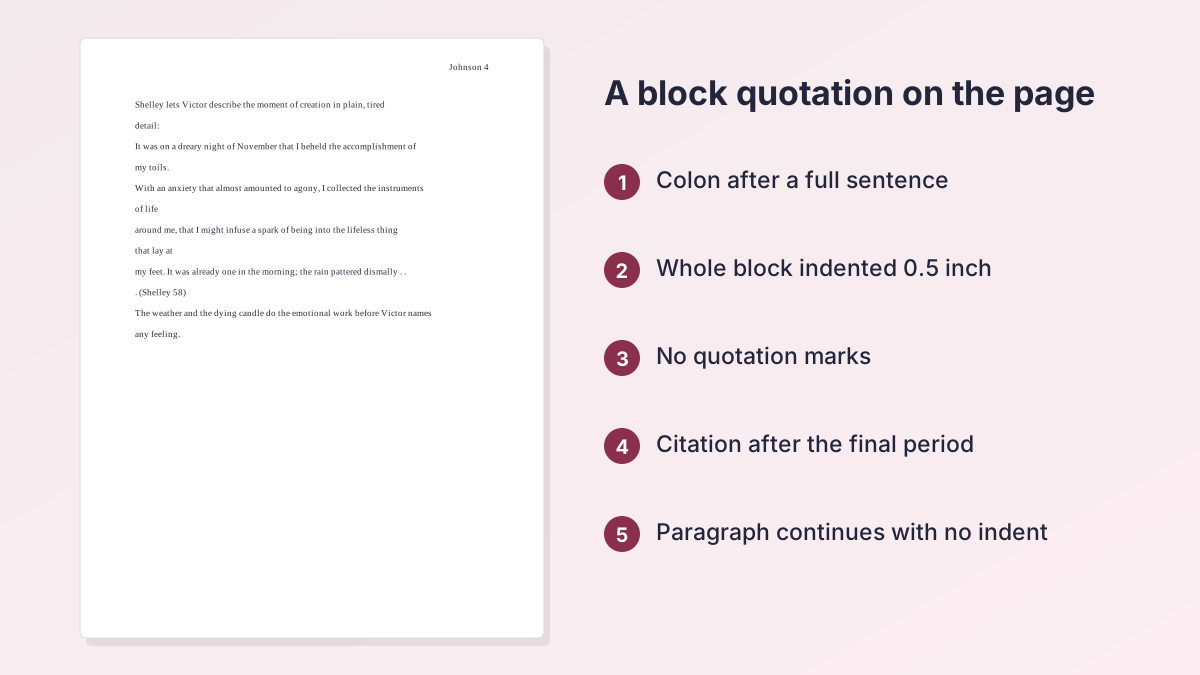
How it looks in your paperShelley slows the scene down: [new line, indented] It was on a dreary night of November that I beheld the accomplishment of my toils. With an anxiety that almost amounted to agony, I collected the instruments of life around me, that I might infuse a spark of being into the lifeless thing that lay at my feet. (Shelley 58)
No quotation marks; the citation follows the final period.
Source and situationThe same passage, but your introduction names Mary Shelley.
How it looks in your paperIn chapter 5, Mary Shelley writes: [block] … that lay at my feet. (58)
With the author in the signal phrase, the parentheses hold only the page.
Source and situationAusten, Jane. Pride and Prejudice. Edited by Vivien Jones, Penguin Books, 2003. You quote the first two paragraphs.
How it looks in your paper[block] It is a truth universally acknowledged, that a single man in possession of a good fortune, must be in want of a wife. [new line, extra 0.25 inch] However little known the feelings or views of such a man may be on his first entering a neighbourhood, this truth is so well fixed . . . (Austen 5)
Indent the first line of the second paragraph a little more than the block.
Source and situationPride and Prejudice, the opening exchange between Mrs. Bennet and her husband.
How it looks in your paper[block] “My dear Mr. Bennet,” said his lady to him one day, “have you heard that Netherfield Park is let at last?” Mr. Bennet replied that he had not. … (Austen 5)
Keep the source's double quotation marks; they aren't added by you.
Source and situationFrost, Robert. “The Road Not Taken.” Mountain Interval, Henry Holt, 1916, p. 9. You quote lines 6–10.
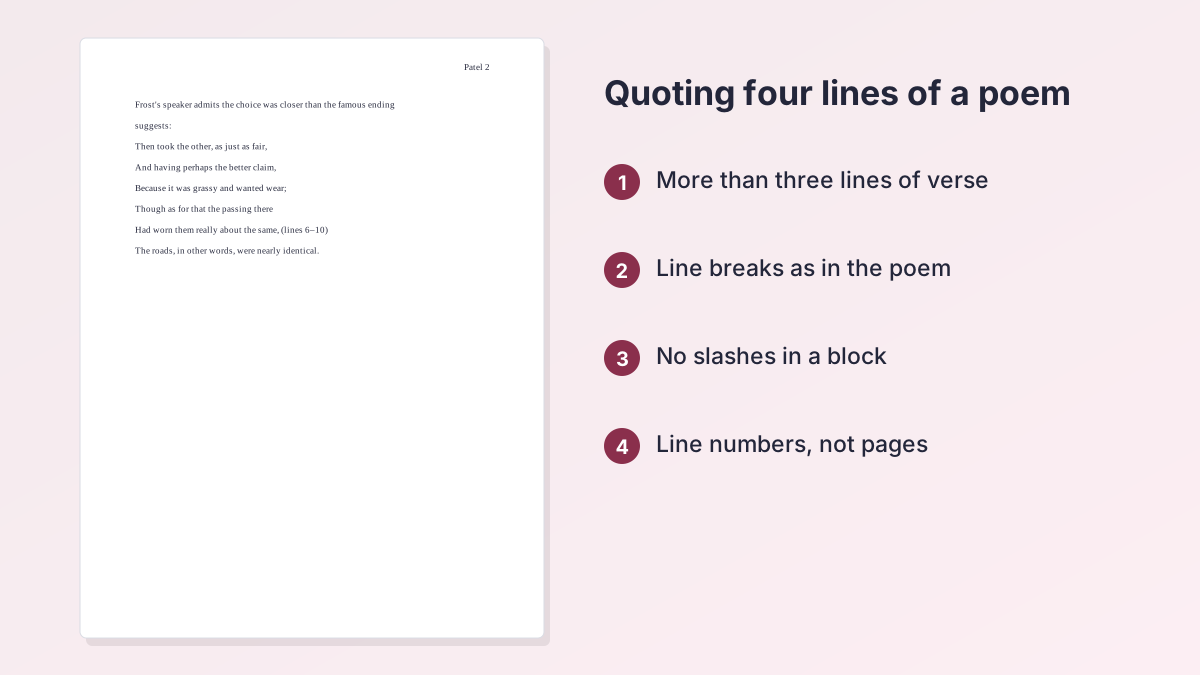
How it looks in your paper[block, line breaks kept] Then took the other, as just as fair, / And having perhaps the better claim, … Had worn them really about the same, (lines 6–10)
Shown with slashes here only to fit; in your paper each verse line gets its own line.
Source and situationShakespeare, William. Hamlet. Edited by Barbara A. Mowat and Paul Werstine, Simon and Schuster, 2012.
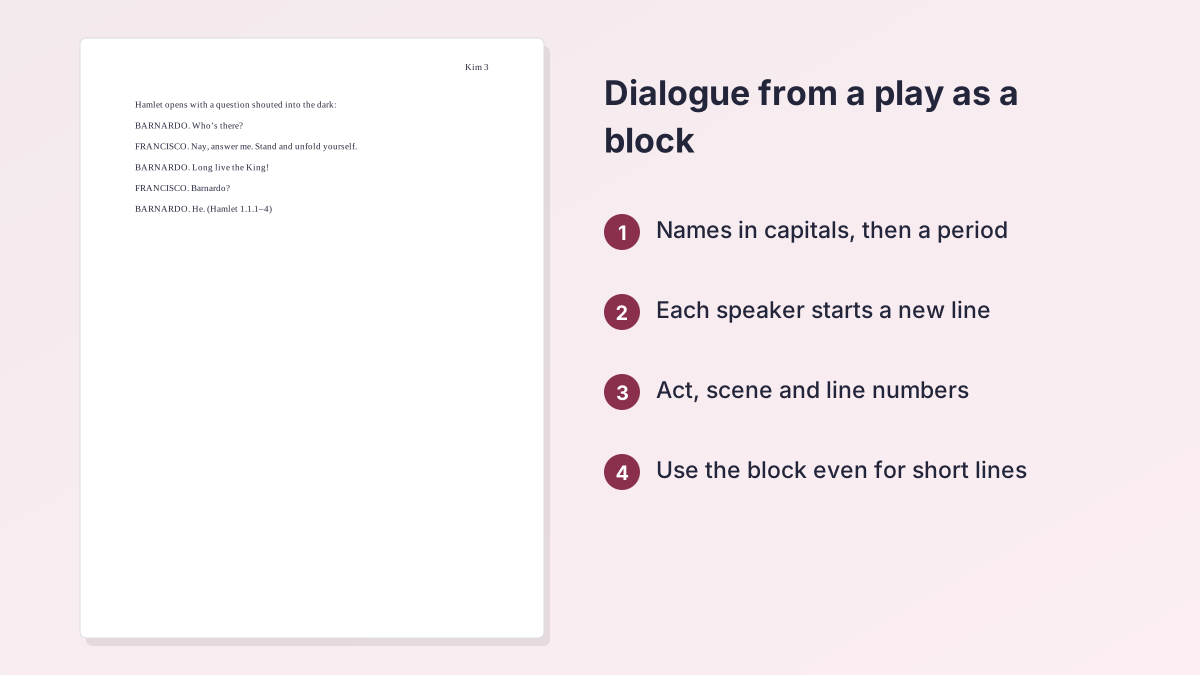
How it looks in your paper[block] BARNARDO. Who’s there? / FRANCISCO. Nay, answer me. Stand and unfold yourself. / BARNARDO. Long live the King! … (Hamlet 1.1.1–3)
Names in capitals with a period; each speech on a new line in your paper.
Source and situationFrankenstein, one sentence of under four lines.
How it looks in your paperVictor recalls that “the rain pattered dismally against the panes” as he worked (Shelley 58).
Short quotations stay in your paragraph, in quotation marks, with the period after the citation.
How to Block Quote in MLA, Step by Step
Use these steps for any long quotation in a paper formatted to MLA 9.
- Count the lines. Type or paste the quotation into your paper. If it runs more than four lines of prose, or more than three lines of verse, it needs a block.
- Introduce it. Write a sentence that leads into the quotation. End it with a colon if it's a complete sentence, or with a comma or no punctuation if the grammar runs straight into the quote.
- Start a new line. Press Enter after your introduction so the quotation begins on its own line.
- Indent the block 0.5 inch. Select the whole quotation and set a left indent of 0.5 inch. Keep it double-spaced, like the rest of the paper.
- Remove the quotation marks. Delete any quotation marks you added around the passage. Keep quotation marks that appear inside the original.
- Cite after the period. Add the parenthetical citation after the final punctuation mark, with no period after the parentheses.
- Continue the paragraph. Start the next line at the left margin if you're still discussing the quote. Indent it only if you're starting a new paragraph.
When Do You Need an MLA Block Quote?
Most quotations in an essay are short and sit inside your sentence. An MLA block quote is the exception. MLA asks you to switch to a block when a quotation gets long, so readers can see where your words stop and the source's words start. The MLA Citation Maker builds the Works Cited entry for whatever you're quoting.
The four-line rule for prose
Use the MLA block quote format for prose when it would run to more than four lines in your paper. Count lines as they appear in your own document, not in the book. Exactly four lines stays in your paragraph.
The three-line rule for poetry
For verse, the threshold is lower: quote more than three lines of a poem as a block. Up to three lines can stay in your sentence, with a slash ( / ) between the lines. You'll find a few older guides that say "four lines or more" for poetry; the Purdue OWL's MLA quotations page reflects both versions, so if your instructor gives a different number, follow the assignment sheet.
Dialogue and multiple paragraphs
Two cases need an MLA block quote even when they're short. Dialogue between two or more characters in a play is always set off, and so is a quotation that runs across more than one paragraph of prose. Both are covered below.
MLA Block Quote Format: The 8 Rules
Every MLA block quote follows the same eight rules of MLA block quote format. Use this list as a checklist.
- Use a block for more than four lines of prose or more than three lines of verse.
- Introduce the quotation with your own words, usually ending in a colon.
- Start the quotation on a new line.
- Indent the whole quotation 0.5 inch from the left margin; the right margin doesn't change.
- Keep the block double-spaced, like the rest of your paper.
- Leave out the quotation marks around the block.
- Put the parenthetical citation after the final punctuation mark.
- After the block, continue at the left margin unless you're starting a new paragraph.
| Feature | Short quotation | Block quotation |
|---|---|---|
| Length | Four lines of prose or fewer; up to three lines of verse | More than four lines of prose; more than three lines of verse |
| Quotation marks | Yes, around the quote | No |
| Indent | None; part of your paragraph | 0.5 inch from the left margin |
| Citation placement | After the closing quotation mark, before the period | After the final period |
| Poetry line breaks | Slashes ( / ) | Line breaks as in the poem |
Do block quotes need quotation marks in MLA?
No. The indent already tells readers the words are quoted, so quotation marks around a block would be redundant. The only quotation marks inside a block are those in the original, such as a character's spoken words.
Spacing and font
The MLA block quote format uses the same font, size and double spacing as your paper; don't shrink it or single-space it.
How to Cite a Block Quote in MLA
An MLA block quote citation follows the same author-page rules as any quotation, so learning how to block quote in MLA mostly means learning where the parentheses go.
The citation goes after the period
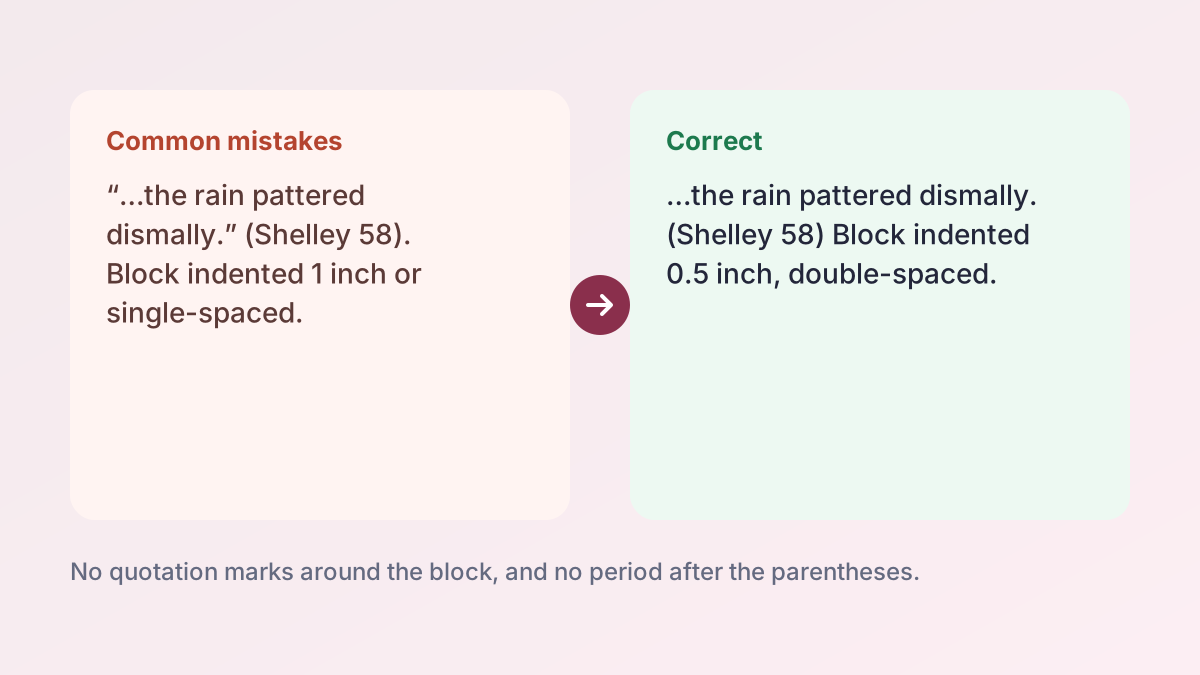
This is the core of the MLA block quote format. In a short quotation, the period follows the citation: "…against the panes" (Shelley 58). In a block, the order flips. End the quotation with its own punctuation, add a space, then the citation, and stop there: …that lay at my feet. (Shelley 58)
Don't add another period after the parentheses.
Author in your sentence or in the parentheses
If your introduction names the author, as in "Mary Shelley writes:", the parentheses need only the page: (58). If it doesn't, give the author and the page: (Shelley 58). The MLA in-text citation guide covers the full system, including sources with two authors, no author or no page number.
Matching the Works Cited page
Every MLA block quote needs a matching Works Cited entry. Paste the book's title or ISBN into the citation maker above to get it.
How to Introduce a Block Quotation in MLA
Don't drop a block quotation MLA style into your paper without warning. Lead into it with a sentence that tells readers who's speaking and why the passage matters.
Use a colon after a complete sentence
The most common way to introduce an MLA block quote is a full sentence ending in a colon: "Shelley lets Victor describe the moment of creation in plain, tired detail:" The colon signals that the quotation illustrates the sentence you just wrote.
Use a comma or nothing when the grammar runs on
After a short signal phrase such as "As Victor explains," a comma fits; if the quote finishes your sentence grammatically, use no punctuation. Douglas College's MLA 9 guide to quotations gives the colon as the default and allows other punctuation when the grammar needs it.
Explain it afterward
A good MLA block quote example always has a few sentences of analysis after it that point to specific words in the passage.
Block Quotation MLA Rules for Poetry
For a block quotation, MLA gives poetry its own threshold and layout, because line breaks are part of the poem's meaning.
Keep the poet's line breaks
When you quote more than three lines of verse, start each line of the poem on a new line of your paper, exactly as it's broken in the original. Don't use slashes in a block; slashes are only for short verse quotations inside your sentence.
Citing line numbers
Cite a poem by line number, not page. Write "lines" in the first citation and the numbers alone after that: (lines 6–10), then (16–20).
Omitting lines
Show skipped whole lines with a row of spaced periods, and words left out within a line with an ellipsis: . . .
Block Quote Dialogue in MLA: Quoting a Play
When you quote a conversation between characters in a play, use an MLA block quote no matter how short the speeches are. The format lets readers follow who's speaking.
Format the character names
Start each speech on a new line indented 0.5 inch. Write the character's name in capital letters, add a period, then the speech: BARNARDO. Who's there? If a speech runs onto a second line, indent the continuation lines a little further than the name. When another character speaks, start a new line at the 0.5-inch indent. Writing Commons' guide to quoting plays shows the same layout.
Cite act, scene and line
For a verse play like Hamlet, give the act, scene and line numbers separated by periods: (Hamlet 1.1.1–4). For a prose play, cite the page instead.
Quoting More Than One Paragraph
Sometimes the passage spans two or more paragraphs. It's still a block quotation MLA requires, even if the whole thing is under four lines.
Indent each new paragraph a little more
Indent the whole block 0.5 inch as usual. Don't add an extra indent to the first line, even if it starts a paragraph in the original. Then indent the first line of each later paragraph an extra 0.25 inch, per the Purdue OWL (instructors vary). In Pride and Prejudice, the second paragraph ("However little known the feelings…") gets that extra indent.
Quotations within the block
Keep any quotation marks inside the passage exactly as the source has them. Since the block has none of its own, don't change double marks to single ones.
MLA After Block Quote: Does the Next Sentence Get Indented?
Usually not. What you write after an MLA block quote depends on whether you're continuing the same paragraph.
Continuing the paragraph
Most of the time, the sentence after a block quotation in MLA discusses it, so it belongs to the same paragraph. Start that line at the left margin with no indent. The BYU–Hawaii Reading Writing Center's MLA format page explains it the same way: the text is still part of the paragraph that began before the quote.
Starting a new paragraph
If the block ends your paragraph, indent the next line 0.5 inch, as you would any new paragraph.
How to Format Block Quotes in MLA in Word and Google Docs
Here's how to block quote in MLA in Word or Google Docs. Don't build the indent with the space bar or with a Tab at the start of each line. If you change the text later, the lines will break in odd places. Set a paragraph indent instead.
Microsoft Word
- Select the whole quotation.
- On the Layout tab, find Indent and set Left to 0.5".
- Make sure Right is 0" and Spacing Before and After are 0 pt.
Google Docs
- Select the quotation.
- Go to Format > Align & indent > Indentation options.
- Set Left indent to 0.5 inches and Special indent to None, then click Apply.
Check the spacing
Set the block to double spacing with no added space before or after, so the MLA block quote matches the rest of the paper.
Common Mistakes With Long Quotes in MLA
Most points lost on long quotes in MLA papers come from a few habits carried over from short quotations or from other styles.
| Mistake | What it looks like | Fix |
|---|---|---|
| Quotation marks around the block | “It was on a dreary night…” | Remove them; the indent shows it's quoted |
| Period after the citation | …at my feet. (Shelley 58). | …at my feet. (Shelley 58) |
| Indenting 1 inch | Two tabs from the margin | 0.5 inch from the left margin (APA also uses 0.5 inch) |
| Single spacing or smaller font | Block set in 10-point, single-spaced | Same font and double spacing as the paper |
| No introduction | Quotation dropped in between paragraphs | Lead in with a sentence that ends in a colon |
| Blocking a short quote | A two-line quote set off | Keep it in your paragraph with quotation marks |
A quick check before you submit
Look at each MLA block quote in your paper: no quotation marks around it, 0.5-inch left indent, double-spaced, citation after the final period, and analysis right after it. If the sources on your Works Cited page still need formatting, the free MLA citation maker builds each entry in MLA 9.
Keeping Long Quotations in Proportion
An MLA block quote is a tool for close reading, not a way to fill space.
Measure your quoting
Paste your draft into the word counter with and without the long quotes in MLA format to see how much of the paper is your own writing.
Build the rest of the paper
Your Works Cited list has its own rules, from the hanging indent to alphabetical order; see the guide to the MLA Works Cited page. For the first-page heading, read the MLA heading guide, and if you're writing in Google Docs, the guide to MLA format in Google Docs covers every setting. Every guide is on the student citation guides page.
Let the tool handle the entries
Let the MLA citation maker format your sources: paste each one into the MLA citation generator and copy the entry.
MLA Block Quote FAQ
How long does a quote have to be to block quote in MLA?
More than four lines of prose or more than three lines of poetry, counted as the lines appear in your paper. Dialogue from a play and quotations of more than one paragraph are also set off.
How do you format a block quote in MLA?
Start it on a new line, indent the whole quotation 0.5 inch from the left margin, keep it double-spaced, leave out the quotation marks, and put the citation after the final period.
Do block quotes need quotation marks in MLA?
No. The indent shows that the words are quoted. Keep only the quotation marks that appear inside the original passage.
Where does the citation go in an MLA block quote?
After the final punctuation mark, with no period after the parentheses: …at my feet. (Shelley 58)
How do you introduce a block quote in MLA?
Usually with a complete sentence ending in a colon. Use a comma or no punctuation if your introduction runs grammatically into the quotation.
Does the next sentence after a block quote get indented in MLA?
Not if it continues the same paragraph; start it at the left margin. Indent it only if you're beginning a new paragraph.
How do you block quote dialogue in MLA?
Start each speech on a new line indented 0.5 inch, with the character's name in capital letters followed by a period. Cite act, scene and line, as in (Hamlet 1.1.1–4).
How do you block quote a poem in MLA?
Keep the poem's line breaks, indent the passage 0.5 inch, and cite line numbers after the last line, writing "lines" the first time: (lines 6–10).
More free guides
- MLA In-Text CitationsAuthor-page citations for every kind of source, with examples.
- How to Cite a Website in MLAWorks Cited entries and in-text citations for web pages.
- MLA Works Cited PageFormat, order and hanging indents, with a full example page.
- MLA Annotated BibliographyFormat, annotation types and a complete example.
- How to Cite Multiple Authors in MLATwo authors, three or more, et al., editors and the same author twice.
- How to Cite a YouTube Video in MLAYouTube videos, movies, TV episodes and streaming, with time stamps.
See all 80 free tools for students
Related tools
Last updated by The Study Corp editorial team.