ACS Citation Format Example for 7 Source Types
Each entry is a real source rendered by our citation engine in ACS style. Added by hand: the journal name is abbreviated to J. Am. Chem. Soc.; Enander's thesis adds the city, Medford, MA, and the patent title uses lowercase for the chemical name, both as the University of Wisconsin-Madison guide prints them. The Freudenrich access date comes from that guide's example.
SourceFoster et al., Journal of the American Chemical Society, 2019
ACS referenceFoster, J. C.; Varlas, S.; Couturaud, B.; Coe, Z.; O’Reilly, R. K. Getting into Shape: Reflections on a New Generation of Cylindrical Nanostructures’ Self-Assembly Using Polymer Building Blocks. J. Am. Chem. Soc. 2019, 141 (7), 2742–2753. https://doi.org/10.1021/jacs.8b08648
Journal name abbreviated by hand; the journal name and volume are italic and the year is bold.
SourceAnastas and Warner, Oxford University Press, 1998
ACS referenceAnastas, P. T.; Warner, J. C. Green Chemistry: Theory and Practice; Oxford University Press, 1998.
A semicolon follows the italic title; the place of publication is optional for large publishers.
SourceK. D. Asmus chapter in a book edited by K. Yagi, 1993
ACS referenceAsmus, K. D. Recent Aspects of Thiyl and Perthiyl Free Radical Chemistry. In Active Oxygens, Lipid Peroxides, and Antioxidants; Yagi, K., Ed.; Japan Scientific Societies, 1993; pp 57–67.
"In" marks the book; the editor is followed by "Ed." and the pages by "pp".
SourceC. Freudenrich, "How Lead Works"
ACS referenceFreudenrich, C. How Lead Works. http://science.howstuffworks.com/lead.htm (accessed 2020-05-21).
Access dates are now optional by default in the 2025 revision; use one if the page may change.
SourcePh.D. thesis by R. T. Enander, Tufts University, 2001
ACS referenceEnander, R. T. Lead Particulate and Methylene Chloride Risks in Automotive Refinishing. Ph.D. Thesis, Tufts University, Medford, MA, 2001.
Degree, institution, location and year close the entry.
SourceUS patent 5380946, Stern and Cheng, 1995
ACS referenceStern, M. K.; Cheng, B. K. M. Process for Preparing N-(p-nitroaryl)amides via Reaction of Nitrobenzene with Nitriles. US 5380946, 1995.
Inventors, title, country code and number, then the year.
SourceNIST Chemistry WebBook, edited by Linstrom and Mallard
ACS referenceLinstrom, P. J.; Mallard, W. G. NIST Chemistry WebBook, NIST Standard Reference Database Number 69. https://doi.org/10.18434/T4D303
No single pattern is fixed for data; cite what you used and add a DOI when one exists.
How to Write References in ACS Format, Step by Step
Follow these five steps to write references in ACS format for every source.
- Choose an in-text option. Pick superscript numbers, italic numbers in parentheses or author-date, and use that option for the whole paper.
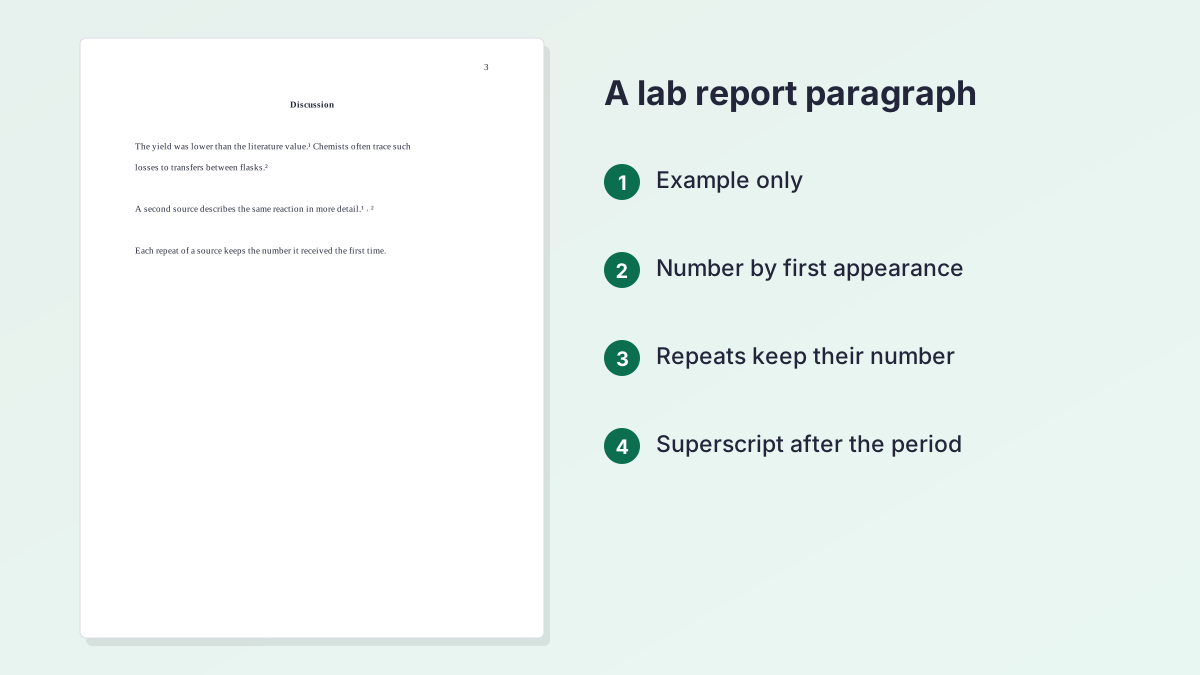
- Number by first citation. Give each source a number the first time you cite it, and reuse that number every time the source returns.
- Build the entry. List authors as surname and initials separated by semicolons, then add the title, source details, year, and DOI or URL for the source type.
- Style the details. Abbreviate and italicize the journal, bold the year, italicize the volume, and keep one consistent style for titles.
- Format the list. Finish the ACS reference format by heading the page References, putting the number and a period before each entry, and keeping every line flush left.
ACS Style of Referencing: What It Is and Who Uses It
The ACS style of referencing is how the American Chemical Society asks authors to cite sources in its journals. Chemistry and related science courses borrow it for lab reports, research papers and posters, so you will see ACS reference format, ACS citation style or just "ACS" on assignment sheets.
It is a numbered system by default. You number sources in the order you cite them, point to them from the sentence, and list them at the end. Two alternatives exist, italic numbers in parentheses and an author-date version, covered below.
The ACS reference format in three parts
Three parts matter: a short pointer in the text, a reference list that holds the full details, and a pattern for each kind of source. Paste a source into the citation tool above to see the numbered entry and its in-text number together. For a longer paper, the ACS citation generator formats the whole list. For another numbered style, see Vancouver referencing examples.
ACS Style Guide or ACS Guide to Scholarly Communication?
Both names appear in syllabi, which causes real confusion. The short version: The ACS Style Guide is the older name, and The ACS Guide to Scholarly Communication is the current one.
What the ACS says about the new name
In an April 2019 post, ACS Axial announced that the ACS Style Guide would be rebranded as The ACS Guide to Scholarly Communication, scheduled for release in 2020. The post said the third edition had appeared almost 13 years earlier. The University of British Columbia's ACS quick guide lists the 2020 book by Banik, Baysinger, Kamat and Pienta, and contrasts it with the earlier ACS Style Guide from 2006.
Why the old ACS style guide name persists
Many library pages still say ACS Style Guide. The University of California, Berkeley's guide, for example, bases its examples on the third edition of the ACS Style Guide and on the quick guide in the newer book. When two sources disagree, follow your instructor.
The April 2025 revision
The University of California, San Diego's ACS page records a revised references chapter released on April 8, 2025. It says journal titles need not be abbreviated if the list is consistent, DOIs may be formatted as URLs, titles may keep their original capitalization, and online resources no longer need access dates by default. Many older guides still teach the abbreviated, dated forms.
Three In-Text Options for Citing Sources in ACS Format
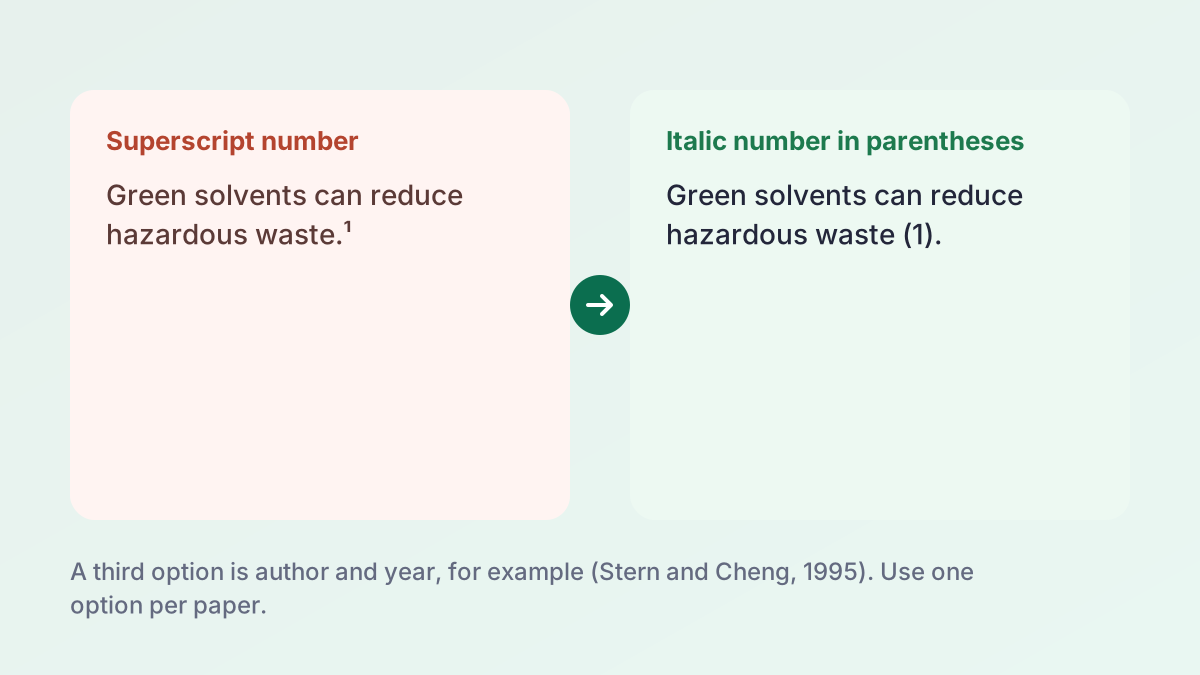
The ACS guide allows three ways to point to a reference inside a sentence. Cal Poly Humboldt's guide lists them as superscript numbers, italic numbers in parentheses, and author name with year. The University of Wisconsin-Madison guide gives the same three. Choose one and keep it throughout.
Superscript numbers
The superscript number goes at the end of the sentence or clause that uses the source. When the citation applies to a whole sentence, the University of Northern British Columbia's guide puts it outside the period, as in "The synthesis was reported previously.³" The University of British Columbia's guide says superscripts are preferred.
Italic numbers in parentheses
An italic number in parentheses, such as (3), does the same job. The same UNBC guide places it inside the punctuation: "reported previously (3)." The University of South Carolina's guide shows (6) in italics.
Author and year
Author-date uses the surname and year, for example (Stern and Cheng, 1995). Two authors are joined with "and," and three or more become the first author plus "et al.," such as (Finnegan et al., 2004). In this version the reference list is alphabetical instead of numbered, according to the Wisconsin guide.
Several sources at once in ACS format
When you cite several numbered references together, list the numbers in increasing order separated by commas. A repeated reference keeps its original number. Our guide to citing two authors in APA shows how author-date works in another style.
ACS Reference Format for a Journal Article, Piece by Piece
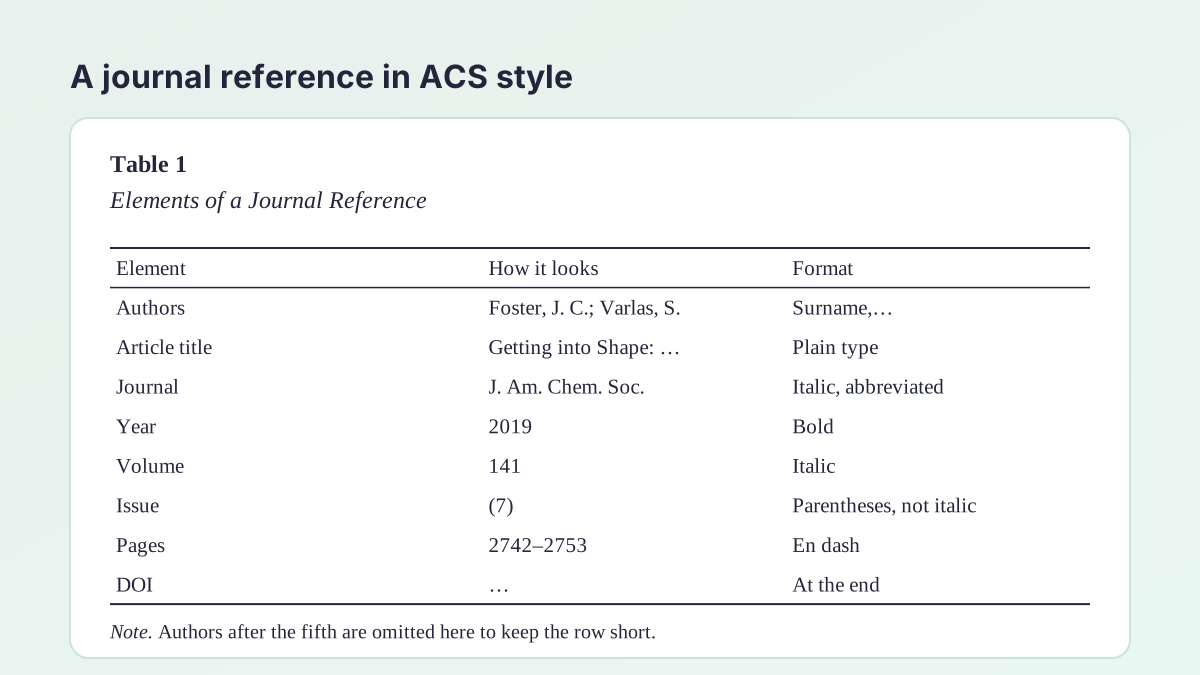
Journal articles are a common source in lab reports, so learn the ACS reference format for them first. Washington University in St. Louis lists authors by last name, then first and middle initials, in the order of the byline. The journal title is italic, the year is bold and the volume is italic. The issue goes in parentheses without italics.
| Element | Rule | Example |
|---|---|---|
| Authors | Surname, initials; semicolon between authors | Foster, J. C.; Varlas, S. |
| Journal | Abbreviated and italic | J. Am. Chem. Soc. |
| Year | Bold, after the journal | 2019 |
| Volume | Italic | 141 |
| Issue | In parentheses, not italic | (7) |
| Pages | Range with an en dash | 2742–2753 |
Minimum elements
The Wisconsin guide gives the minimum for a journal: author, abbreviated journal title, year and DOI. Add the title, volume, issue and pages when you have them.
Abbreviating journals in ACS reference format
Several guides, including Wisconsin's and Humboldt's, say to find standard abbreviations in CASSI, the Chemical Abstracts Service Source Index. For the Journal of the American Chemical Society, the abbreviation is J. Am. Chem. Soc., the form used in the ACS's own Quick Guide. Since the 2025 revision, full journal titles are acceptable, but the list must stay consistent, so don't abbreviate one journal and spell out the next.
Article numbers
Some online journals use article numbers instead of pages. British Columbia's guide says to list them the same way.
Books, Chapters, Websites, Theses and Patents
Other source types follow the same logic: authors, title, source details, then the year.
Books and chapters
A book entry gives authors, italic title, publisher and year. The UNBC guide says the place of publication is needed only for smaller or specialized publishers. For a chapter, "In" signals that the authors wrote only part of the book, as the Wisconsin guide explains, and the editor's name is followed by "Ed."
Websites
A website entry needs the page title and URL, plus the author when one is listed. Wisconsin's example ends with (accessed 2020-05-21). Berkeley's guide italicizes the website title, so check whether your instructor's guide does. Access dates are optional by default since the 2025 revision.
Theses and patents
A thesis names the degree, institution, location and year. A patent lists the inventors, title, country code and number, and year, as in "US 5380946, 1995."
Datasets and databases
The UNBC guide says there is no fixed format for datasets and chemical data, and tells students to "cite what you read." Data from a handbook is cited as a book, and data from a journal article as the article.
DOIs, URLs and Access Dates in ACS Format
In ACS reference format, a DOI is a persistent identifier for one online resource, while a URL is a web address that can change, as the University of British Columbia's guide defines them. Where a source has a DOI, use it.
How to write a DOI
Older guides use the label form, "DOI: 10.1021/jacs.8b08648." The UC San Diego page says that since 2025 a DOI may be written as a URL, and our engine prints https://doi.org/10.1021/jacs.8b08648. Follow your instructor.
Subscription databases
British Columbia's guide says aggregator databases such as Web of Science or ProQuest must be noted in the reference, while publisher databases such as ScienceDirect need no note.
When to add an access date
Under the older rules every online source got an access date. The 2025 revision says online resources no longer need one by default, though a date helps when a page may change or vanish without an archive. If a guide asks for one, write it as (accessed 2020-05-21), as the Wisconsin guide does.
How to Number and Format the Reference List
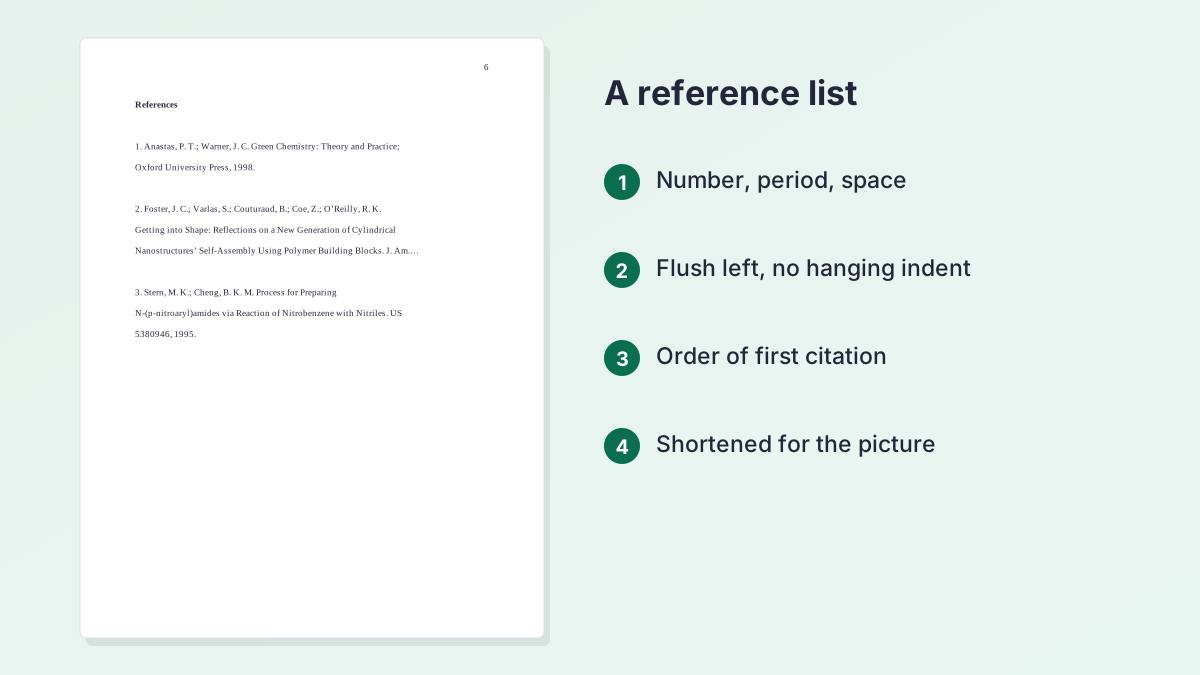
The ACS style guide's list rules, as the University of British Columbia's quick guide spells them out, are short. Title the page "References," bold and left-justified. List every source cited in the text. In the numbered system, put each entry in the order the source first appears, and write the number, a period, a space, then the citation.
Flush left, no hanging indent
The same guide says to keep all lines flush left with no hanging indent, unlike the MLA works cited page or APA format.
Author-date lists
With author-date pointers, the Wisconsin guide says the list is alphabetical, not numbered.
A Full ACS Citation Format Example for a Lab Report
This reference list belongs to an invented green-chemistry lab report. The report is made up, but every source is real, and the entries carry the hand edits listed above. Sources are numbered in the order the report cites them.
-
Anastas, P. T.; Warner, J. C. Green Chemistry: Theory and Practice; Oxford University Press, 1998.
-
Foster, J. C.; Varlas, S.; Couturaud, B.; Coe, Z.; O’Reilly, R. K. Getting into Shape: Reflections on a New Generation of Cylindrical Nanostructures’ Self-Assembly Using Polymer Building Blocks. J. Am. Chem. Soc. 2019, 141 (7), 2742–2753. https://doi.org/10.1021/jacs.8b08648
-
Linstrom, P. J.; Mallard, W. G. NIST Chemistry WebBook, NIST Standard Reference Database Number 69. https://doi.org/10.18434/T4D303
-
Freudenrich, C. How Lead Works. http://science.howstuffworks.com/lead.htm (accessed 2020-05-21).
-
Enander, R. T. Lead Particulate and Methylene Chloride Risks in Automotive Refinishing. Ph.D. Thesis, Tufts University, Medford, MA, 2001.
How the report would cite them
In the text, the first sentence that uses the Anastas and Warner book carries a 1, the sentence using the Foster article carries a 2, and so on. If the report cites the book again in the conclusion, it uses 1 again. The NIST Chemistry WebBook names its editors and its DOI, which is how entry 3 was built.
Common ACS Reference Format Mistakes
Most lost points in references in ACS format come from small details in a long list. Check yours against this table.
| Mistake | Fix |
|---|---|
| Numbering alphabetically | Number in order of first citation |
| Hanging indent on the list | Keep every line flush left |
| Year not bold, volume not italic | Bold the year; italicize journal and volume |
| Commas between authors | Separate authors with semicolons |
| Mixing numbers and author-date | Pick one in-text option |
| Abbreviating some journals only | Abbreviate all or none |
| New number for a repeat source | Reuse the first number |
Check the version your instructor uses
The biggest source of confusion is the edition. A course built on the older ACS style guide may expect abbreviated journals and access dates, while the 2025 revision relaxes both. If the syllabus doesn't say, ask which one to follow, then apply it everywhere. Engineers can compare IEEE reference format.
Finish with the tool
The free ACS citation generator formats each entry and its number, and every other style is on our student writing guides page. For biology courses, the CSE citation generator does the same for CSE.
ACS Reference Format FAQ
What is ACS reference format?
It is the American Chemical Society's citation style: a numbered list with authors as surname and initials, an italic journal, a bold year, an italic volume and pages.
What is the ACS style of referencing?
A numbered system by default, where a superscript or italic number points to a list ordered by first citation. Author-date is also allowed.
How do you write references in ACS format?
List authors as surname and initials with semicolons, add the title, then the italic journal, bold year, italic volume, pages and DOI.
Is the ACS style guide the same as the ACS Guide to Scholarly Communication?
The Guide to Scholarly Communication replaced the ACS Style Guide in 2020, though some pages still use the older name.
Do you need to abbreviate journal names in ACS format?
The 2025 revision says abbreviation is optional if the list is consistent. Older guides require CASSI abbreviations, so follow your instructor.
Do references in ACS format use a hanging indent?
No. The University of British Columbia's guide says to keep all lines flush left with no hanging indent.
How do you cite a website in the ACS style of referencing?
Give the author if listed, the page title and the URL. An access date is optional by default under the 2025 revision but useful for pages that change.
Should an ACS reference format list be numbered or alphabetical?
In ACS reference format the list is numbered by first citation for superscript or italic numbers, and alphabetical for author-date.
More free guides
- MLA In-Text CitationsAuthor-page citations for every kind of source, with examples.
- How to Cite a Website in MLAWorks Cited entries and in-text citations for web pages.
- MLA Works Cited PageFormat, order and hanging indents, with a full example page.
- MLA Annotated BibliographyFormat, annotation types and a complete example.
- APA Table FormatNumber, title, body and notes for APA 7 tables, with templates.
- MLA HeadingThe four-line first-page heading and the page header, with Word and Google Docs steps.
See all 80 free tools for students
Related tools
Last updated by The Study Corp editorial team.