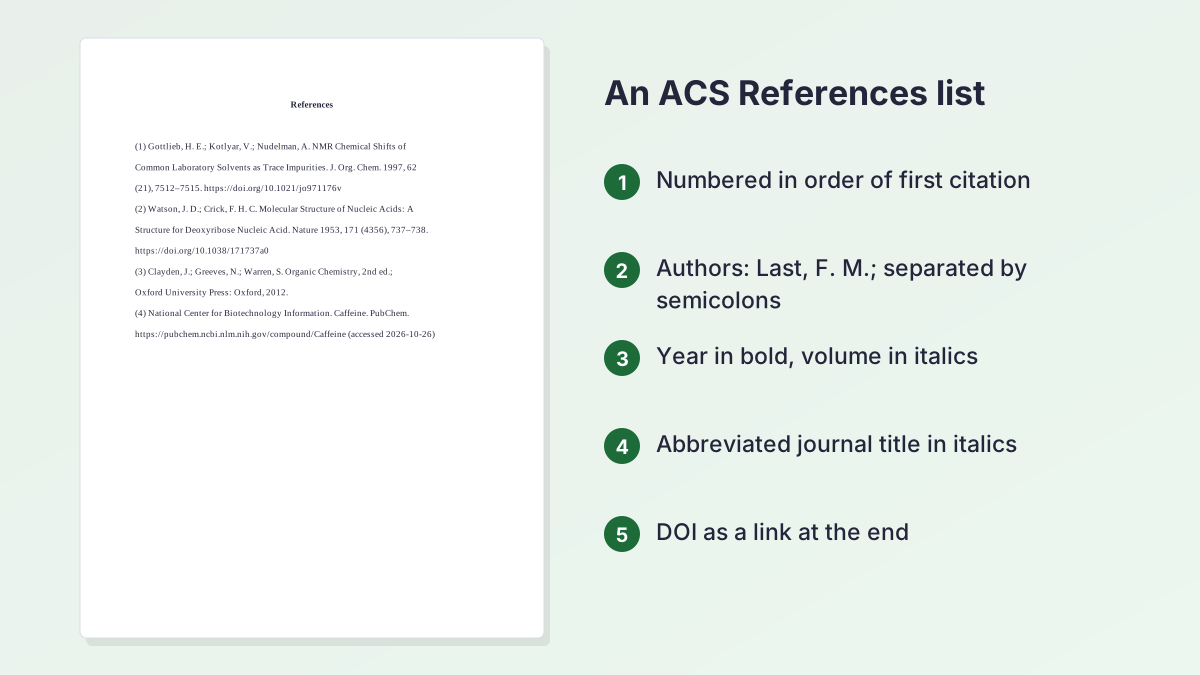
ACS citation examples for six real sources
Each reference below is the ACS citation generator's own output for a real source chemistry students cite, numbered as one list. In Word, titles and volumes are italic and the year is bold.
Source detailsHugo E. Gottlieb, Vadim Kotlyar and Abraham Nudelman, "NMR Chemical Shifts of Common Laboratory Solvents as Trace Impurities," The Journal of Organic Chemistry, vol. 62, no. 21, pp. 7512–7515, 1997; DOI 10.1021/jo971176v
ACS reference(1) Gottlieb, H. E.; Kotlyar, V.; Nudelman, A. NMR Chemical Shifts of Common Laboratory Solvents as Trace Impurities. J. Org. Chem. 1997, 62 (21), 7512–7515. https://doi.org/10.1021/jo971176v
The DOI lookup fills in The Journal of Organic Chemistry. Replace it with the CASSI abbreviation J. Org. Chem. in Edit details. In the text: superscript 1.
Source detailsJ. D. Watson and F. H. C. Crick, "Molecular Structure of Nucleic Acids," Nature, vol. 171, no. 4356, pp. 737–738, April 25, 1953; DOI 10.1038/171737a0
ACS reference(2) Watson, J. D.; Crick, F. H. C. Molecular Structure of Nucleic Acids: A Structure for Deoxyribose Nucleic Acid. Nature 1953, 171 (4356), 737–738. https://doi.org/10.1038/171737a0
One-word titles such as Nature and Science are not abbreviated. This is the source loaded by Try it with an example.
Source detailsMartin Jinek, Krzysztof Chylinski, Ines Fonfara, Michael Hauer, Jennifer A. Doudna and Emmanuelle Charpentier, Science, vol. 337, no. 6096, pp. 816–821, 2012; DOI 10.1126/science.1225829
ACS reference(3) Jinek, M.; Chylinski, K.; Fonfara, I.; Hauer, M.; Doudna, J. A.; Charpentier, E. A Programmable Dual-RNA–Guided DNA Endonuclease in Adaptive Bacterial Immunity. Science 2012, 337 (6096), 816–821. https://doi.org/10.1126/science.1225829
Every author is listed, surname first, with semicolons between them. Titles are put in title case for you.
Source detailsJonathan Clayden, Nick Greeves and Stuart Warren, Organic Chemistry, 2nd edition, Oxford University Press, Oxford, 2012
ACS reference(4) Clayden, J.; Greeves, N.; Warren, S. Organic Chemistry, 2nd ed.; Oxford University Press: Oxford, 2012.
Type 2 in the Edition box and the city in City of publication. ACS puts a colon between publisher and city.
Source detailsAuthor (organization): National Center for Biotechnology Information; page "Caffeine"; site PubChem; accessed October 26, 2026
ACS reference(5) National Center for Biotechnology Information. Caffeine. PubChem. https://pubchem.ncbi.nlm.nih.gov/compound/Caffeine (accessed 2026-10-26)
Choose Website. Today's date is filled in as the access date.
Source detailsAuthor (organization): National Institute of Standards and Technology; page "NIST Chemistry WebBook, SRD 69"; site NIST; accessed October 26, 2026
ACS reference(6) National Institute of Standards and Technology. NIST Chemistry WebBook, SRD 69. NIST. https://webbook.nist.gov/chemistry/ (accessed 2026-10-26)
Useful for melting points and IR spectra.
How to use the ACS citation generator
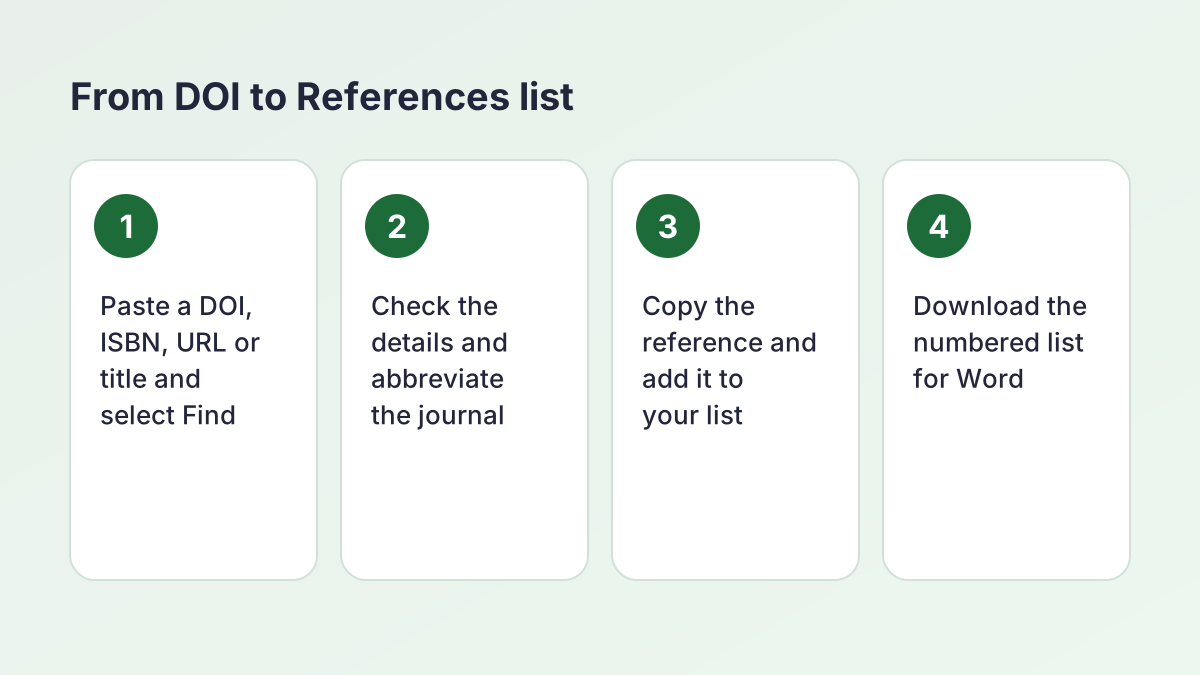
Five steps in the ACS citation maker, from a DOI or link to a finished References list.
- Paste your source or pick a type. Paste a URL, DOI, ISBN or article title into Find your source and select Find. Or choose Website, Journal or Book under Enter manually, with Newspaper, Magazine, Report, Thesis, Book chapter and Film or video under More.
- Pick the right match. A title search can return several records. Choose the one you actually read.
- Check the details. Fix any highlighted field. Replace a full journal name with its CASSI abbreviation, and for books type the edition and city of publication.
- Copy or add to your list. Copy the Reference or the In-text citation, then select Add to reference list. Add sources in the order you first cite them, because ACS numbers follow that order.
- Download your References list. Open My reference list and select Download for Word, or Copy all. More formats gives plain text, RIS for Zotero, Mendeley and EndNote, and BibTeX for LaTeX and Overleaf.
How the ACS citation generator finds your source
Paste one thing into the search box and the ACS citation generator works out what it is before looking it up. The hint under the box says DOI detected, ISBN detected, Web address detected, or We'll search by title.
ACS citation machine lookups: DOIs, ISBNs, links and titles
- A DOI (it starts with 10.) is looked up at doi.org, with Crossref as a backup. It is the best route for chemistry articles; the DOI is on the first page of the paper.
- An ISBN is looked up in Open Library, then Google Books. These lookups don't fill in the city of publication, so type it.
- A web address is read for the page's own title, author, date and site name. If the page carries a DOI, the DOI record is used instead.
- A title is searched in Crossref and Open Library, and up to eight matches come back, closest first.
Every result says how sure it is
The ACS citation machine never invents a missing detail. A result is marked Source details matched, Details need review or Entered by you, and missing fields are highlighted.
Select Try it with an example to load Watson and Crick's 1953 Nature paper on the structure of DNA.
ACS reference format: the parts of a journal reference
An ACS journal reference packs a lot into one line. Each part below comes from the Gottlieb, Kotlyar and Nudelman reference the ACS citation generator produced, the solvent-impurity table organic chemistry students use to read NMR spectra.
| Part | ACS rule | From the generator |
|---|---|---|
| Number | In parentheses, in the order the source is first cited | (1) |
| Authors | Last name, initials; every author, separated by semicolons | Gottlieb, H. E.; Kotlyar, V.; Nudelman, A. |
| Article title | Title case, no quotation marks, ending with a period | NMR Chemical Shifts of Common Laboratory Solvents as Trace Impurities. |
| Journal | CASSI abbreviation in italics | J. Org. Chem. |
| Year | Bold, followed by a comma | 1997, |
| Volume and issue | Volume in italics, issue in parentheses | 62 (21), |
| Pages | Full page range with an en dash | 7512–7515. |
| DOI | At the end, as a link | https://doi.org/10.1021/jo971176v |
ACS citation format for books and edited books
Book titles are italicized and followed by the edition, then a semicolon, the publisher, a colon, the city and the year: Clayden, J.; Greeves, N.; Warren, S. Organic Chemistry, 2nd ed.; Oxford University Press: Oxford, 2012. For a chapter in an edited book, choose Book chapter and add the editors, book title and chapter pages.
The ACS reference page in a lab report
The list goes at the end under the heading References. Unlike APA or MLA, it is not alphabetical: entries are numbered (1), (2), (3) in the order you first cite them. The Word file from the ACS citation generator uses 1.15 line spacing.
ACS in-text citation: superscript numbers
The ACS Guide allows three ways to cite in the text: superscript numbers, italic numbers in parentheses, or the author's name and the year. As the West Virginia University Libraries guide to ACS in-text citations puts it, all three are acceptable as long as you pick one and use it throughout. The ACS citation generator gives you superscript numbers.
How the ACS in-text citation numbers work
- Placement: the superscript goes right after the fact or the source name, and outside a period or comma, like this: the residual CHCl₃ peak appears at 7.26 ppm.¹
- The same source again: reuse its first number. Source 1 is always 1.
- Several sources at once: separate the numbers with commas, such as ¹,³, or use a dash for a run, such as ²⁻⁵.
- Which number to use: the In-text tab previews one source at a time, so it always shows 1. Use the number beside the entry in My reference list, which follows the order you added your sources.
Italic numbers and author-date: when to change it by hand
If your instructor wants italic numbers in parentheses, such as (1), type them yourself; the numbered list stays the same. Author-date citations, such as (Gottlieb et al., 1997), go with an alphabetical list, which the ACS citation generator doesn't produce.
ACS citation maker for every source type
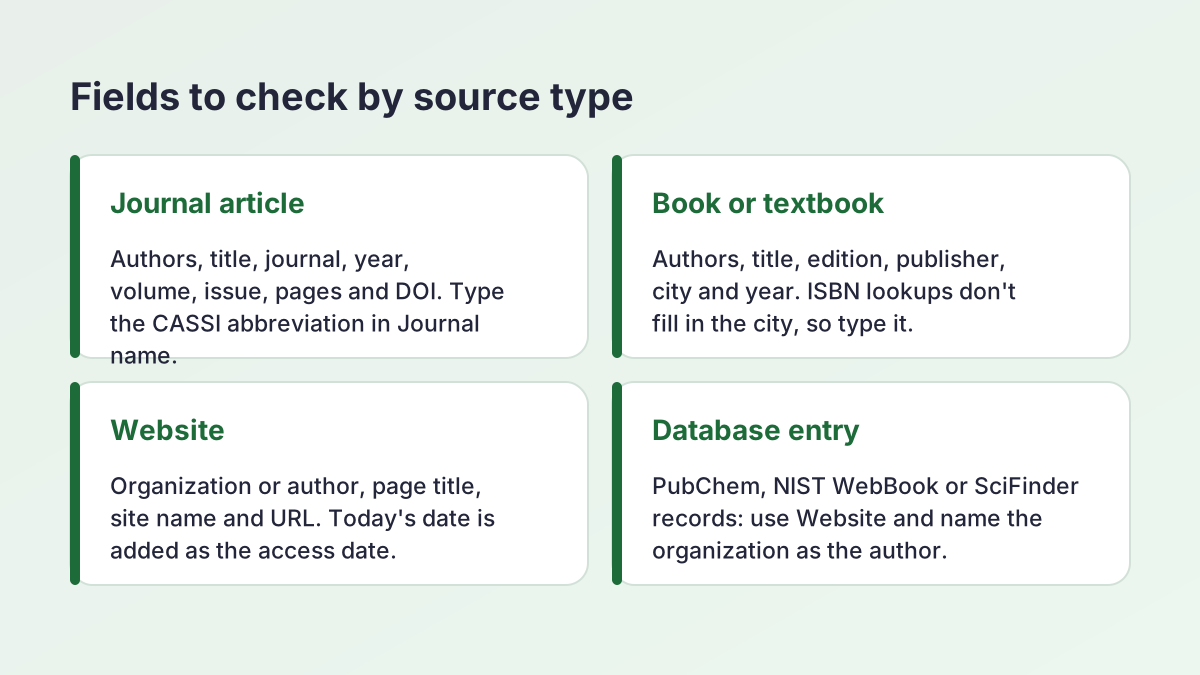
Each source type has its own form in the ACS citation maker, with only the fields that type needs. Here is what to watch for in each.
American Chemical Society journal abbreviations
ACS references abbreviate journal titles of more than one word, following the Chemical Abstracts Service Source Index (CASSI). DOI lookups usually return the full title, such as The Journal of Organic Chemistry, and the generator prints whatever is in the Journal name box. Type the abbreviation there: J. Org. Chem., J. Am. Chem. Soc., J. Chem. Educ. or Org. Lett. One-word titles such as Nature, Science and Biochemistry stay as they are.
Books and textbooks
Paste the ISBN, then check the authors, year, publisher and edition, and type the city. Enter a department lab manual the same way, with the college as publisher.
ACS citation for a website
Choose Website, or paste the link. The generator prints the author or organization, the page title in italics, the site name, the URL and an access date in the form (accessed 2026-10-26). The access date is filled in with today's date, so change it if you used the page on an earlier day. With no named author, the page title comes first.
Databases, safety data sheets and reports
For PubChem, the NIST Chemistry WebBook or a supplier's safety data sheet, use Website in the ACS citation maker and put the organization in the Author field. For a government report, choose Report under More.
ACS lab report format: where citations go
The ACS citation generator formats references and in-text citations only. It doesn't lay out your report, so the points below are guidance; your lab manual comes first.
Sections of a typical chemistry lab report
Many US chemistry courses follow the shape of a journal article: title, abstract, introduction, experimental, results and discussion, conclusion and references. Citations cluster in the introduction and in the discussion, where you compare your melting point, yield or spectrum with literature values. A literature value such as a 122 °C melting point needs a superscript number pointing to the handbook, database or paper it came from.
Abstract, title and length
The Abstract Generator can help draft the summary, and the Research Paper Title Generator can suggest a title. If your instructor wants an APA-style cover page, the APA Title Page Generator lays one out. The Word Counter can leave the References list out of a count.
American Chemical Society citation generator and the ACS Guide
The American Chemical Society's rules for writing and citing now live in The ACS Guide to Scholarly Communication, an online guide that ACS published in 2020 and keeps updating. It replaced the print ACS Style Guide edited by Anne M. Coghill and Lorrin R. Garson (2006). Many university libraries summarize it for students; the University of South Carolina Libraries ACS guide is a good free one with examples.
What this American Chemical Society citation generator uses
References are formatted with the Citation Style Language project's American Chemical Society style file, whose current version is titled "ACS Guide 2026 revision". It produces numbered references with surnames first, semicolons between authors, title-case article titles, a bold year, an italic volume and a DOI link.
Who uses ACS citation style in the US
ACS is the standard for chemistry and biochemistry, from first-year labs to senior theses. Biology departments more often use CSE, and engineering departments IEEE. If you need one of those, the CSE Citation Generator and the IEEE Citation Generator work the same way.
ACS reference generator: saved lists and export
Every source you add goes into a saved list, and the ACS reference generator numbers that list in the order you add sources.
Keep the numbers in citation order
Add each source to the ACS reference generator when you first cite it. If you later cite a new source earlier in the text, remove the sources that should follow it and add them again, or renumber by hand. Each list holds up to 300 sources, and the tool tells you if a source is already on the list.
Saved lists in your browser
Keep a list per assignment, such as "CHEM 2210 Lab 4 Grignard". Lists are saved in your browser's local storage on this device. They don't follow you to another computer, and clearing browser data deletes them.
ACS bibliography generator downloads
- Download for Word gives a .docx file headed References, in Times New Roman 12 pt with 1.15 line spacing and a hanging indent, with each entry keeping its (1), (2) number.
- Copy all copies the whole list, with italics and bold, ready for Word or Google Docs.
- More formats gives plain text, RIS (Zotero, Mendeley, EndNote) and BibTeX (LaTeX, Overleaf).
ACS format citation generator vs IEEE, CSE and AMA
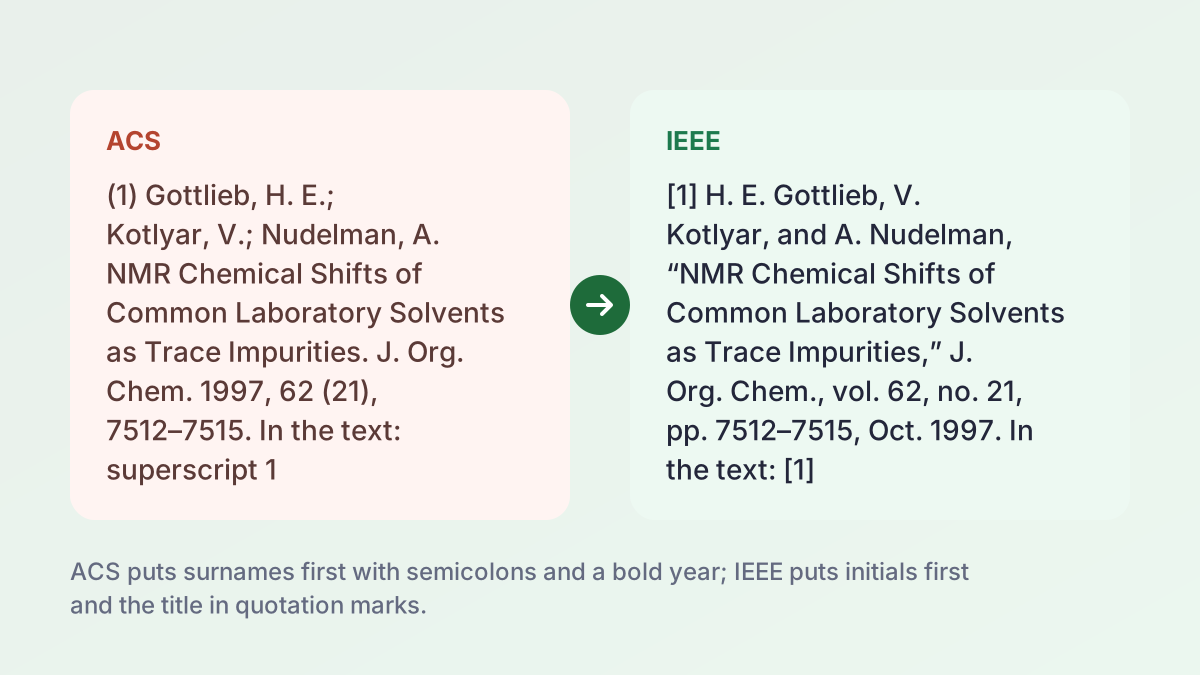
Here is the same 1997 article in four numbered styles, all from this site's generators. For CSE and AMA the title was retyped in sentence case and the journal abbreviated without periods, as those styles require.
| Style | Reference | In the text |
|---|---|---|
| ACS | (1) Gottlieb, H. E.; Kotlyar, V.; Nudelman, A. NMR Chemical Shifts of Common Laboratory Solvents as Trace Impurities. J. Org. Chem. 1997, 62 (21), 7512–7515. | Superscript 1 |
| IEEE | [1] H. E. Gottlieb, V. Kotlyar, and A. Nudelman, “NMR Chemical Shifts of Common Laboratory Solvents as Trace Impurities,” J. Org. Chem., vol. 62, no. 21, pp. 7512–7515, Oct. 1997. | [1] |
| CSE 9th (citation-sequence) | 1. Gottlieb HE, Kotlyar V, Nudelman A. NMR chemical shifts of common laboratory solvents as trace impurities. J Org Chem. 1997;62(21):7512–7515. | Superscript 1 |
| AMA 11th | 1. Gottlieb HE, Kotlyar V, Nudelman A. NMR chemical shifts of common laboratory solvents as trace impurities. J Org Chem. 1997;62(21):7512-7515. | Superscript 1 |
Only ACS uses semicolons between authors and a bold year. For medicine and nursing, see the AMA Citation Generator; for social science, the ASA Citation Generator or the APA Citation Machine. Every style is on the citation machines page.
Common ACS citation mistakes and how to fix them
Here is how to cite ACS format correctly when you check your list.
| Mistake | Fix |
|---|---|
| An alphabetical reference list | Number the list in the order you first cite each source. |
| A new number every time a source is cited | Reuse the source's first number. |
| The full journal name: The Journal of Organic Chemistry | Use the CASSI abbreviation in italics: J. Org. Chem. |
| Using "and" or "&" between authors | Separate every author with a semicolon: Gottlieb, H. E.; Kotlyar, V.; Nudelman, A. |
| Superscript inside the period: …7.26 ppm¹. | Put it outside: …7.26 ppm.¹ |
| Copying the In-text tab's 1 for every source | Use each source's number from My reference list. |
A free ACS citation generator: what is sent and what stays private
The ACS citation generator is free, with no account and a fair-use cap of 60 lookups every 10 minutes. Here is where your information goes.
- Lookups: what you type in the search box goes to our server, which asks doi.org, then Crossref, for DOIs; Open Library, then Google Books, for ISBNs; Crossref and Open Library for titles; or the public page you linked, for URLs. Results stay in the server's memory for up to six hours to speed up repeat lookups.
- Formatting: source details are sent to our server, formatted, and sent back. They are not stored.
- Your lists: saved lists are stored only in your browser's local storage. Each time a list is formatted, its sources' details are sent to our server, formatted, sent straight back, and not stored or linked to an account.
Built on citeproc-js and the CSL ACS style
References in this ACS citation generator are formatted by citeproc-js, the open-source citation processor used by Zotero and Mendeley, with the Citation Style Language project's American Chemical Society style file. That file is maintained by Zotero and CSL volunteers; it is not published by the American Chemical Society. The same engine powers the Vancouver Citation Generator and the Harvard Referencing Generator. To sort any pasted list by hand, use the Alphabetizer.
ACS citation generator FAQ
Is this ACS citation generator free?
Yes. It is free with no account and no sign-up, within a fair-use limit of 60 lookups every 10 minutes.
What version of ACS style does it follow?
The online ACS Guide to Scholarly Communication, through the CSL project's American Chemical Society style file (its "ACS Guide 2026 revision").
How do you do an ACS in-text citation?
Put a superscript number after the fact or source, outside the period or comma. Number sources in the order you first cite them and reuse a source's number when you cite it again.
How do you cite a website in ACS format?
Give the author or organization, the page title in italics, the site name, the URL and the date you accessed it, such as (accessed 2026-10-26). The generator fills in today's date as the access date.
Does ACS abbreviate journal names?
Yes. Journal titles of more than one word use CASSI abbreviations, such as J. Am. Chem. Soc. DOI lookups usually give the full name, so type the abbreviation in the Journal name box.
Is the ACS reference list alphabetical?
No. It is numbered (1), (2), (3) in the order the sources are first cited in your text.
Can it make italic or author-date ACS citations?
No. The ACS citation generator gives superscript numbers. If your instructor wants italic numbers in parentheses, type them yourself.
Where are my saved sources stored?
In your browser's local storage on this device. When a list is formatted, its sources' details are sent to our server, formatted and sent back, never stored. Download your list before clearing browser data.
More free citation generators
- MLA Citation MakerMLA 9 works cited entries from a URL, DOI, ISBN or title.
- APA Citation MachineAPA 7 references and in-text citations, exported to Word.
- Chicago Citation GeneratorChicago 18th edition notes, bibliography and author-date citations.
- Chicago Footnote GeneratorFirst notes, shortened notes and the bibliography entry for each source.
- Turabian Citation MachineTurabian 9 footnotes, bibliography and author-date references.
- IEEE Citation GeneratorNumbered [1] IEEE references for engineering and computer science.
- Harvard Referencing GeneratorHarvard (Cite Them Right) references and (Author, Year) citations.
- ASA Citation GeneratorASA 7th edition references and (Author Year) citations for sociology.
- CSE Citation GeneratorCSE 9th edition citation-sequence, name-year and citation-name references.
- AMA Citation GeneratorAMA 11th edition references with superscript numbers for medicine and nursing.
- Vancouver Citation GeneratorNumbered Vancouver (NLM) references for medicine and nursing.
See all 80 free tools for students
Free guides
Related tools
Last updated by The Study Corp editorial team.