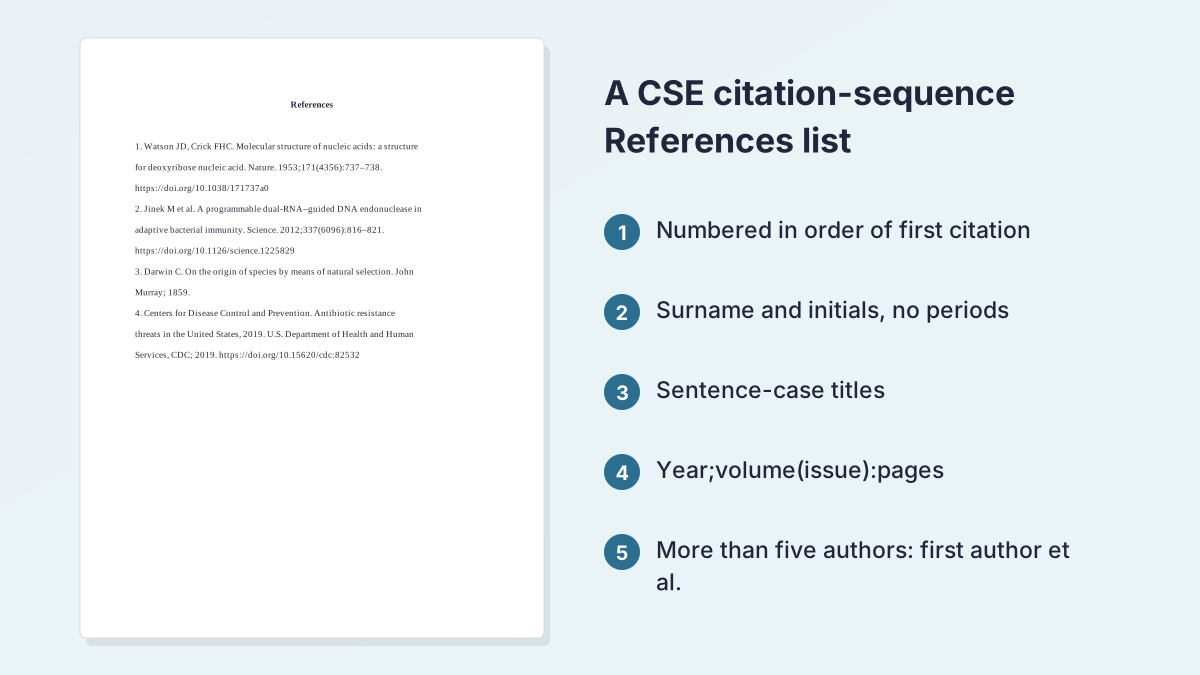
CSE citation examples for six real sources
Each entry below is the CSE citation generator's own output for a real source of the kind biology students cite. The first five are one citation-sequence list; the last shows a source in name-year.
Source detailsJ. D. Watson and F. H. C. Crick, "Molecular Structure of Nucleic Acids," Nature, vol. 171, no. 4356, pp. 737–738, April 25, 1953; DOI 10.1038/171737a0
CSE 9th edition entry1. Watson JD, Crick FHC. Molecular structure of nucleic acids: a structure for deoxyribose nucleic acid. Nature. 1953;171(4356):737–738. https://doi.org/10.1038/171737a0
The DOI lookup returns the title in title case. Retype it in sentence case in Edit details, as here. This is the source loaded by Try it with an example.
Source detailsMartin Jinek, Krzysztof Chylinski, Ines Fonfara, Michael Hauer, Jennifer A. Doudna and Emmanuelle Charpentier, Science, vol. 337, no. 6096, pp. 816–821, 2012; DOI 10.1126/science.1225829
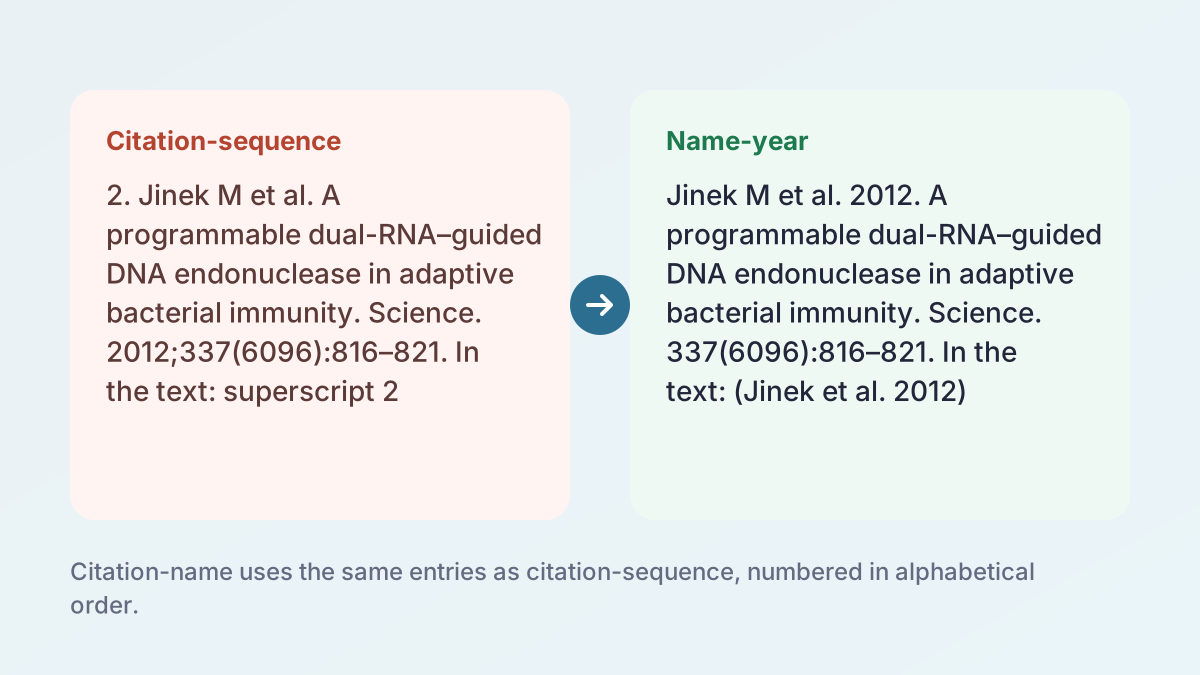
CSE 9th edition entry2. Jinek M et al. A programmable dual-RNA–guided DNA endonuclease in adaptive bacterial immunity. Science. 2012;337(6096):816–821. https://doi.org/10.1126/science.1225829
CSE 9th lists the first author and et al. when there are more than five authors. Retype the title in sentence case. In the text: superscript 2.
Source detailsCharles Darwin, On the Origin of Species by Means of Natural Selection, John Murray, London, 1859
CSE 9th edition entry3. Darwin C. On the origin of species by means of natural selection. John Murray; 1859.
CSE 9th gives the publisher and year with no city. Book titles are not italicized.
Source detailsCenters for Disease Control and Prevention, Antibiotic Resistance Threats in the United States, 2019, U.S. Department of Health and Human Services, CDC, November 2019; DOI 10.15620/cdc:82532
CSE 9th edition entry4. Centers for Disease Control and Prevention. Antibiotic resistance threats in the United States, 2019. U.S. Department of Health and Human Services, CDC; 2019. https://doi.org/10.15620/cdc:82532
Paste the DOI 10.15620/cdc:82532. It loads as a Report; check the author and publisher against the report's title page. Proper nouns such as United States keep their capitals.
Source detailsAuthor (organization): National Human Genome Research Institute; page "Talking Glossary of Genomic and Genetic Terms"; site Genome.gov; accessed October 26, 2026
CSE 9th edition entry5. National Human Genome Research Institute. Talking glossary of genomic and genetic terms. Genome.gov. [accessed 2026 Oct 26]. https://www.genome.gov/genetics-glossary
Citation-sequence and citation-name keep the page title. In name-year, check this kind of entry: see the web pages section below.
Source detailsSame Jinek et al. 2012 Science article, with the toggle set to Name-Year
CSE 9th edition entryJinek M et al. 2012. A programmable dual-RNA–guided DNA endonuclease in adaptive bacterial immunity. Science. 337(6096):816–821. https://doi.org/10.1126/science.1225829
No number; the year follows the authors. In the text: (Jinek et al. 2012), or Jinek et al. (2012) from the Narrative tab.
How to use the CSE citation generator
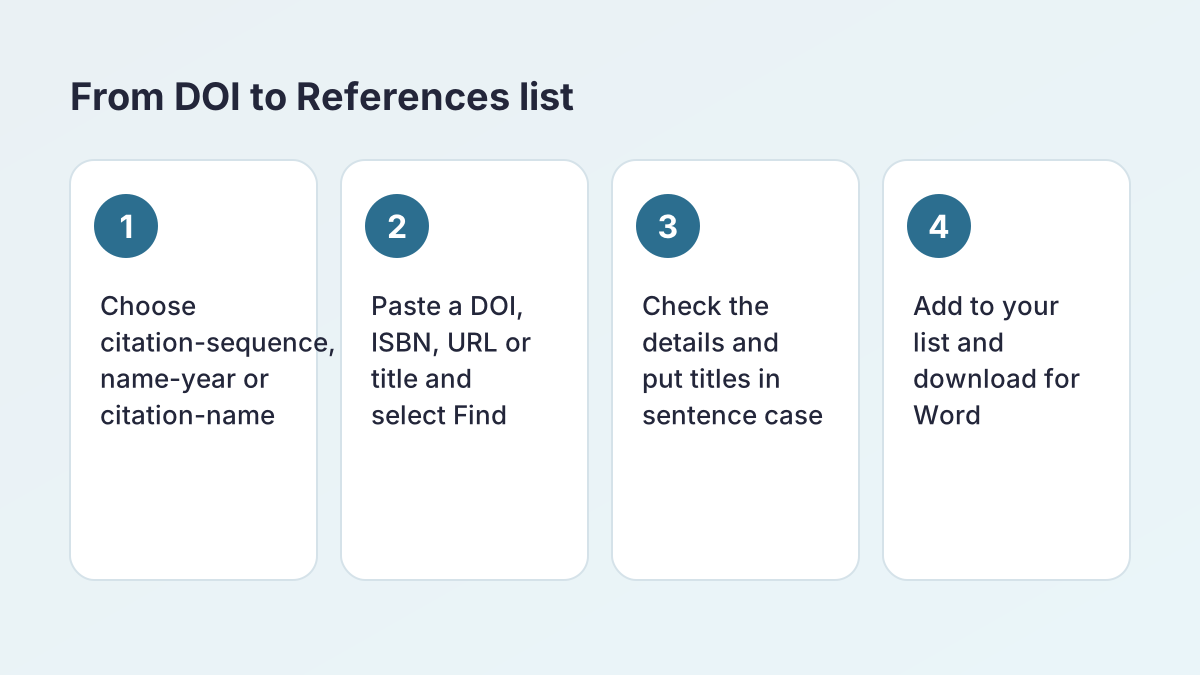
Five steps in the CSE citation maker, from choosing a system to a finished References list.
- Choose your CSE system. At the top of the tool, pick Citation-Sequence, Name-Year or Citation-Name. Citation-sequence is selected first. You can switch at any time and every entry is reformatted.
- Paste your source or pick a type. Paste a URL, DOI, ISBN or article title into Find your source and select Find. Or choose Website, Journal or Book under Enter manually, with Report, Thesis, Book chapter and more under More.
- Check the details. Fix any highlighted field. Retype article and book titles in sentence case, and abbreviate multi-word journal titles, such as J Biol Chem.
- Copy or add to your list. Copy the Reference or the In-text citation, then select Add to reference list. For citation-sequence, add sources in the order you first cite them.
- Download your References list. Open My reference list and select Download for Word, Copy all or More formats.
How the CSE citation generator finds your source
Paste one thing into the search box and the CSE citation generator works out what it is before looking it up.
CSE citation machine lookups: DOIs, ISBNs, links and titles
- A DOI (it starts with 10.) is looked up at doi.org, with Crossref as a backup. It is the best route for articles you found in PubMed, BIOSIS or a journal site; the DOI is on the first page of the paper.
- An ISBN is looked up in Open Library, then Google Books.
- A web address is read for the page's own title, author, date and site name. If the page carries a DOI, the DOI record is used instead.
- A title is searched in Crossref and Open Library, and up to eight matches come back, closest first.
Every result says how sure it is
The CSE citation machine never invents a missing detail. A result is marked Source details matched, Details need review or Entered by you, and missing fields are highlighted. Select Try it with an example to load Watson and Crick's 1953 Nature paper on DNA.
The three CSE systems and the system toggle
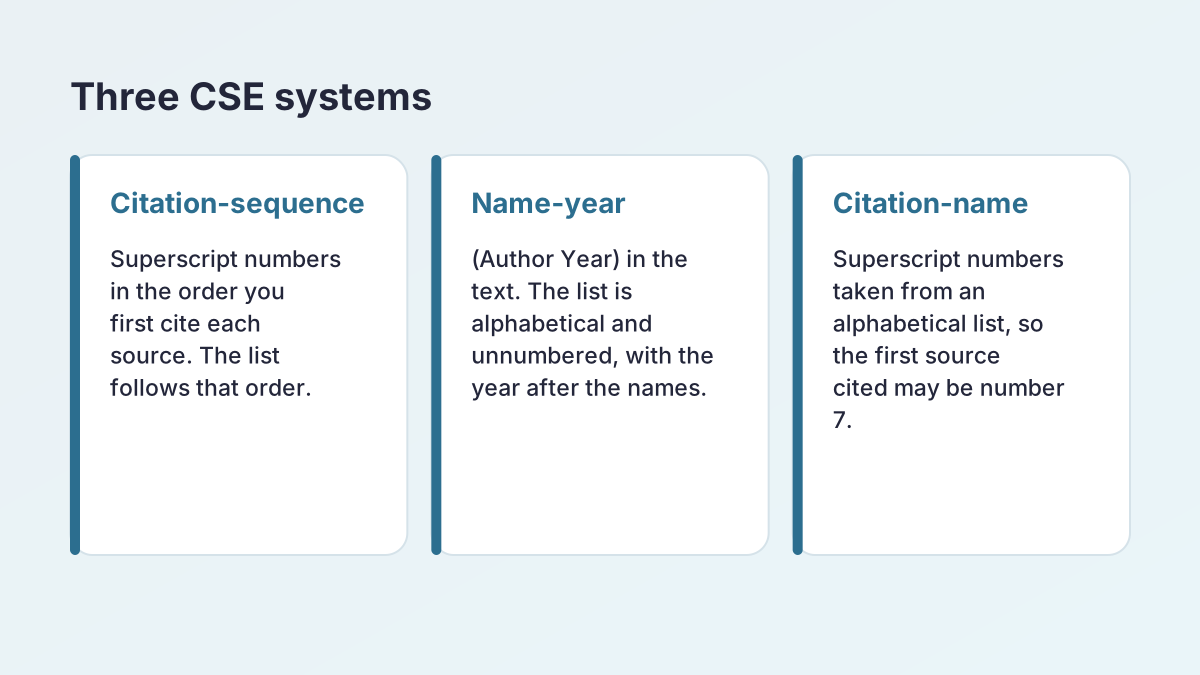
The CSE Manual gives three ways to cite, and they share one reference format with small changes. The CSE citation generator puts all three in a toggle above the search box. Pick one, and the preview, your saved list and the Word download all switch with it.
Citation-sequence
Sources get superscript numbers in the order you first cite them, and the References list follows that order. It is the system the CSE citation generator opens with.
Name-year
You cite the author and year in parentheses, such as (Darwin 1859), and the References list is alphabetical with no numbers. The year moves to just after the authors. Use it when your instructor wants readers to see who did the work without flipping to the list.
Citation-name
The list is alphabetical, as in name-year, but numbered, and the numbers in your text come from that alphabetical list. If Carson is first alphabetically, Carson is 1 wherever you cite it, even if Watson and Crick come first in your introduction. The CSE citation generator's note for this system says so.
Which CSE citation style should you choose?
Use whatever your syllabus or lab manual names. If it just says "CSE," ask; as the Duke University Libraries CSE guide explains, citation-sequence and citation-name are nearly identical apart from how the list is ordered, while name-year works differently.
CSE citation format: the parts of a reference
CSE references are compact: no periods in initials, no italics, and the date, volume, issue and pages run together. Each part below comes from the Watson and Crick reference the CSE citation generator produced in citation-sequence.
| Part | CSE 9th rule | From the generator |
|---|---|---|
| Number | Order of first citation (citation-sequence) | 1. |
| Authors | Surname, then initials with no periods or spaces; commas between authors | Watson JD, Crick FHC. |
| Article title | Sentence case, no quotation marks | Molecular structure of nucleic acids: a structure for deoxyribose nucleic acid. |
| Journal | Abbreviated, no periods, not italicized | Nature. |
| Date, volume, issue, pages | year;volume(issue):pages | 1953;171(4356):737–738. |
| DOI | At the end, as a link | https://doi.org/10.1038/171737a0 |
CSE style citation for books and reports
Books follow the same pattern with the publisher and year after the title: Darwin C. On the origin of species by means of natural selection. John Murray; 1859. Reports put the agency first and the issuing department as publisher. In name-year, the year moves up behind the authors: Darwin C. 1859. On the origin…
Citation in CSE format: the References list
The list goes at the end under the heading References. In citation-sequence it is in citation order; in name-year and citation-name it is alphabetical by first author. The Word file uses 1.15 line spacing.
CSE in-text citation in each system
Every CSE in-text citation points to one entry in your References list. Its form depends on the system in the toggle.
CSE in-text citation with numbers
In citation-sequence and citation-name, put a superscript number right after the fact or the author's name, such as "the double helix was proposed in 1953.¹" Reuse a source's number each time you cite it, and separate several numbers with commas, such as ¹,³. The In-text tab previews one source at a time, so it always shows 1; use the number beside the entry in My reference list.
CSE in-text citation in name-year
In name-year, the In-text tab gives (Watson and Crick 1953), and the Narrative tab gives Watson and Crick (1953) for when the names are part of your sentence. For three or more authors it shortens to the first author and et al., as in (Jinek et al. 2012). To cite two sources at once, join them with a semicolon yourself: (Darwin 1859; Carson 1962).
CSE style citation generator for every source type
Each source type has its own form in the CSE style citation generator, with only the fields that type needs. Here is what to check in each.
Journal articles and abbreviations
Paste the DOI. CSE abbreviates multi-word journal titles with no periods, such as J Biol Chem or Proc Natl Acad Sci U S A, while one-word titles such as Nature, Science and Genetics stay whole. The CSE citation generator prints whatever is in the Journal name box, so type the abbreviation there. The NLM Catalog lists standard abbreviations.
Sentence case for titles
CSE capitalizes only the first word and proper nouns in article and book titles. The CSE style citation generator prints titles exactly as you enter them, and database records often use title case, so retype them: Silent spring, not Silent Spring.
Books, chapters and reports
Paste the ISBN and check the authors, publisher and year. For a chapter, choose Book chapter. For CDC, NIH or USDA reports, choose Report under More.
CSE name-year citation generator: check organization web pages
In name-year only, a web page whose author is an organization can lose its page title. The CSE name-year citation generator then gives the organization, the site and the access date with no title. When you cite a page from NIH, the CDC or a museum in name-year, compare the entry with the page and type the title back in after you copy or download it. Citation-sequence and citation-name keep the title.
The CSE Manual, 9th edition: what this generator follows
The CSE Manual: Scientific Style and Format for Authors, Editors, and Publishers, 9th edition, was published in 2024 by the Council of Science Editors. It is a standard style guide in the life and natural sciences, and US biology departments use it for lab reports, research papers and theses.
What this CSE citation generator uses
References are formatted with the Citation Style Language project's three CSE 9th edition style files, one per system. They give surnames with unpunctuated initials, sentence case as entered, no city for books, and the first author plus et al. for long author lists.
Who uses CSE citation style in the US
You will meet CSE in biology, ecology, microbiology, botany and zoology courses, and in some environmental science programs. Chemistry departments more often use ACS, and nursing and pre-med courses AMA or APA, so check the syllabus. The ACS Citation Generator, the AMA Citation Generator and the APA Citation Machine work the same way.
CSE citation maker: saved lists and export
Every source you add goes into a saved list, and the CSE citation maker formats that list in whichever system the toggle shows.
How each system orders your list
In citation-sequence, the list is numbered in the order you add sources, so add each one when you first cite it. If you later cite a new source earlier, remove the sources that should follow it and add them again. In name-year and citation-name, the list sorts itself alphabetically and renumbers as you go.
Saved lists in your browser
Keep a list per assignment, such as "BIOL 2100 enzyme lab". Each list holds up to 300 sources, and the tool tells you if a source is already on the list. Lists are saved in your browser's local storage on this device. They don't follow you to another computer, and clearing browser data deletes them.
Download formats
- Download for Word gives a .docx file headed References, in Times New Roman 12 pt with 1.15 line spacing and a hanging indent.
- Copy all copies the whole list, ready for Word or Google Docs.
- More formats gives plain text, RIS (Zotero, Mendeley, EndNote) and BibTeX (LaTeX, Overleaf).
The Alphabetizer is handy for sorting a pasted list by hand.
CSE format citation generator vs ACS and AMA
Here is the same 1953 article in the CSE citation format and in two other numbered styles, all from this site's generators.
| Style | Reference | In the text |
|---|---|---|
| CSE citation-sequence | 1. Watson JD, Crick FHC. Molecular structure of nucleic acids: a structure for deoxyribose nucleic acid. Nature. 1953;171(4356):737–738. | Superscript 1 |
| CSE name-year | Watson JD, Crick FHC. 1953. Molecular structure of nucleic acids: a structure for deoxyribose nucleic acid. Nature. 171(4356):737–738. | (Watson and Crick 1953) |
| ACS | (1) Watson, J. D.; Crick, F. H. C. Molecular Structure of Nucleic Acids: A Structure for Deoxyribose Nucleic Acid. Nature 1953, 171 (4356), 737–738. | Superscript 1 |
| AMA 11th | 1. Watson JD, Crick FHC. Molecular structure of nucleic acids: a structure for deoxyribose nucleic acid. Nature. 1953;171(4356):737-738. | Superscript 1 |
CSE and AMA look alike. The giveaways are AMA's italic journal title, its hyphen in page ranges (737-738) and its doi: prefix. AMA also lists three authors and et al. for seven or more, where CSE gives the first author and et al. above five. ACS adds periods to initials and semicolons between authors. Every style is on the citation machines page.
Common CSE citation mistakes and how to fix them
Most errors in the CSE citation format come from APA or MLA habits.
| Mistake | Fix |
|---|---|
| Periods in initials: Watson, J. D. | No periods or comma: Watson JD. |
| Title case: Silent Spring | Sentence case: Silent spring. |
| Full journal name: Journal of Biological Chemistry | Abbreviate without periods: J Biol Chem. |
| Mixing systems in one paper | Pick one system in the toggle and keep it for the whole paper. |
| Citation-name numbered in citation order | Number from the alphabetical list. |
| A five-author source shortened to et al. | CSE 9th uses et al. only above five authors, but the style file shortens at five, so type the other four names back in. |
Check your length with the Word Counter, which can leave the References list out of the count. If your instructor wants an APA-style cover page, the APA Title Page Generator lays one out; this tool doesn't format title pages.
A free CSE citation generator: what is sent and what stays private
The CSE citation generator is free, with no account and a fair-use cap of 60 lookups every 10 minutes. Here is where your information goes.
- Lookups: what you type in the search box goes to our server, which asks doi.org, then Crossref, for DOIs; Open Library, then Google Books, for ISBNs; Crossref and Open Library for titles; or the public page you linked, for URLs. Results are cached for up to six hours.
- Formatting: source details are sent to our server, formatted, and sent back. They are not stored.
- Your lists: saved lists are stored only in your browser's local storage. When a list is formatted, its sources' details are sent to our server and back, and not stored.
Built on citeproc-js and the CSL CSE styles
References in this CSE citation generator are formatted by citeproc-js, the open-source citation processor used by Zotero and Mendeley, with the Citation Style Language project's three CSE 9th edition style files. Those files are maintained by Zotero and CSL volunteers; they are not published by the Council of Science Editors. The same engine powers the Vancouver Citation Generator and the IEEE Citation Generator.
CSE citation generator FAQ
Is this CSE citation generator free?
Yes. It is free with no account and no sign-up, within a fair-use limit of 60 lookups every 10 minutes.
What edition of CSE does it use?
The 9th edition of The CSE Manual (2024), through the CSL project's three CSE 9th edition style files.
What are the three CSE citation systems?
Citation-sequence numbers sources in the order you cite them; name-year uses (Author Year) and an alphabetical list; citation-name numbers sources from an alphabetical list. The toggle switches between them.
How do you do a CSE in-text citation?
In citation-sequence or citation-name, use a superscript number after the fact. In name-year, put the author and year in parentheses with no comma, such as (Darwin 1859).
How do you cite a website in CSE?
Give the author or organization, the page title, the site name, the date of publication or update, and the URL. CSE 9th adds an access date in brackets when the page has no date; the generator always prints one, so delete it if your instructor wants it only for undated pages. In name-year, check that the page title is there and add it if it is missing.
Does CSE use italics?
No. CSE references don't italicize article, book or journal titles, and the CSE citation generator follows that.
Is CSE the same as Vancouver or AMA?
They are close relatives with numbered lists and unpunctuated initials. Both use sentence-case article titles. CSE offers name-year and uses no italics; AMA italicizes journal and book titles and lists three authors, then et al., for seven or more.
Where are my saved sources stored?
In your browser's local storage on this device. When a list is formatted, its sources' details are sent to our server, formatted and sent back, never stored.
More free citation generators
- MLA Citation MakerMLA 9 works cited entries from a URL, DOI, ISBN or title.
- APA Citation MachineAPA 7 references and in-text citations, exported to Word.
- Chicago Citation GeneratorChicago 18th edition notes, bibliography and author-date citations.
- Chicago Footnote GeneratorFirst notes, shortened notes and the bibliography entry for each source.
- Turabian Citation MachineTurabian 9 footnotes, bibliography and author-date references.
- IEEE Citation GeneratorNumbered [1] IEEE references for engineering and computer science.
- Harvard Referencing GeneratorHarvard (Cite Them Right) references and (Author, Year) citations.
- ASA Citation GeneratorASA 7th edition references and (Author Year) citations for sociology.
- ACS Citation GeneratorNumbered ACS references for chemistry papers and lab reports.
- AMA Citation GeneratorAMA 11th edition references with superscript numbers for medicine and nursing.
- Vancouver Citation GeneratorNumbered Vancouver (NLM) references for medicine and nursing.
See all 80 free tools for students
Related tools
Last updated by The Study Corp editorial team.