Sample AP Lang Argument Essays: Thesis and Commentary Fixes
These pairs show the most common gaps between a weak and a strong response. The statements are written for this guide on invented prompts, so they model the habits readers reward without borrowing any official wording.
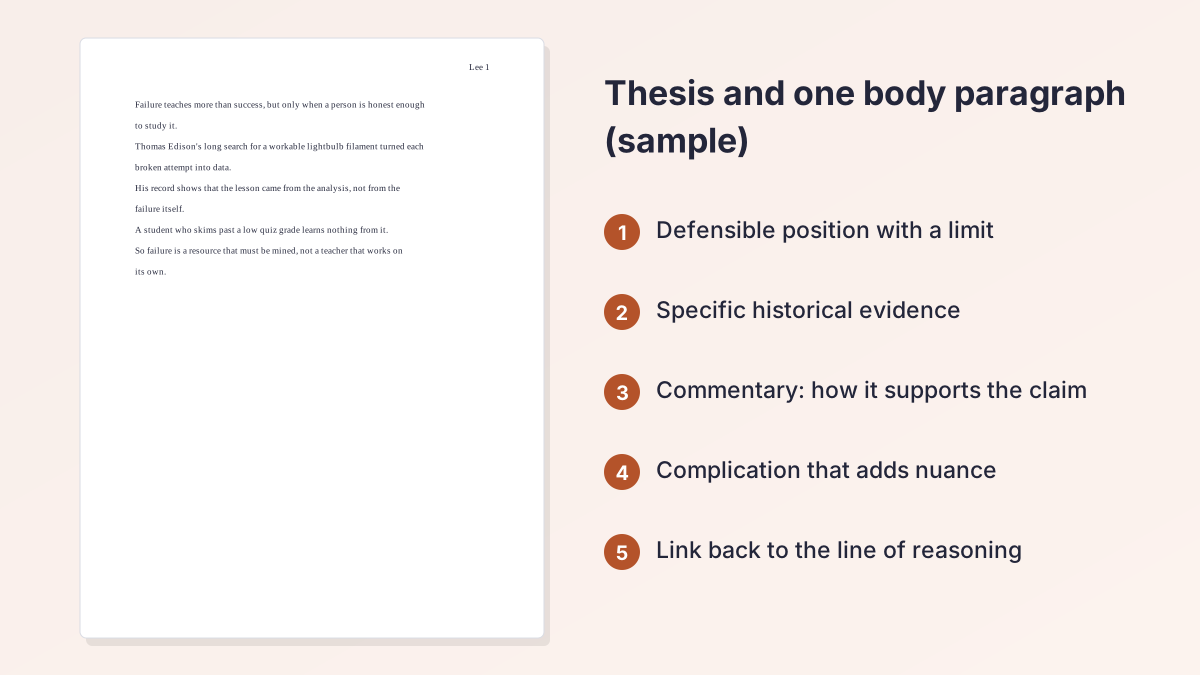
Weaker responseFailure can be a good teacher, and success can also be a good teacher.
Stronger responseFailure teaches more than success, but only when a person is honest enough to study it.
Take a clear position. Naming both sides is not a position.
Weaker responseMany famous people failed before they succeeded.
Stronger responseThomas Edison tested thousands of filament materials before finding one that lasted, and each failure narrowed the search.
One specific, accurate example beats a general list.
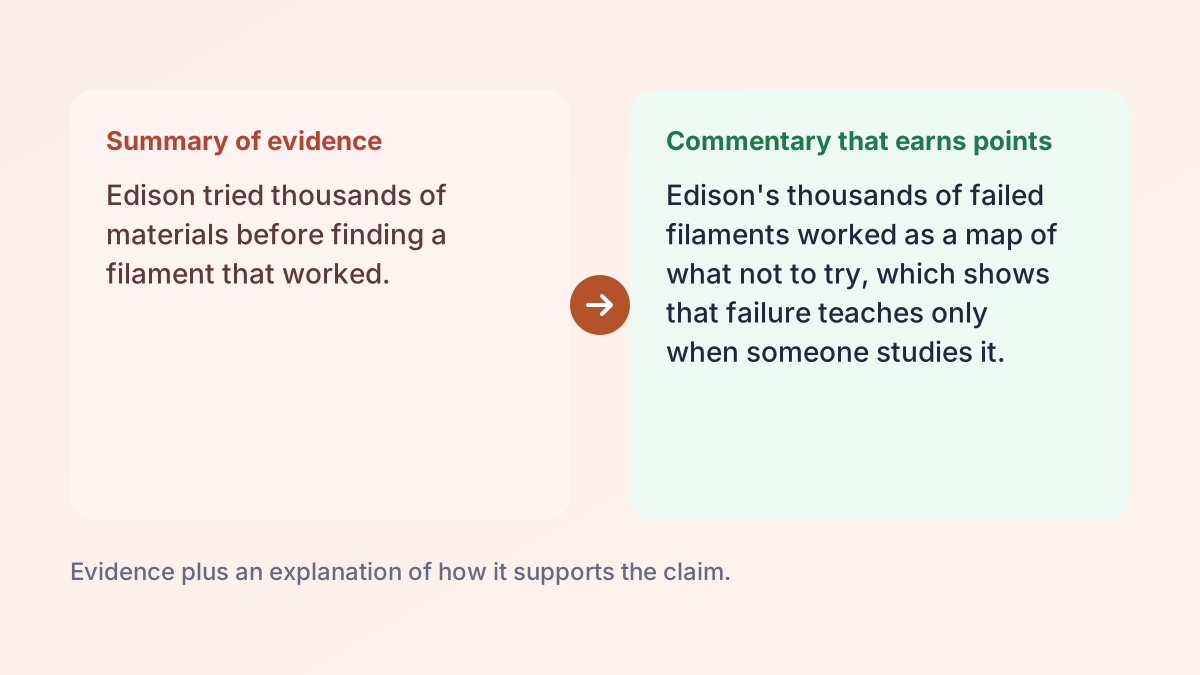
Weaker responseEdison tried many materials. This is a good example of failure.
Stronger responseHis failures became a map of what not to try, so the lesson came from studying them, not from failing alone.
Explain how the evidence supports the claim.
Weaker responseWhile some may argue that success teaches more, I disagree.
Stronger responseSuccess does teach, but it hides its causes: a winning team rarely examines the plays that almost failed.
Engage the other view; do not just mention it.
Weaker responseThroughout history, people have always learned from mistakes.
Stronger responseBefore their 1903 flight, the Wright brothers built a wind tunnel after finding that published lift tables did not match their glider's results.
Anchor context in something specific you are sure is true. If you are not sure, do not include it.
Weaker responseFailure is an ineffable crucible of ontological growth.
Stronger responseFailure is useful because it costs something, and that cost makes people pay attention.
Complex language that does not improve the argument earns nothing.
How to Write an AP Lang Argument Essay in 6 Steps
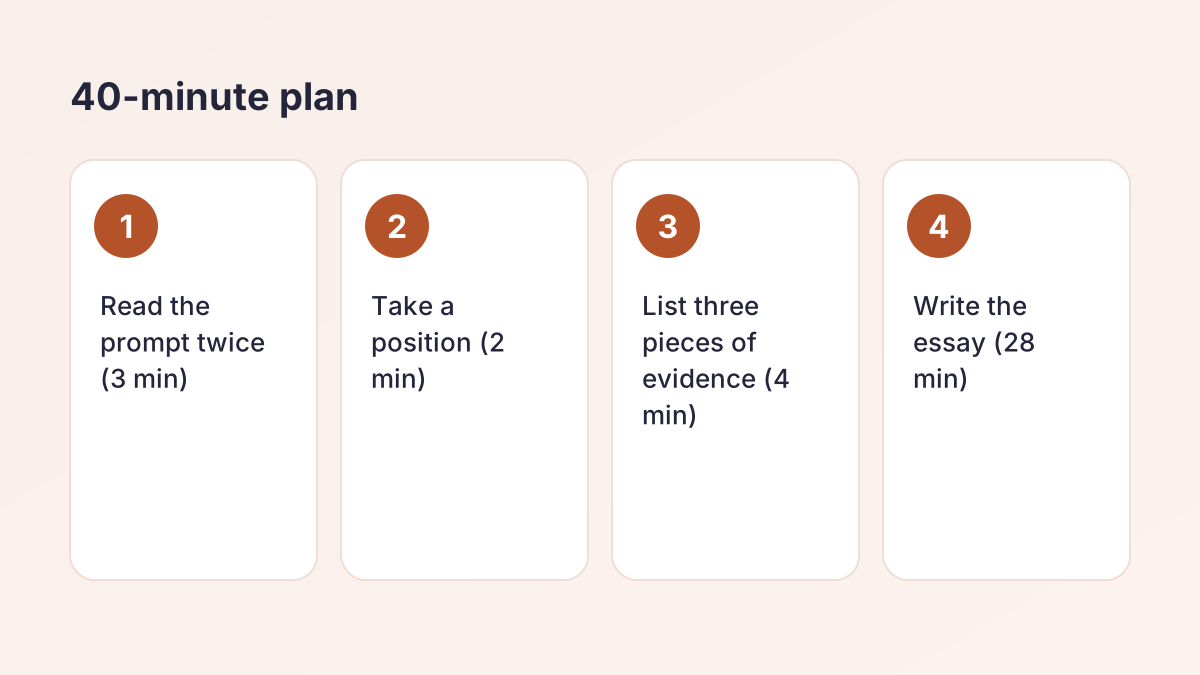
This routine fits the suggested 40 minutes for Question 3. Practice it on past prompts until the timing feels automatic.
- Decode the prompt. Underline the claim or topic and the task word, such as the extent to which, then restate it in your own words.
- Choose a position. Pick the side you can defend with the most specific evidence, not the one you like best.
- Brainstorm evidence. List three examples from history, literature, science, current events or personal experience, and note what each one proves.
- Write a defensible thesis. State a position that qualifies the claim and could be argued against, in one or two sentences.
- Draft with commentary. Give each body paragraph a claim, specific evidence and at least two sentences of explanation tied to the thesis.
- Add nuance and proofread. Work in a complication or limit, then use the last minutes to fix errors that could block communication.
Where the AP Lang Argument Essay Fits on the Exam
According to the College Board's AP English Language and Composition exam page, the exam is taken digitally in the Bluebook testing app. Section I is 45 multiple-choice questions in one hour and counts for 45% of your score. Section II is the free-response section: three questions in 2 hours and 15 minutes, including a 15-minute reading period, worth 55% of the score. The three questions are the synthesis essay, the rhetorical analysis essay and the AP Lang argument essay. Each essay is scored out of 6 points.
AP Language and Composition argument essay: what it asks
The AP English Language argument essay asks you to create an evidence-based argument that responds to a given topic. The prompt gives you a short quotation or claim, usually with a bit of context, and asks how far it is valid. You don't get a packet of sources, as you do for the synthesis essay. You supply the evidence yourself from reading, history, experience and observation. If you need to review the second question, our guide on what a rhetorical analysis is covers it.
Timing for the AP Lang argument essay
The 2025 exam booklet suggests about 40 minutes for the argument essay. You can move between questions, so many students write it last, when they know how much time is left. Many teachers recommend a few minutes of planning first, because a plan keeps the essay on one line of reasoning. For an untimed model to study, the free argumentative essay generator drafts one from your position.
AP Lang Argument Essay Rubric: The 6 Points Explained
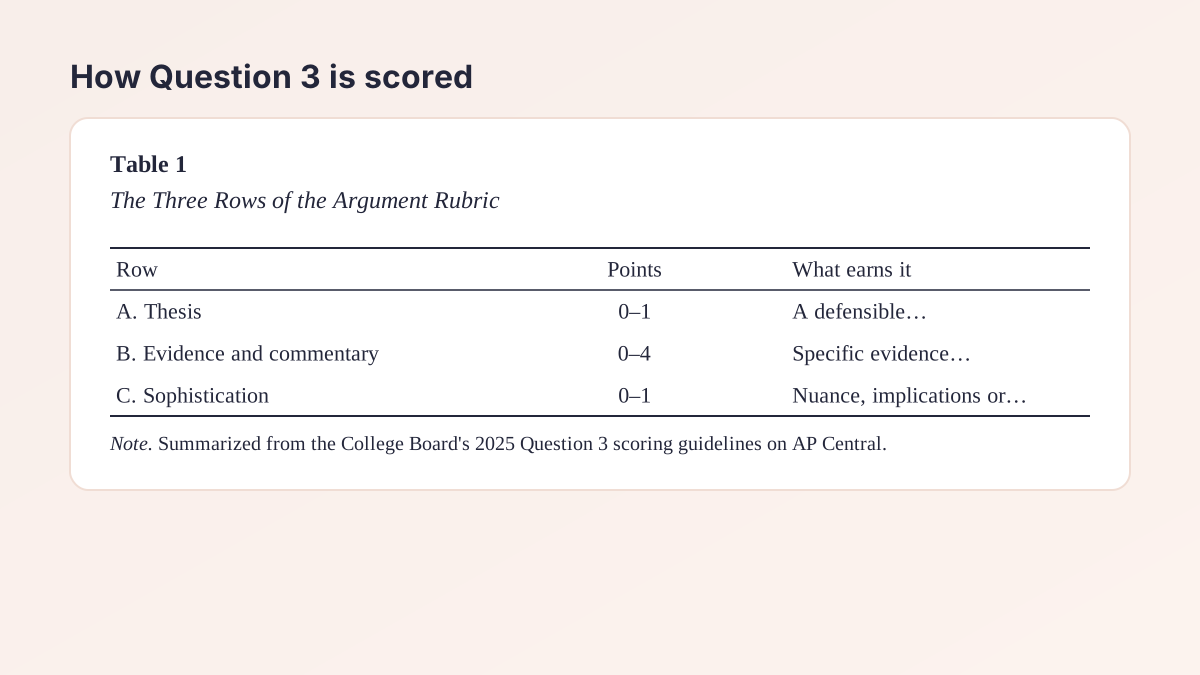
The AP Lang argument essay rubric is a three-row, 6-point scale. The AP Lang argument essay rubric explained here follows the wording in the College Board's 2025 Set 1 scoring guidelines, so check the newest guidelines on AP Central before your exam, since scoring language can change. You may also see it called the AP Lang argumentative essay rubric.
| Row | Points | What the guidelines reward |
|---|---|---|
| A. Thesis | 0–1 | A thesis that presents a defensible position |
| B. Evidence and commentary | 0–4 | Specific evidence for all claims in a line of reasoning, with consistent explanation of how it supports that line |
| C. Sophistication | 0–1 | Sophistication of thought, a complex understanding of the rhetorical situation, or a consistently vivid, persuasive style |
Row A: thesis (0 to 1 point)
The guidelines say a response earns the point when it "responds to the prompt with a thesis that presents a defensible position." That means a clear stand on the extent to which the claim is valid. Restating the prompt does not earn the point, and neither does a summary of the issue with no clear claim.
Row B: evidence and commentary (0 to 4 points)
This row carries most of the score. Early points go to evidence that is general and commentary that merely summarizes. Higher scores need specific evidence for every claim and an explanation of how the evidence supports a line of reasoning. The top score requires that explanation to be consistent across the whole essay. In practice, a body paragraph that ends without a sentence of "this shows that" is leaving points behind.
Row C: sophistication (0 to 1 point)
The point is for a response that shows sophistication of thought or a complex understanding of the rhetorical situation. The guidelines list ways to earn it, such as exploring tensions or complexities, explaining the implications or limits of the argument, or making rhetorical choices that consistently strengthen it. A passing "while some may argue" does not count, and neither does elaborate language that doesn't help the argument.
AP Lang Argument Essay Prompts From Recent Exams
Past AP Lang argument essay prompts are the best practice material because they show the style readers expect. The College Board posts free-response questions and scoring guidelines for each year on its past exam questions page. Here are three Question 3 topics from the first set of each year; each exam year has more than one set, so check the page for the full list.
Recent AP Lang and Comp argument essay prompts
- 2025: Naomi Osaka's 2022 claim about trying to be present in each moment. The task asks you to argue your position on the extent to which her claim about embracing the present moment is valid.
- 2024: The value of documenting life with selfies, based on a claim by J Wortham. Students argue how far the idea of a selfie as a kind of visual diary holds true.
- 2023: The value of a community of voices, based on Maxine Hong Kingston's 2016 claim that individual voices are weaker than "a community of voices."
What the pattern tells you
Each of these AP Lang argument essay prompts gives a short claim from a real writer or public figure and asks you to take a position on its validity. The wording "the extent to which" invites a qualified answer. Expect that format, not any particular subject. Start with the most recent year and work backward, timing yourself to 40 minutes each.
Reading any AP Lang argument essay prompt
Underline the claim and the task. Ask what the claim assumes, and where it stops being true. Then check whether you can name a specific example for each side of your position. If you can't, choose another position. If you want practice on topics outside AP, the argumentative essay generator can turn any question into a draft with a counterargument and a rebuttal.
How to Plan a High-Scoring Argument in 40 Minutes
Planning is not wasted time on the AP Lang argument essay. Even three minutes of notes make the difference between an essay that has a line of reasoning and one that wanders.
Choose a position you can support
Don't pick the side that sounds most impressive. Pick the one for which you can recall the most specific, accurate examples. A modest position with strong evidence beats a bold one with vague support.
Gather evidence from many places
For any AP Lang argument essay, strong evidence comes from history, literature you've read in class, science, current events, sports, art and your own experience. Aim for two or three solid examples that you remember well enough to describe accurately. Don't invent statistics or quotations. If you aren't sure of a number, describe the pattern without it.
Build a line of reasoning
A line of reasoning is the chain that connects your claims. Each paragraph should add a step: your first claim sets the idea, the second extends or complicates it, and the third shows its implications. Link paragraphs with a sentence that says how the new claim builds on the last one.
AP Lang Argument Essay Example: A High-Scoring Sample With Notes
This sample AP Lang argument essay answers an invented practice prompt, not an official one: "A popular saying holds that failure is the best teacher. Write an essay that argues your position on the extent to which this claim is valid." It was written for this guide to model the rubric. It has not been scored by the College Board, and real student responses are shorter, because they're typed under time pressure. Use it as an AP Lang argument essay example to imitate, then write your own on a prompt from AP Central.
Introduction
"Everyone has heard that failure is the best teacher, usually from someone trying to comfort a person who just failed. The saying holds some truth, yet it hides a condition. Failure teaches more than success does, but only when a person is honest enough to study it."
Annotation: the last sentence is a thesis (row A). It takes a position and qualifies it, which also sets up sophistication.
Body paragraph one
"Thomas Edison's search for a long-lasting lightbulb filament shows the value of failure. He tested a huge range of materials, and each one that burned out or snapped narrowed what he needed to try next. Those failures worked like a map of what not to do. But the failures did not teach on their own. Edison recorded his results and compared them, which is why the broken filaments pointed somewhere. His example suggests that the teacher is not failure but attention to it."
Annotation: specific evidence, then three sentences of commentary that tie it to the thesis (row B).
Body paragraph two
"Success, by contrast, is a poor teacher because it hides its causes. A team that wins a championship rarely reviews the plays that almost lost the game, since a win feels like proof that everything worked. A student who earns an A by cramming may conclude that cramming works and repeat it until it fails. In both cases the good result discourages the questions that failure forces."
Annotation: a second line of reasoning that extends the first, with specific, realistic examples and commentary that explains why they matter.
Body paragraph three
"Still, the claim has limits. Failure can also discourage. A student who fails an audition for the third time may stop trying, not learn. That risk is real, and it explains why mentors matter: a coach or teacher helps a person turn a stinging loss into a question. Failure is therefore a resource that must be mined, not a teacher that works alone."
Annotation: this paragraph engages a complication and states an implication (row C), instead of only hinting at an objection.
Conclusion
"The saying is worth keeping, but it should be corrected: failure teaches those who examine it, and success can teach too, for people who ask how they got there. The lesson is less about losing than about looking closely at what happened and why."
Annotation: the conclusion moves from the prompt to a broader idea and doesn't just repeat the thesis.
Sophistication Strategies for the Last Rubric Point
The sophistication point is the hardest to earn, and it usually isn't won by a single clever sentence. It comes from a way of thinking that runs through the whole essay. These habits help.
Explore tensions instead of ignoring them
State where your own position runs into trouble, as the sample does when failure discourages instead of teaches. Then explain why the position survives. A thoughtful complication shows readers a complex understanding.
Name implications and limits
Ask what follows if your argument is true, and where it stops applying. A sentence such as "This matters most for students who have a mentor" adds context and limits at the same time.
Make deliberate style choices
A consistent, vivid voice can earn the point, but only if the style serves the argument. Use concrete verbs, vary sentence length, and write a closing line you'd be proud of. Skip long words chosen to sound smart.
Avoid the false signals
Sweeping statements about "all of history," a "while some may argue" tacked on in passing, and elaborate vocabulary don't count. Real sophistication takes space, so sometimes two well-developed paragraphs outscore four thin ones.
Common Mistakes on the AP Lang Argument Essay
Most lost points on the AP Lang argument essay come from a short list of habits. Check your practice essays against it.
Writing a thesis that only repeats
If your thesis could be copied from the prompt, it earns nothing. Say what you think and how far.
Listing evidence without commentary
Three examples with one sentence each score lower than two examples explained in depth. Each piece of evidence needs a sentence on how it supports your claim.
Using a bare personal story as the only evidence
Personal experience is allowed, but a single anecdote rarely supports a whole argument. Combine it with examples from history, literature or current events.
Running out of time
Write the thesis and at least two developed paragraphs before polishing. The rubric has no separate row for a conclusion, so don't rush to finish at the expense of commentary.
Confusing the three questions
The argument essay isn't the rhetorical analysis essay. You don't analyze a writer's choices here; you build your own case. If your essay slips into describing a speaker's techniques, see what is a rhetorical analysis and keep it for Question 2. For the basics that apply beyond AP, read what an argumentative essay is, and browse every student writing guide we publish. Try the free rhetorical analysis tool when you practice Question 2.
Questions About the AP Lang Argument Essay
What is the AP Lang argument essay?
It's Question 3 of the AP English Language and Composition exam: an essay where you create an evidence-based argument responding to a given topic.
How is the AP Lang argument essay scored?
Out of 6 points: 1 for the thesis, up to 4 for evidence and commentary, and 1 for sophistication.
How long should the AP Lang argument essay take?
The exam suggests about 40 minutes. The free-response section is 2 hours and 15 minutes in total, including a 15-minute reading period.
Is the AP Lang exam digital?
Yes, the exam page on AP Central describes a digital exam taken in the Bluebook app. Check AP Central for any changes in your exam year.
Where can I find AP Lang argument essay prompts?
On AP Central's past exam questions page, which posts free-response questions and scoring guidelines for each year.
Where can I find a sample AP Lang argument essay?
This guide includes an annotated sample on a practice prompt. For real student responses, see the sample responses and scoring commentary the College Board posts on AP Central.
How do I get the sophistication point?
Explore a tension or limit in your own argument, explain its implications, or write in a consistently vivid, persuasive style that supports your argument.
How do I write an AP Lang argument essay quickly?
Spend a few minutes on a position and three pieces of evidence, then write a defensible thesis and paragraphs that pair each example with commentary.
How is it different from the rhetorical analysis essay?
The argument essay asks for your own position and evidence. The rhetorical analysis essay asks how another writer's choices create meaning.
More free guides
- What Is an Argumentative Essay?Definition, structure, outline and conclusion for an argumentative essay.
- MLA In-Text CitationsAuthor-page citations for every kind of source, with examples.
- How to Cite a Website in MLAWorks Cited entries and in-text citations for web pages.
- MLA Works Cited PageFormat, order and hanging indents, with a full example page.
- MLA Annotated BibliographyFormat, annotation types and a complete example.
- APA Table FormatNumber, title, body and notes for APA 7 tables, with templates.
See all 80 free tools for students
Related tools
Last updated by The Study Corp editorial team.