How to Begin a Scholarship Essay: 7 Sample Openings
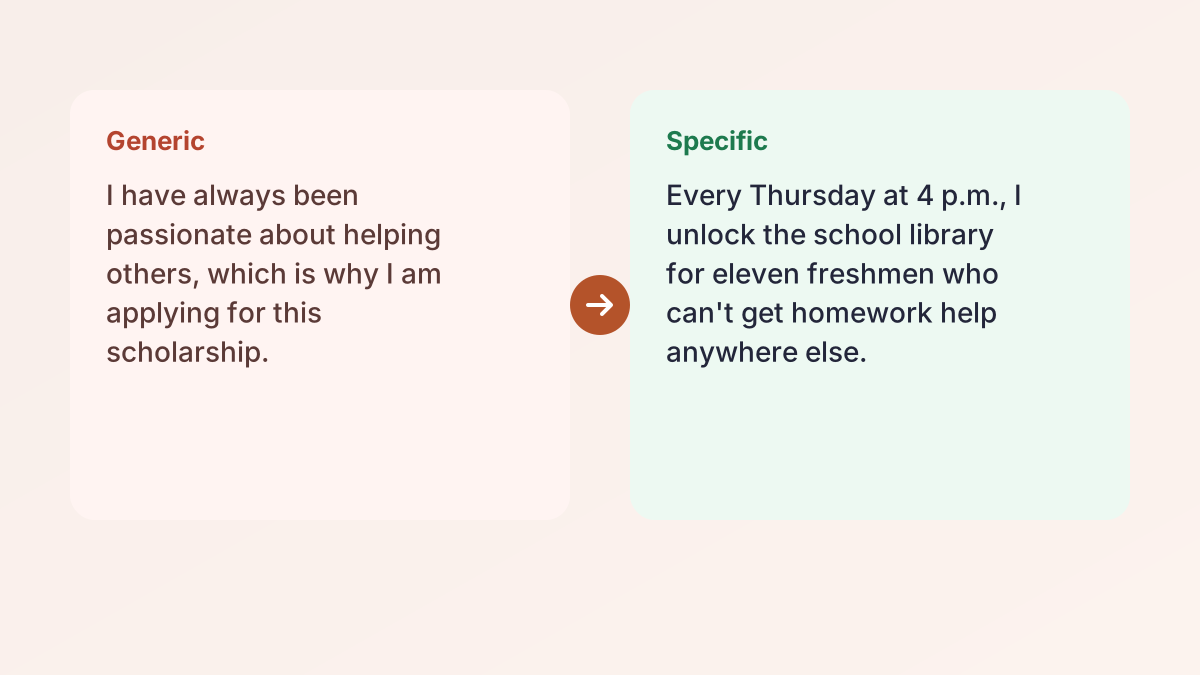
Every opening below was written for this guide by an invented student, so none of it is a real applicant's work. Each pair shows a weak first line and a stronger one, so you can see how to begin a scholarship essay with a different strategy each time. Borrow the strategy, never the words.
Weak openingI have always loved working with my hands.
Stronger openingThe soldering iron slipped, and the radio I had spent three weeks rebuilding hissed back to life anyway.
Start in the middle of a scene so the reader sees a result before the explanation.
Weak openingMy family has taught me the value of hard work.
Stronger openingWhen my grandmother sold tamales outside the clinic, I counted the change because she trusted me more than the register.
A short story carries a value without naming it.
Weak openingMany students struggle with money in college.
Stronger openingWhat do you do when the textbook costs more than the week's groceries?
Use a real question that your essay then answers; skip questions the reader can't care about.
Weak openingI am a hardworking, determined student.
Stronger openingI am the only person in my school who can fix a bicycle, play the oboe and referee a soccer match, sometimes on the same Saturday.
Choose a fact that opens a door into the story you plan to tell.
Weak openingI decided to become a nurse after a difficult time.
Stronger opening"You're going to be fine," the nurse told my brother, and then she told me the same thing, like I was the patient too.
One line of speech can do the work of a paragraph. Keep it to a line or two.
Weak openingI faced many challenges but never gave up.
Stronger openingThe day I got my first failing grade, I did not cry. I walked to the tutoring center and asked what a B would take.
Show the moment things changed. The reflection comes in paragraph four.
Weak openingThis scholarship is important to me for many reasons.
Stronger openingYou asked about a time I led without a title. For me, that was the night the school bus broke down and I became the person with the phone list.
A direct link to the prompt tells the reader you read it. Use it when the question is specific.
How to Make a Scholarship Essay From a Blank Page
These steps show how to make a scholarship essay, moving from the prompt to a first paragraph you can build on. Do them in order the first time through.
- Read the prompt twice. Before you decide how to start a scholarship essay, underline each verb, such as describe, explain and discuss. Each one is something the essay must do.
- List real moments. Write five or six specific moments connected to the prompt: a place, a person, a date and what happened.
- Choose one story. Pick the moment that shows the most change in you, and that connects to your goals and to the award.
- Draft the middle first. Write the challenge, what you did and what you learned before you touch the opening.
- Try two openings. To learn how to begin a scholarship essay, write one opening with a scene and one with a question or fact, then keep the one that sounds like you.
- Cut to the word limit. Trim anything that does not answer the prompt, then read it aloud and proofread.
How to Start a Scholarship Essay: Read the Prompt First
Before you decide how to start a scholarship essay, work out what the committee is asking. The University of Toledo's financial aid office suggests checking your finished statement against the prompt and asking, "Does your statement respond to all parts of the prompt?" Do that check before you write.
Break the prompt into jobs
Most prompts bundle two or three tasks: describe an experience, explain what it taught you, and say how the award helps. List them. If a prompt says "describe a challenge you overcame and how it shaped your goals," your essay owes the reader a challenge, an action, a change and a goal. An opening that skips straight to goals leaves the other three jobs without a home.
Pick a story the prompt can hold
To make a scholarship essay that answers the question, list real moments, then choose the one that fits every job on your list. A story that is impressive but doesn't answer the question loses to a smaller story that does. If you want a faster way to get a first draft of an essay for scholarships from your notes, the free scholarship essay generator turns the details you enter into a structured draft that you then rewrite in your own voice.
What Scholarship Readers Look For
Several university offices describe the same priorities, which helps you decide how to begin a scholarship essay and what the opening should promise. The University of Washington's scholarship office says your statement should honestly reflect who you are and how your interests and plans developed. Its advice is that a personal statement is "more than a listing of your achievements," and it warns, "Do not write your personal statement based on what you think the selection committee wants to hear" (University of Washington).
Specific detail and a clear point
Toledo's financial aid page asks whether your essay offers "enough compelling detail to stand out from the many other submissions the review committee will read" (University of Toledo). A concrete opening is the quickest way to say yes.
Fit with the scholarship
UCF's financial aid office advises you to "tailor your essay for your intended audience," identify the donor's goals and explain why you fit the scholarship (UCF Financial Aid). It also notes that tear-jerker approaches can backfire; when you write about hardship, keep the focus on how you overcame it.
| Reader wants | Opening that helps | Opening that hurts |
|---|---|---|
| Who you are | A scene only you could write | A line any applicant could use |
| Specific detail | A place, time and action | Abstract words like passion and dedication |
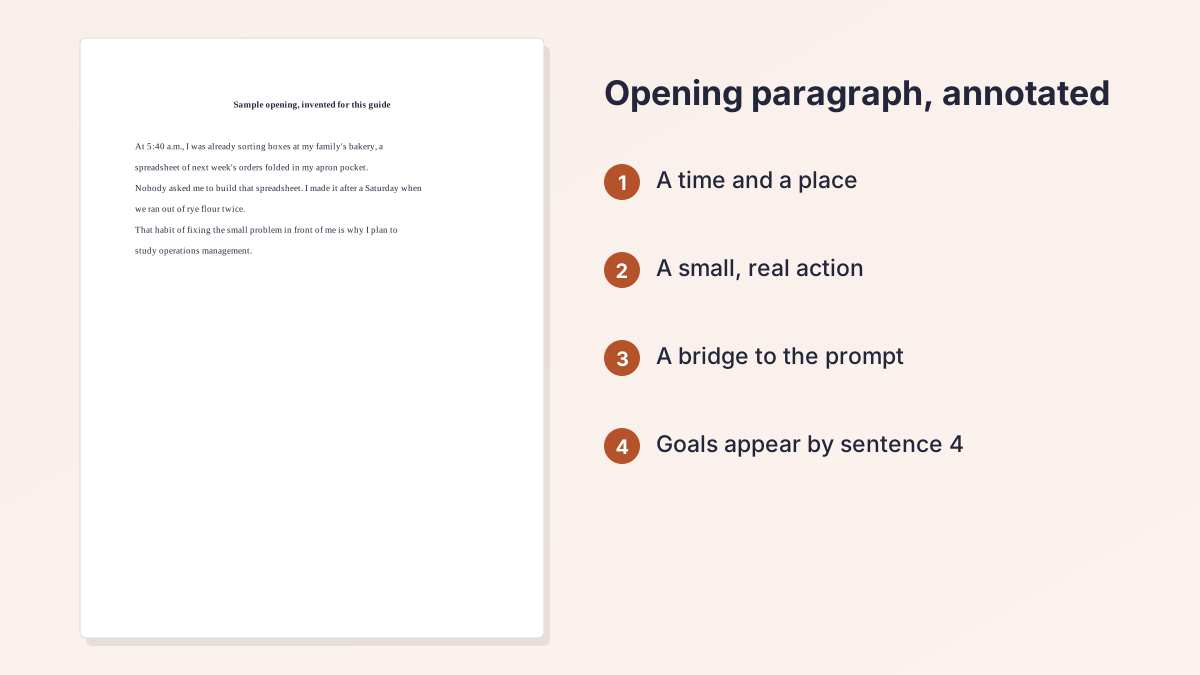
| Fit with the award | A bridge to the prompt by sentence 3 or 4 | Goals that never connect to the story |
| Honesty | A small, true moment | A dramatic claim you can't back up |
| Clear writing | Short, plain sentences | A long quotation from a famous person |
Seven Ways to Open: Which One Fits Your Story?
The seven samples above use seven different strategies, and each suits a different kind of story. To begin a scholarship essay well, pick the strategy first, then write the sentence.
A vivid moment or an anecdote
These work when your story has a clear scene. The vivid moment is a single second, such as a slipped soldering iron. The anecdote is a few sentences of story. Both let the reader draw a conclusion, which is more convincing than being told one.
A question or a surprising fact
These work when the story begins with a puzzle or an unusual detail about you. They are the riskiest openings because they can sound like gimmicks.
Dialogue and turning points
Dialogue is useful when someone else's words changed how you saw things. A turning point is useful when the essay is about growth. In both, keep the opening short.
How to begin a scholarship essay without a cliché
When you start a scholarship essay, skip the dictionary definition, the famous quotation and the sentence that begins "Ever since I was a child." Readers have seen each of these many times, and none tells them who you are. Skip also the apology, such as "I am not a great writer, but." Begin with your strongest real detail instead.
How Do You Start an Essay for a Scholarship When You Feel Stuck?
Many students freeze when they try to start an essay for a scholarship, because the first sentence feels like the most important one. It matters, but it is also the easiest to fix later. The University of Washington advises drafting with the expectation that you will write multiple drafts, and writing out all of your ideas first, "no matter how long your document becomes" (University of Washington).
Write a bad first line, then start the scholarship essay for real
To start a scholarship essay, open your document and type "This essay is about the time I..." and keep going. You can delete it later. Once the scene is on the page, the real opening is usually sitting in the second or third sentence.
Freewrite the moment for five minutes
Set a timer and describe the moment as if telling a friend: where you were, what you heard, who spoke. Circle the most specific sentence. That sentence is often your opening.
Use the two-sentence test for how to start a scholarship essay
A good opening and its second sentence should tell a reader who is in the scene and what is at stake. If they don't, add one detail, a name, a number or a place, until they do.
Ask someone else to read only the opening
Once you know how to start a scholarship essay, hand the first paragraph to a teacher, counselor or writing center tutor. Ask what they expect the essay to be about. If their guess matches your plan, the opening works.
Scholarship Essay Template, Paragraph by Paragraph
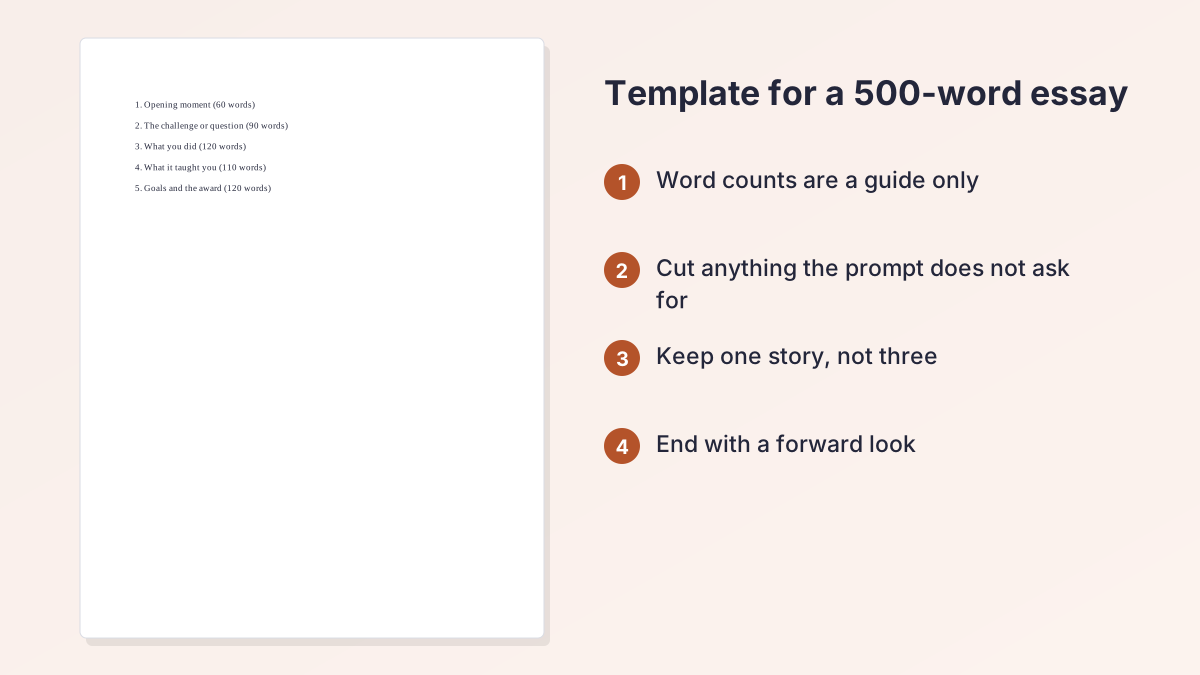
A scholarship essay template gives you a shape to fill with your own story. This scholarship essay template suits a 500-word personal essay; shrink or stretch the paragraphs for other limits. The words in brackets are placeholders, and the plan itself was written for this guide, not taken from any scholarship.
Scholarship essay template you can copy
Paragraph 1 - Opening moment (about 60 words)
[A specific scene: time, place, action.]
[One sentence that points toward the prompt.]

Paragraph 2 - The challenge or question (about 90 words)
[What was at stake? Why did it matter to you?]

Paragraph 3 - What you did (about 120 words)
[Two or three actions, in order, with a detail for each.]

Paragraph 4 - What it taught you (about 110 words)
[The change in how you think or act. One example of it since.]

Paragraph 5 - Goals and the award (about 120 words)
[Your next step, the field you plan to study, and how this
scholarship connects to it. Return to the opening image.]
Why this scholarship essay template works
Paragraphs 2 through 4 show how you developed, which the University of Washington asks for instead of a list of achievements. Paragraph 5 handles the fit that UCF recommends. Returning to your opening image in the last lines of the scholarship essay template is a simple way to end a scholarship essay without a summary.
Adjusting the scholarship essay template
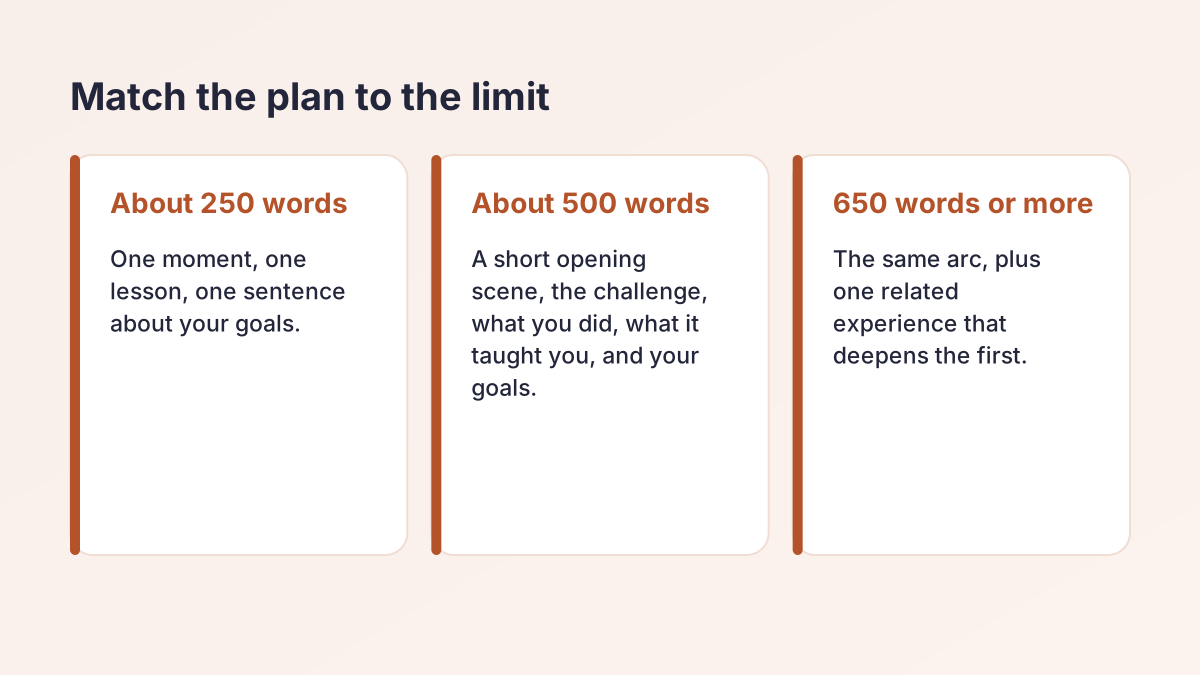
For a 250-word limit, the plan shrinks: merge paragraphs 2 and 3 and cut the goals paragraph to two sentences. For a 650-word limit, add a second example under paragraph 4. A simple outline for a scholarship essay is just these five headings, so you can use this scholarship essay template as your plan before you draft.
How Long Should a Scholarship Essay Be?
For an essay for scholarships, follow the stated limit. Toledo's financial aid page advises meeting the word count while staying concise, and notes that a response far below the limit may not fully answer the prompt. If the limit is 500 words, aim for roughly 450 to 500. If the instructions give no limit, ask the program.
Short essays for scholarships
Typical short answers of 150 to 250 words have room for one moment and one lesson. To begin a scholarship essay this short, start in the scene at once.
Longer essays
At 650 words or more, an essay for scholarships can hold a second, related experience. Make sure it extends the first story instead of introducing a new topic.
Can You Use the Same Essay for Different Scholarships?
You can reuse your material when you make a scholarship essay for a second award, but you shouldn't send one essay unchanged to every award. UCF advises tailoring your essay to its audience and the donor's goals, and the University of Washington suggests researching the committee and the published selection criteria.
Build a core story, then change the ends
To make a scholarship essay reusable, keep one strong story as your core. Rewrite the opening line and the last paragraph for each scholarship so they answer that prompt and mention what that award values. The middle often needs little change.
Check before you paste
Search the final file for the old scholarship's name. Reusing a draft is fine; submitting one that praises the wrong organization is not.
Essay for Scholarships: First-Generation and Service Angles
Two themes come up often in prompts for scholarships, and each has a trap.
First-generation students
If you are the first in your family to go to college, show it through specific tasks: filling out a financial aid form with a parent, translating a letter, learning what an office hour is. Don't let the label stand in for the story. In an essay for scholarships, readers learn more from one scene than from the sentence "I am a first-generation student."
Community service
Don't list hours and organizations. Pick one moment of service and explain what you did, what changed and what you learned. A paragraph about one Thursday at a food pantry says more than a paragraph that names five clubs.
Hardship
When you write about a difficult time, follow the UCF advice to keep the focus positive by showing how you responded. You don't need to hide the difficulty, only to make sure the essay is about your action and growth.
Common Mistakes When You Begin
Most weak attempts to start a scholarship essay fail in one of a few ways. The University of Washington warns against vague statements, lists of achievements and writing what you think the committee wants to hear.
Starting with the conclusion instead of a scene
"This scholarship will change my life" tells the reader nothing yet. Earn it with a scene first; that is the core of how to start a scholarship essay well.
Opening with a cliché
Quotes about success, dictionary definitions and "since the dawn of time" lines are familiar to every reader. Replace them with a detail only you could supply.
Skipping part of the prompt
However well you begin a scholarship essay, a beautiful opening can't rescue one that ignores half the question. Check the draft against each verb in the prompt.
Skipping proofreading
Toledo's advice is to treat your application essay as academic writing, with complete sentences and correct grammar, and to have someone else review it. Read it aloud and ask a teacher or a writing center to look at it. If you also need a personal statement for a college application, the personal statement generator can check your draft against a word limit.
Next Steps After the Opening
Once you know how to start a scholarship essay, write the rest using the template, then revise for specifics. For the persuasive structures behind many prompts, see our guide to what an argumentative essay is. If your application includes a research paper, the guide to APA format guidelines covers that style, and you can browse every topic in the student writing guides.
When you are ready for a full draft, try the scholarship essay generator on your notes, then revise the result until it sounds like you.
Scholarship Essay Questions Answered
How do you start an essay for a scholarship?
Begin with a specific moment, such as a scene, a line of dialogue or a turning point, and connect it to the prompt within a few sentences. Avoid broad statements like "I have always wanted to help people."
How do you begin a scholarship essay about yourself?
To begin a scholarship essay about yourself, choose one small, true moment that shows who you are, and describe it with a time, place and action. Then explain what it taught you and how it connects to your goals.
What is a good hook for a scholarship essay?
A good hook is a vivid scene, a short line of dialogue, a real question or a surprising fact about you that leads into your story. It should be specific and connected to the prompt.
How long should a scholarship essay be?
Follow the limit in the application. If it is 500 words, aim for roughly 450 to 500. If no limit is given, check with the program.
How do you end a scholarship essay?
Return to your opening image or moment, state what you plan to do next, and connect it to the award. Don't simply repeat your introduction.
Can I use the same essay for different scholarships?
You can reuse a core story across essays for scholarships, but rewrite the opening and conclusion for each prompt, and confirm that each version answers every part of that question.
Should a scholarship essay have a title?
Only if the application allows or asks for one. Otherwise, follow the instructions for your name and begin with your first paragraph, however you chose to start a scholarship essay.
What should I include in a scholarship essay?
Include a specific story, what you did, what you learned, your goals and how the award connects to them. Answer every part of the prompt.
More free guides
- MLA In-Text CitationsAuthor-page citations for every kind of source, with examples.
- How to Cite a Website in MLAWorks Cited entries and in-text citations for web pages.
- MLA Works Cited PageFormat, order and hanging indents, with a full example page.
- MLA Annotated BibliographyFormat, annotation types and a complete example.
- APA Table FormatNumber, title, body and notes for APA 7 tables, with templates.
- MLA HeadingThe four-line first-page heading and the page header, with Word and Google Docs steps.
See all 80 free tools for students
Related tools
Last updated by The Study Corp editorial team.