Case study analysis generator examples
Illustrative examples: the cases are invented, and the output shows the kind of sections the tool gives. Your own results will differ.
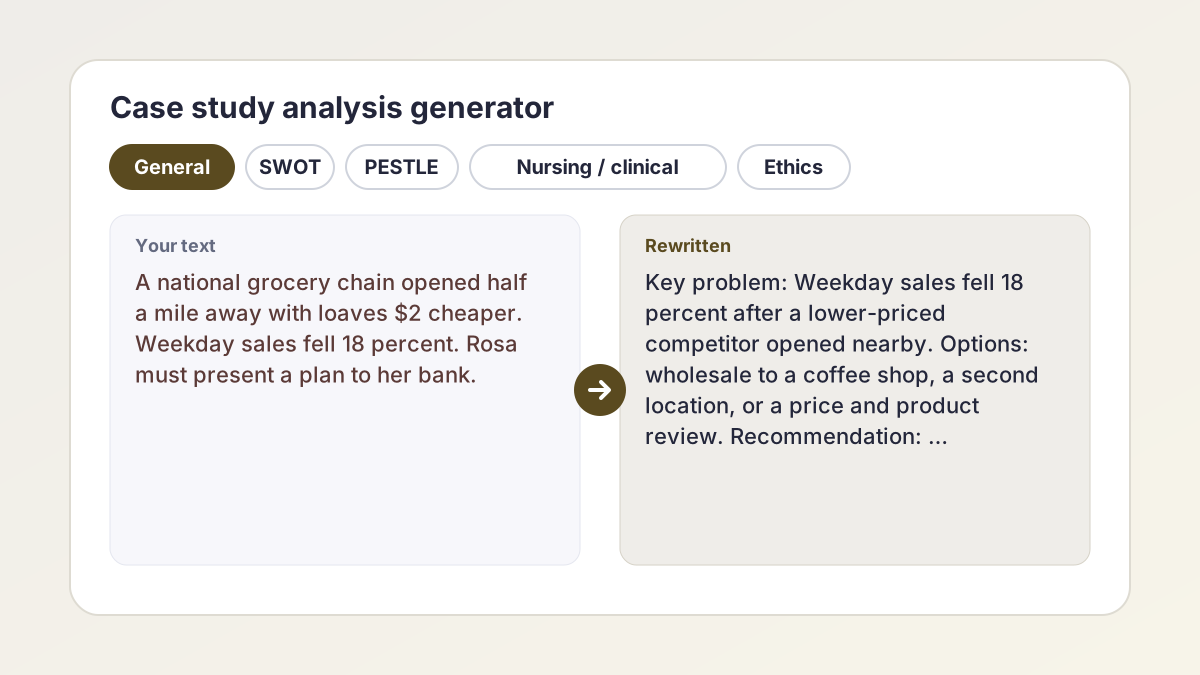
Case pastedThe Try an example case: Maple Street Bakery loses weekday sales to a new grocery bakery. Question: What should Rosa do to keep the bakery profitable, and why?
Analysis madeKey problem: Weekday sales fell 18 percent after a lower-priced competitor opened half a mile away. … Recommendation: Review prices and the product mix before taking a $90,000 loan. Risk: [add the bakery's current margins]. …
Sections follow the General framework. The bracket marks a figure the case doesn't give, instead of an invented number.
Case pastedA 400-word case about a campus coffee cart with loyal customers, a short permit and a rival cart opening nearby.
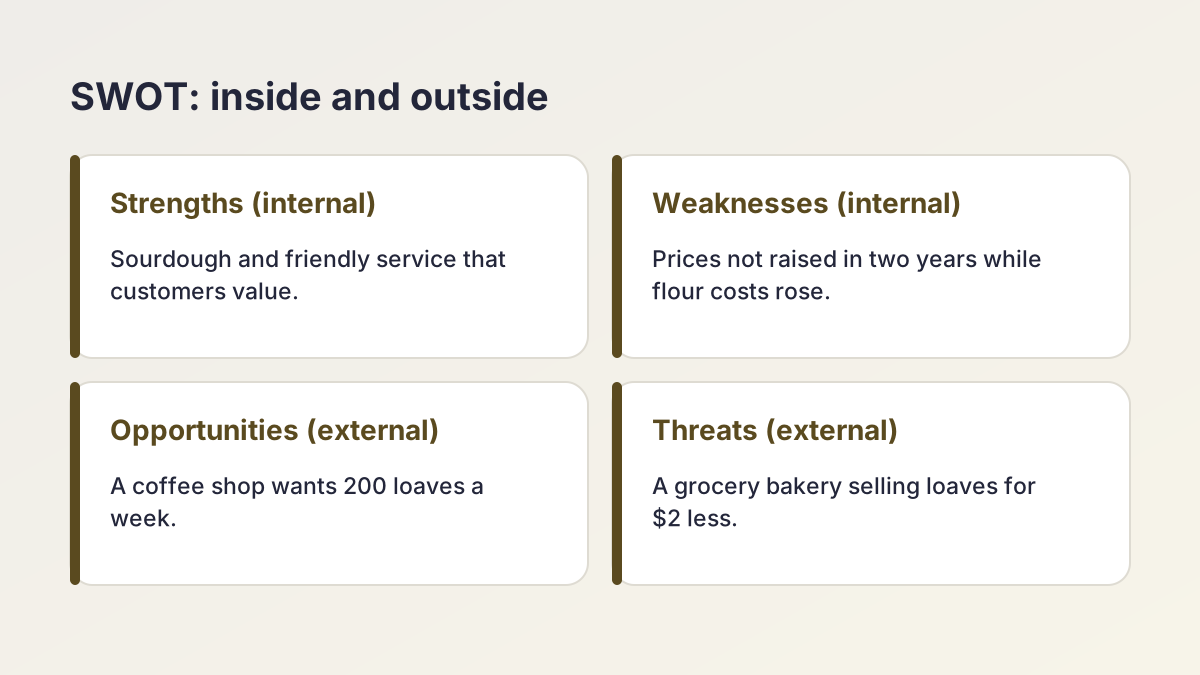
Analysis madeStrengths: Loyal regulars and a prime spot. Weaknesses: A permit that ends in June. Opportunities: Catering for campus events. Threats: A second cart nearby. Recommendation: …
SWOT sorts facts into internal and external factors, then ends with a recommendation tied to them.
Case pastedA case about a city weighing a ban on single-use plastic bags, with details on a vote, local store costs and a state law.
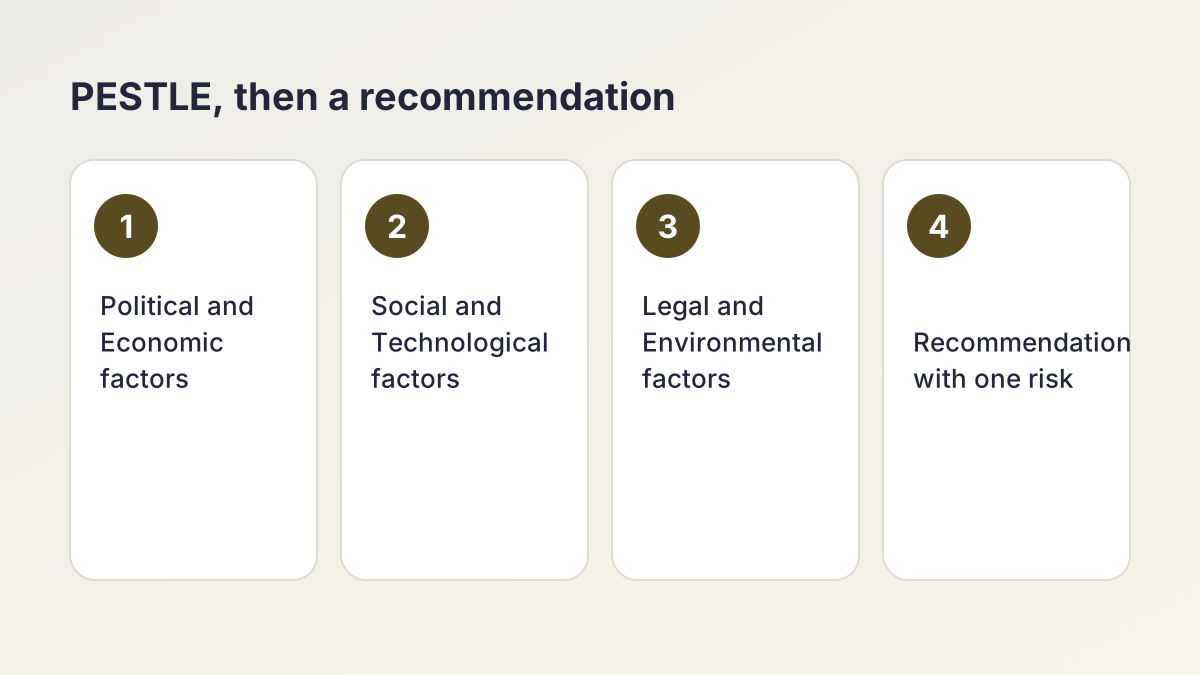
Analysis madePolitical: The city council vote is scheduled for … Economic: Stores report added costs of … Legal: A state law may limit … Recommendation: …
PESTLE lists six outside factors. If the case says nothing about one, the tool is told to say so instead of guessing.
Case pastedInvented case: a 72-year-old admitted with pneumonia, oxygen saturation 89 percent on room air, new confusion, family at the bedside.
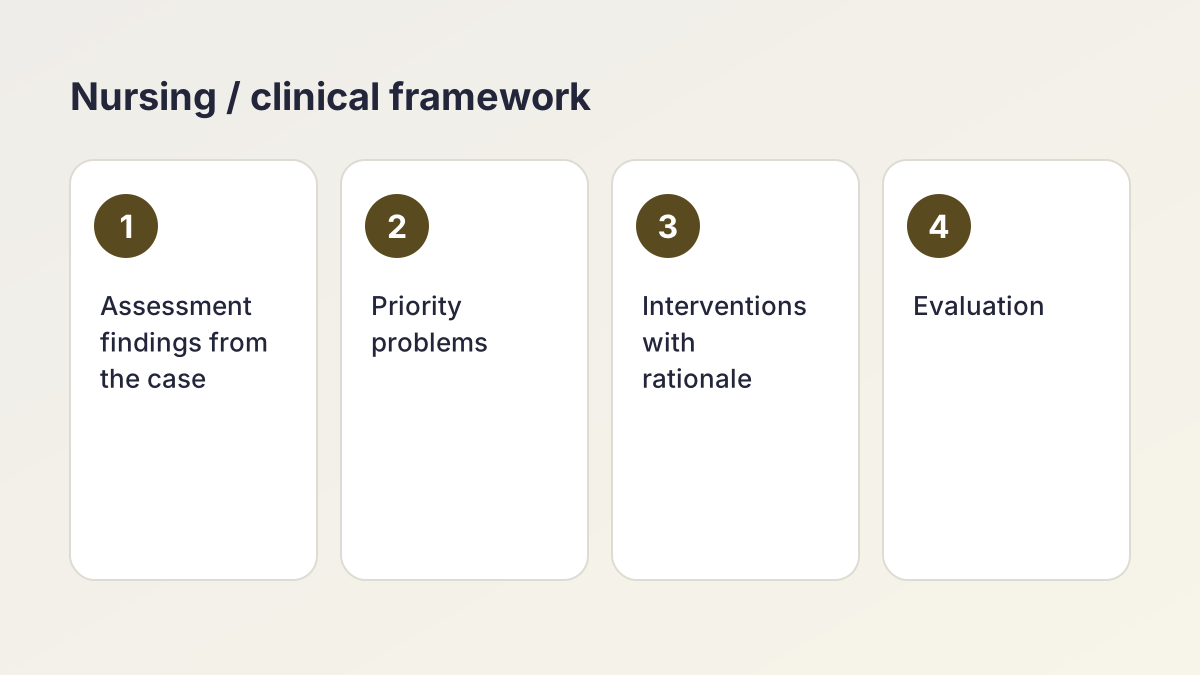
Analysis madeAssessment findings: Low oxygen saturation and new confusion. Priority problems: Impaired gas exchange. Interventions with rationale: … Evaluation: Recheck oxygen saturation and orientation. [add allergy history]
For a study aid only. It does not use your program's care-plan template, so adapt the sections to the format your instructor requires.
Case pastedA case in which a lab assistant sees a classmate change data in a shared experiment and must decide whether to report it.
Analysis madeThe dilemma: Loyalty to a classmate against honesty in research. Stakeholders: The classmate, the class, the instructor. Ethical principles: Honesty, fairness. Decision: …
The Ethics framework names the dilemma, stakeholders, options and principles, then justifies one decision.
Case pastedThe case says: "Rosa has not raised prices in two years." An analysis section quotes it as "Rosa never raised her prices for two years".
Analysis made"Rosa never raised her prices for two years" [check this quote against your text]
A quotation of four or more words that isn't in your case gets this note, so you fix the wording or paraphrase it.
How to use the case study analysis generator
Paste the case, choose a framework and select one button.
- Choose a Framework. Pick General, SWOT, PESTLE, Nursing / clinical or Ethics. If your assignment names a framework, choose it. If not, General is a sensible default for most business and school cases.
- Paste The case study. Paste the whole case, or select Try an example. You need at least 200 characters, and the box takes up to 15,000 (roughly 2,500 words).
- Add Your assignment question (optional). Type the question your instructor asked, up to 400 characters. The tool is told to answer it directly.
- Set the Level. Choose High school, College, Middle school or Graduate. Spelling switches between US English and UK English.
- Select Analyze the case. While it works the button reads Analyzing the case… Each section arrives on its own card with a word count and a Copy button.
- Check and adapt. Fill any [bracketed placeholder] from your course materials, check quotations marked [check this quote against your text] and rewrite in your own words.
Case study analysis: what instructors expect
A case study analysis takes a real or realistic situation and asks you to explain what is going on and what should happen next. Most instructors expect the same things from a case study analysis: the facts of the case used as evidence, a clear statement of the problem, a few realistic options, and a recommendation you can defend.
The usual parts
- Background: the key facts, briefly.
- Key problem: the one issue that matters most.
- Causes and options: why it happened and what could be done.
- Recommendation: the best option and the reasons for it.
- Implementation or risks: how it would work and what could go wrong.
Those are conventions, not a universal rule. Your course may use its own template, so check the assignment sheet before you start any case study analysis. The tool's General framework follows the list above.
Case study analysis generator: what each framework gives you
The case study analysis generator writes one card per section of the framework you choose, and it is asked for four to seven cards in all. It is told to ground every point in the facts of your case, and each card is labeled so you can lift it into your own outline.
| Framework | What the sections cover |
|---|---|
| General | Background, key problem, causes, options, recommendation and implementation |
| SWOT | Strengths, weaknesses, opportunities and threats, then a recommendation |
| PESTLE | Political, economic, social, technological, legal and environmental factors, then a recommendation |
| Nursing / clinical | Assessment findings, priority problems, interventions with rationale, and evaluation |
| Ethics | The dilemma, stakeholders, options, ethical principles that apply, and a justified decision |
Section names can vary a little from case to case, for example Key problem, Options or Recommendation. The recommendation is meant to give reasons drawn from the case and to mention one risk and how to reduce it.
How to read a case before you analyze it
The tool works best when you have read the case first. A Simmons University guide on how to analyze a case study starts by asking what type of case you are reading, and then asks you to form a hypothesis that would resolve the dilemma of the person at the center of the case, test it against the evidence and ask what the best alternative is.
Three questions to ask first
- Who has to decide, and by when?
- What facts does the case actually give, including numbers?
- What does the case leave out?
Underline the facts, then compare them with the generated sections. If the analysis uses a fact that isn't in your case, delete it. If it misses a fact you think matters, add it yourself.
Case study analysis example: the bakery case in four steps
Here is how a short case study analysis of the invented Maple Street Bakery case might run. Every fact below comes from the case you load with Try an example.
Step 1: Name the problem
Weekday sales fell 18 percent in three months after a grocery chain opened a bakery half a mile away that sells loaves for $2 less. Rosa wants a plan for her bank by the end of the quarter.
Step 2: List the options the case supports
- Sell 200 loaves a week to the coffee shop, using spare oven capacity at a lower price per loaf.
- Open a second location near a community college with a $90,000 loan.
- Review prices and the product mix, since Rosa hasn't raised prices in two years and flour costs have risen.
Step 3: Weigh each option against the facts
The wholesale order brings steady income but pays less per loaf. The second location adds debt while the first store is losing sales. Customers value the sourdough and the service, which supports a review of what the bakery sells.
Step 4: Recommend and name a risk
A sensible recommendation might favor a price and product review plus the wholesale order, with the loan postponed. The risk is that regular customers resist higher prices, and the bakery can reduce it by raising prices gradually. Anything the case doesn't give, such as profit margins, stays a placeholder. Your instructor may reach a different, equally defensible answer.
SWOT analysis generator: internal and external factors
Choose SWOT and the SWOT analysis generator sorts the facts of your case into strengths, weaknesses, opportunities and threats, then adds a recommendation. A University of Kansas Community Tool Box SWOT checklist lists internal strengths and weaknesses alongside external opportunities and threats, which is the split to keep in mind. A University of Kansas SWOT analysis page puts it in terms of control: internal factors are ones you have some measure of control over, and external factors are ones you don't control.
How to check a SWOT
- A strength or weakness is usually something the organization has some control over, like staff, prices or location.
- An opportunity or threat usually comes from outside, like a competitor, a trend or a new rule.
- Each point should cite a fact from the case, not a guess.
When you use a SWOT analysis generator, remember that in the bakery example the grocery chain's cheaper loaves are a threat, and the coffee shop's order is an opportunity. If you spot a point filed under the wrong heading, move it yourself.
PESTLE analysis generator: six outside factors
PESTLE looks at the outside environment. A North Carolina State University risk management guide to using PESTLE analysis frames it as a way to ask how external political, economic, social, technological, legal or environmental factors might affect an organization. The PESTLE analysis generator writes a section for each of those six factors, then adds a recommendation.
When to choose PESTLE
PESTLE tends to suit cases about a whole industry, a city policy or a new market, and is often less useful for the day-to-day choices of a small family business. If your course hasn't asked for it, General or SWOT may fit a smaller case better.
What to expect when the case is silent
A case rarely covers all six factors. Where your case gives nothing, the tool is told to say so and to use a bracketed placeholder instead of inventing information. Fill the gaps from your reading, or note them as a limitation in your paper. A PESTLE analysis generator can organize the factors, but you supply the evidence. Don't leave an invented statistic in the final draft.
Nursing case study analysis: the clinical framework
Choose Nursing / clinical and the tool writes a nursing case study analysis with assessment findings, priority problems, interventions with rationale and evaluation. Nursing students on clinicals may be asked for something like this in a reflection or care-plan assignment.
What to do with it
- Use the nursing case study analysis to organize your thinking, then rewrite in the format your program requires.
- Fill every placeholder, such as an allergy history, from the real chart or case.
- Check the rationale against your textbook and your instructor's guidance.
What it is not
It is a study aid, not clinical advice, and it can't replace your instructor, your facility's policies or a licensed provider. It also doesn't follow a specific care-plan template, so match the sections to the one you were taught. Use only invented or de-identified cases, never real patient information.
Ethics case studies: dilemma, stakeholders, decision
Ethics cases ask what is right when values conflict. The Ethics framework names the dilemma, lists the stakeholders, sets out the options, applies the ethical principles that fit, and reaches a justified decision.
Your instructor may want one theory applied, such as duty-based or outcome-based reasoning. If so, add it to the Your assignment question box, for example: Apply a duty-based approach.
Read the decision critically. Many instructors look for an ethics analysis that admits what the other side gets right. If the generated decision ignores a stakeholder, add that point yourself.
Use your assignment question to focus the analysis
The optional Your assignment question box holds up to 400 characters. If you fill it in, the tool is told to answer it directly.
Good examples
- What should the manager do, and why?
- Which of the two options is better for the hospital unit?
- Evaluate the company's decision using a SWOT.
Copy the exact wording from your assignment, because a vague question gives a vague focus. For a long prompt with several parts, run the tool once per part. If you're still stuck on defining the issue, the guide to a problem statement shows how to state it in one clear sentence.
Check the output, then write it in your own words
Treat the output of the case study analysis generator as a first draft. The tool may misread a case or weigh an option differently than your instructor would.
The quote check
When a section quotes your case, the tool checks each quotation. Any quoted passage of four or more words that can't be found in your case, ignoring case and punctuation, gets a note: [check this quote against your text].
Academic integrity
Use the output to study the case and to draft your thinking, not to replace your own case study analysis. Then write your analysis in your own words and follow your school's AI policy. If you submit work for a grade, don't present generated text as yours unless your teacher allows it.
Is the case study analysis generator free and private?
Yes, it is free, with no account. There is a limit of 30 requests per hour for each visitor.
Your case is sent to our AI providers, Groq with Google Gemini as a backup, only to create the analysis. The Study Corp doesn't save it. Don't paste real patient details or private records.
Next, condense a long case with the Key Points Generator, make practice questions with the Question Generator, or read the case in short form with the Essay Summary Generator. The Study Notes Generator and the Word Counter help with the rest.
Case study analysis generator FAQ
How do I write a case study analysis?
Read the case, state the key problem, list realistic options, recommend one and explain why. Paste the case into the generator, choose a framework and select Analyze the case for a draft of each part.
Which framework should I choose?
Use the one your assignment names. If none is named, General covers background, problem, causes, options, recommendation and implementation. Choose SWOT or PESTLE if your instructor asks for them.
Does the tool invent facts about my case?
It is told not to. Where the case lacks information, the analysis uses a bracketed placeholder for you to fill in, rather than making up facts, figures or names.
Can I add my assignment question?
Yes. Type it into Your assignment question (up to 400 characters, optional). The tool is told to answer it directly.
How long can the case be?
At least 200 characters and up to 15,000 characters, which is roughly 2,500 words. For a longer case, paste the most important parts.
Can it do a nursing case study analysis?
Yes. Choose Nursing / clinical for assessment findings, priority problems, interventions with rationale and evaluation. It is a study aid and doesn't use your program's care-plan template.
What does "check this quote against your text" mean?
The tool found a quotation of four or more words that isn't in your case. Fix the wording to match, or paraphrase it.
Is it free, and is my case saved?
It is free, with a limit of 30 requests per hour for each visitor. Your case goes to Groq, with Google Gemini as a backup, only to create the analysis. The Study Corp doesn't save it.
More free study tools
- Essay Summary GeneratorA summary in your chosen length, plus a one-sentence version, using only what the text says.
- Key Points GeneratorThe main idea and the 3 to 10 most important points of any text, ranked.
- Study Notes GeneratorOutline, Cornell, bullet or flashcard notes from your class material.
- Question GeneratorQuiz and study questions from any text, with an answer key.
- Quote Analysis ToolMeaning, key words, devices and significance, plus a ready analysis paragraph.
- Rhetorical Analysis GeneratorSOAPSTone, appeals and rhetorical choices with exact quotes, or two AP-style body paragraphs.
- Poem Analysis ToolTheme, tone, structure and devices with quoted lines, plus a sample paragraph.
- Debate Argument GeneratorDefinitions, contentions with claim, warrant and impact, rebuttals and a closing.
- Speech GeneratorA timed speech for class, a campaign, graduation or a special occasion, with speaking notes.
See all 80 free tools for students
Related tools
Last updated by The Study Corp editorial team.