Essay summary generator examples
Five illustrative runs on invented texts, shortened here so they fit. Your results will vary with the text you paste. Each one shows the length and level that were chosen.
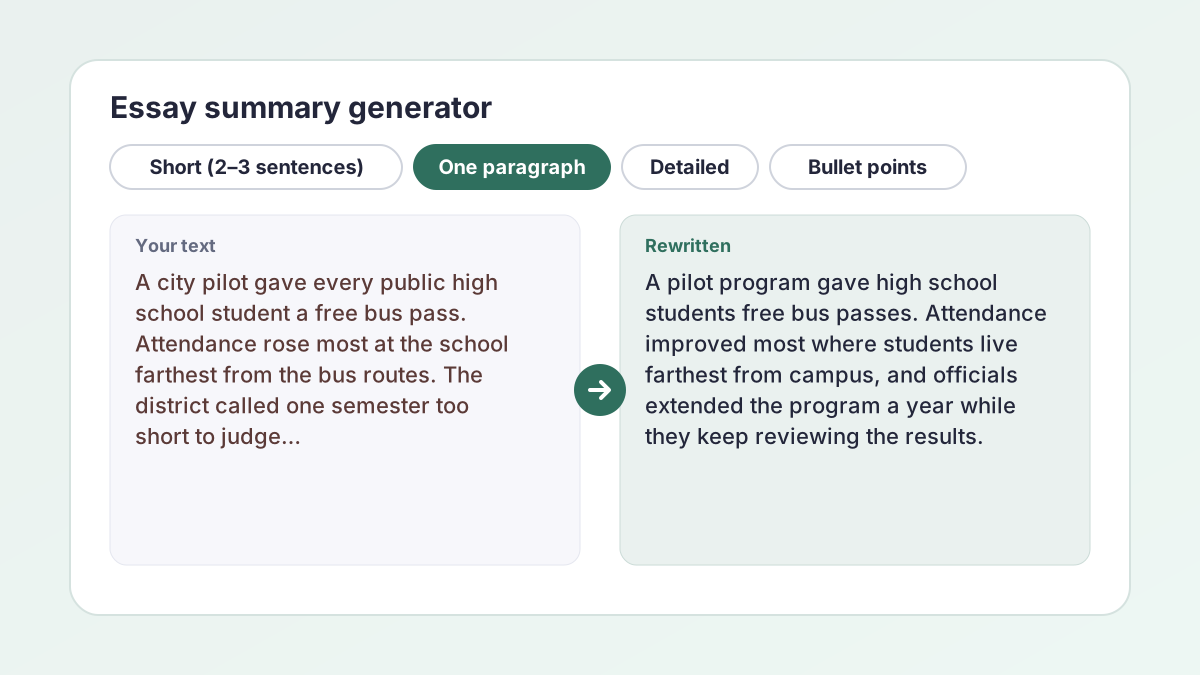
You pastedA mid-sized Ohio city gave every public high school student a free bus pass for one semester. Attendance improved most at the school where many students live more than two miles from campus; at the other two schools the change was small. Survey answers suggested students used the passes for after-school jobs and clubs as well as for getting to class. The transportation director warned that one semester is too short for firm conclusions. The school board extended the pilot and added two evening routes.
Illustrative resultA pilot program in a mid-sized Ohio city gave every public high school student a free bus pass. Attendance improved most at the school where students live farthest from campus, and students used the passes for jobs and clubs as well as for getting to class. The transportation director warned that one semester is too short for firm conclusions, but the school board extended the pilot for a second year and added two evening routes.
Main idea first, then the supporting points in the order the text gives them. The director's caution stays in the summary.
You pastedThe same article about the free bus pass pilot.
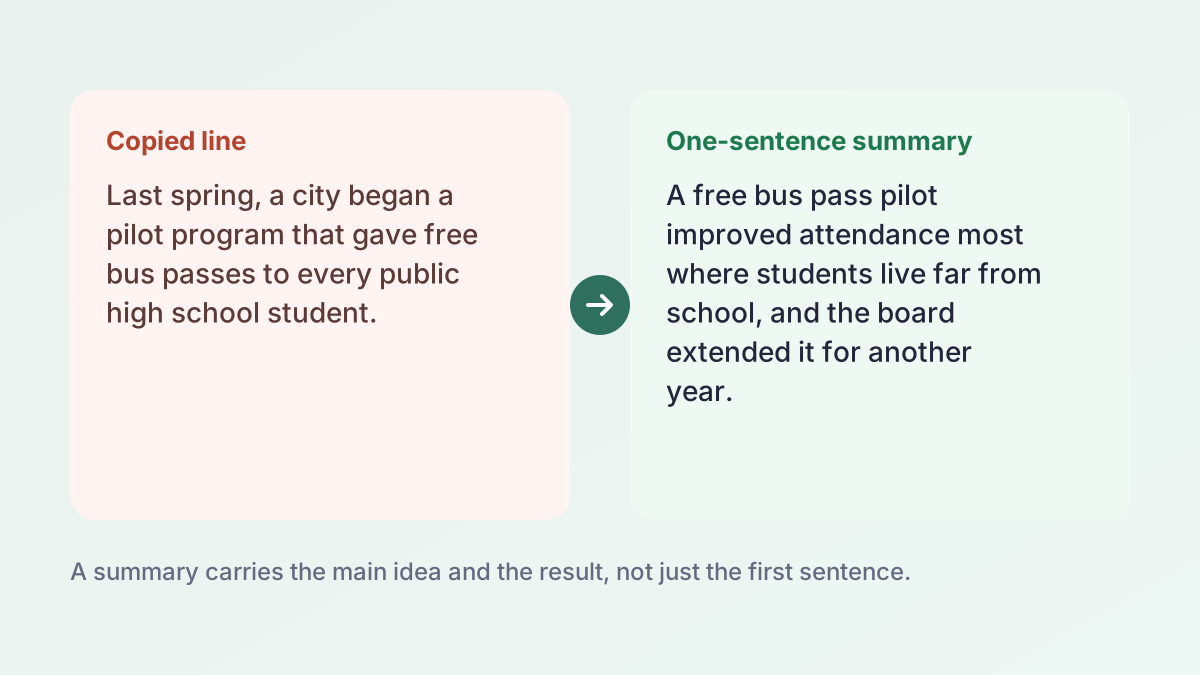
Illustrative resultA free bus pass pilot improved attendance most where students live far from school, and the board extended it for another year while it reviews the results.
Every result includes this second text, so you do not need to ask for it. It stays under 35 words.
You pastedTextbook excerpt on the Dust Bowl: Settlers plowed up millions of acres of prairie grass to plant wheat. When a long drought began in the 1930s, the crops failed and the exposed soil had nothing to hold it. Strong winds lifted the dry topsoil into huge dust storms, which damaged farms and forced many families to leave the Great Plains.
Illustrative result- Settlers plowed up prairie grass to plant wheat. - A long drought began in the 1930s and the crops failed. - Bare, dry soil had nothing to hold it in place. - Strong winds lifted the topsoil into dust storms. - The storms damaged farms and pushed many families off the Great Plains.
The focus box (here, the causes) tells the generator what to give more weight. Each bullet is a single line.
You pastedExcerpt from an invented nursing study: Two hospital units tested bedside reminders to wash hands. The unit that used the reminders recorded more hand hygiene by the end of the study period than the comparison unit. The authors note that staff may have changed their behavior simply because they knew they were being observed, and that results from two units may not apply to other hospitals.
Illustrative resultThe study compared two hospital units to see whether bedside reminders could improve hand hygiene. The unit that used reminders recorded more hand hygiene by the end of the study period than the comparison unit did. The authors caution that staff may have changed their behavior because they knew they were being observed, and that results from two units may not apply to other hospitals.
The summary keeps the authors' hedging (“may”) instead of turning a cautious finding into a firm claim. Detailed mode runs about 200 to 300 words on a full-length text.
You pastedWater on Earth is always moving. The sun heats oceans, lakes and rivers, and some of the water evaporates into the air as vapor. High in the sky the vapor cools and condenses into clouds. When the droplets get heavy enough they fall as rain or snow, and the water runs back into rivers, lakes and oceans to begin again.
Illustrative resultWater on Earth moves in a cycle. The sun makes water evaporate, the vapor condenses into clouds, and the water falls back as rain or snow and flows to the oceans again.
Setting Level to Middle school keeps the vocabulary simple. Short mode gives two or three sentences.
You pastedInvented opinion column: The writer argues that community colleges deserve more attention in the college debate. She points to low tuition, evening classes for working adults and transfer agreements with state universities, and she says students who start there often save thousands of dollars before transferring. She admits that transfer credits do not always count.
Illustrative resultThe author argues that community colleges deserve more attention because they offer low tuition, evening classes and transfer agreements with state universities. She says students who start there can save a lot of money before transferring, though she admits that transfer credits do not always count.
With the focus set to “the author's argument,” the summary leaves out the background and stays with the claim and its reasons.
How to use the essay summary generator
You need a text of at least 200 characters. Everything else on the form has a sensible default.
- Paste your text. Put your essay, article, chapter or report in the Text to summarize box. It takes up to 15,000 characters, and a live count shows the words and characters you have used.
- Choose the summary length. Under Summary, pick Short (2–3 sentences), One paragraph, Detailed or Bullet points. One paragraph is selected to start.
- Say what to focus on. Optionally type a few words in What to focus on, such as the causes, the author's argument or the results. Leave it blank for an overall summary.
- Set the level and spelling. Choose High school, College, Middle school or Graduate under Level, and US English or UK English under Spelling.
- Select Summarize. Read the Summary and the One-sentence summary. Use Copy on either one, or Generate more for another version.
What an essay summary generator does
An essay summary generator shortens a text while keeping its meaning. You paste in the original and it returns a version that states the main idea first, then the most important supporting points, in the order the text gives them.
A good summary is not a few sentences lifted from the original. As Columbia University's writing handout on summaries puts it, a summary restates the author's main point, purpose and supporting details in your own words, and unless your instructor says otherwise, it contains only the author's views.
The essay summary generator follows the same rules:
- Main idea first, then the supporting points.
- Your text only. It does not add outside facts, and it does not guess the author, date or source unless you give them.
- No opinions. It reports what the text says without evaluating it.
- Same level of certainty. If the author writes “may” or “some,” the summary keeps those words.
What you get back
Each run of the summarizer returns two separate results, each with its own Copy button and a word count: a Summary in the length you chose, and a One-sentence summary of under 35 words.
Summary length: short, paragraph, detailed or bullets
The Summary chip sets how much comes back. The essay summary generator can summarize the same text four ways, and each suits a different job.
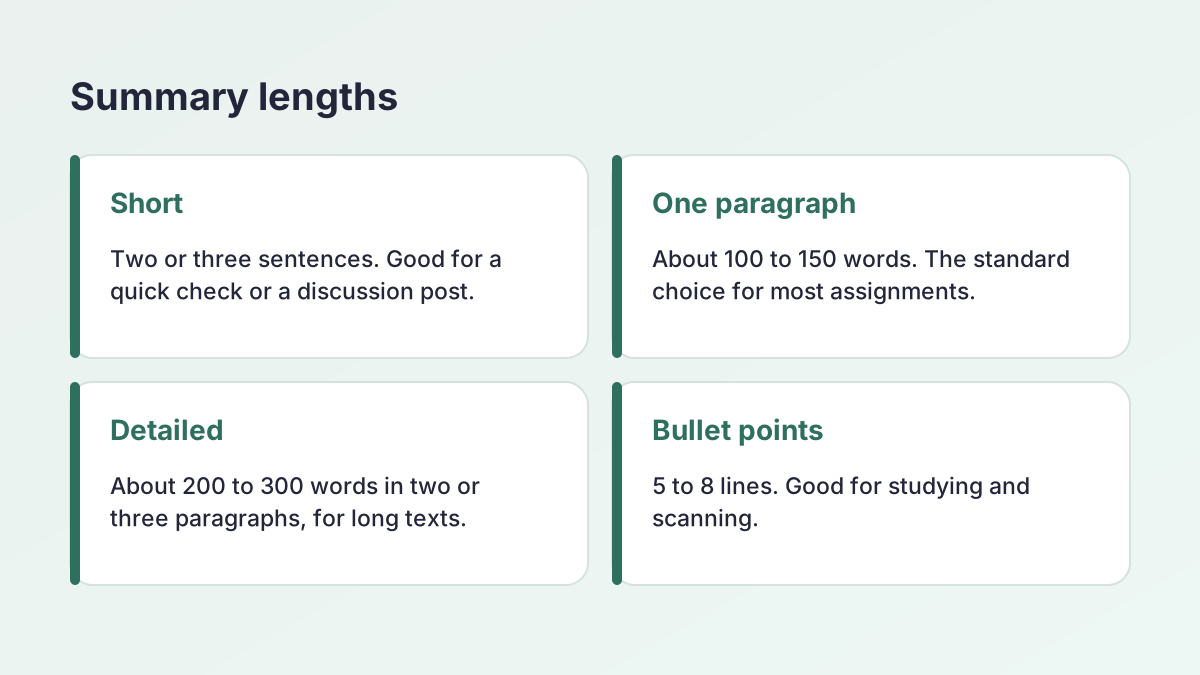
Short (2–3 sentences)
The fastest option. Use it to check that you understood a reading, to open a discussion post or to decide whether an article is worth reading in full.
One paragraph
About 100 to 150 words. This is the default, and it fits most assignments that ask for “a summary of the reading.”
Detailed
About 200 to 300 words in two or three paragraphs. Choose it for a long chapter, a report with several sections or a text where the order of ideas matters.
Bullet points
Five to eight bullets, each a single line. Bullets are easiest to scan, so they suit studying more than an assignment that wants full sentences.
If a teacher gave you a word count, pick the closest length and trim by hand. If you are unsure, start with One paragraph.
The one-sentence summary that comes with every result
Next to the main summary you always get a one-sentence summary of under 35 words. It states what the whole text is about and gives the most important result or claim.
Why a one-sentence summary helps
- Annotations and reading logs. Many classes ask for a single line per reading.
- Thesis spotting. If the one-sentence summary does not match what you thought the text argued, reread the original.
Read it and ask whether someone who had not read the text would understand the main point. If not, add a focus and run it again.
For a method you can practice by hand, see the guide on how to summarize.
Article summary generator for news, journals and textbooks
The same tool works as an article summary generator. The type of text changes what a good summary looks like.
News and magazine articles
Check that the summary answers who, what, when and why. News articles often put the main point in the first paragraph, so a short summary may be enough.
Journal articles and reports
Use Detailed and set the focus to what you need, such as the research question, the method or the results. The generator is told to keep words like “may” and “some,” but check the authors' cautions yourself.
Textbook chapters
Paste one section at a time, not the whole chapter. A section of a few pages gives a sharper summary than 15,000 characters of mixed topics.
Essays and op-eds
Set What to focus on to the author's argument. You will get the claim and the reasons, without the background.
Stories and novels
For fiction, the summary covers what happens and to whom. Interpreting symbolism is analysis, not summary; for that, try the Quote Analysis Tool.
Use the focus box and level to shape the summary
Two settings change a summary more than anything else.
What to focus on
In this summarizer the optional focus box takes up to 200 characters. It tells the generator what to give more weight. Useful focuses include:
- The causes of an event in a history reading
- The author's argument in an essay or editorial
- The results of a study
- The main characters and what they want in a chapter of fiction
- The steps in a process described in a science or nursing text
The summary will still cover the main idea. The focus only changes the emphasis, so it will not drop everything else.
Level
Level offers High school, College, Middle school and Graduate. It sets the reader the summary is written for, which mainly affects wording and vocabulary; the length still comes from the Summary chip. High school is the default.
- Middle school: the summary is written for a middle school reader, so expect simpler wording
- High school: written for a high school student
- College: written for a college student, so expect more formal wording
- Graduate: written for a graduate student
Why this summarizer sticks to your text
Many tools that shorten text also add to it. A good summarizer does not. The prompt behind this summarizer tells the model to use only information in your text, to write in its own words, and not to add opinions or evaluation.
What the generator will not invent
- Facts, statistics, dates or names that are not in your text
- The author or source, unless you provide them
- Opinions about whether the author is right
Quotation check
If a result contains a quotation of four or more words that cannot be found in your pasted text, it is followed by a note: [check this quote against your text]. Summaries rarely need quotations, but if one appears, check it before you rely on it.
What it cannot do
It cannot check whether your text is true. If the text contains an error, the summary will repeat it. It also reads only what you paste, so a table or chart in the original will not be summarized unless you describe it in the text. Always compare the summary with the original before you submit anything.
How to check a generated summary against the original
Reading a summary against the source takes about two minutes and catches most problems. Miami University's Howe Center handout on summaries suggests reviewing your draft to confirm that your main points match the original and that excess detail is gone. Use the same checks on any generated summary.
Four checks
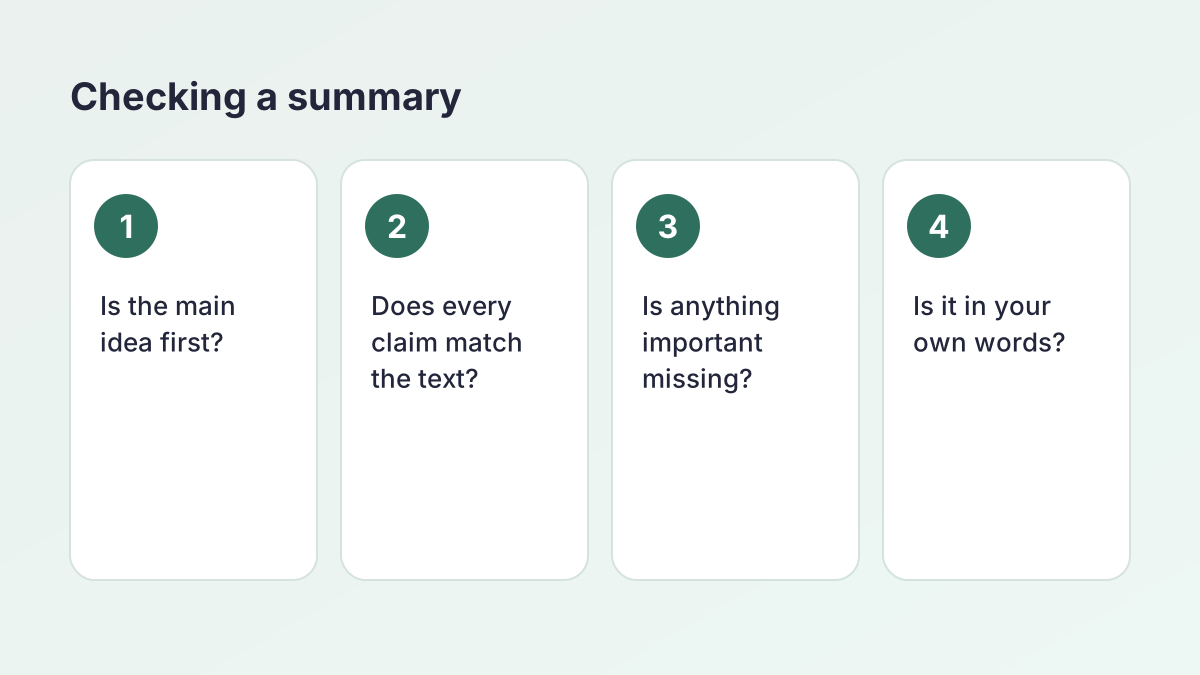
- Main idea. Does the first sentence say what the whole text is about?
- Accuracy. Pick three claims in the summary and find each one in the original.
- Coverage. Is any major section, result or objection missing?
- Wording. Is it in your own words, so that it sounds like you?
Fixing what you find
- If the summary is too general, choose Detailed or add a focus.
- If it is too long, choose Short or Bullet points.
- If it misses something important, name that topic in What to focus on and select Summarize again.
Using the essay summary generator in English, history, science and nursing
Teachers ask for summaries in different ways, so match the settings to the assignment.
English and literature
Use One paragraph and set the focus to the plot or the main character. A summary of a short story should name what happens, not what it means. Save meaning for your analysis.
US history and government
Set the focus to causes, effects or the main argument of a primary source. For a document such as an excerpt from a court case, use Detailed and ask for the issue and the decision.
AP and science classes
For an argument-heavy AP reading, use Detailed with the focus on the author's claim and evidence. For a lab article, focus on the question, method and result, and check numbers and units in the original.
Nursing and health courses
Students on clinicals often have to summarize a journal article or a care guideline. Choose College, use Detailed and set the focus to the findings or recommendations. A summary is not a substitute for reading a guideline before you apply it to a patient.
When a summary is not what you need
A summary is one way to work with a text. Others may suit the task better.
- You need the most important ideas, ranked. Use the Key Points Generator for the main idea plus 3, 5, 7 or 10 ranked points.
- You are studying for a test. The Study Notes Generator makes outline, Cornell, bullet or flashcard notes.
- You need practice questions. The Question Generator turns a text into quiz questions with answers.
- Your text is too complicated. The Text Simplifier rewrites hard passages in plainer language.
To check a word limit on your finished summary, use the Word Counter.
Is this AI summarizer free? Privacy and limits
Yes. This AI summarizer is free to use, with no account or sign-up. Each visitor can make up to 30 requests an hour, which keeps it fast for everyone.
What happens to your text
The text you paste and the focus you type are sent to our AI providers (Groq, with Google Gemini as a backup) only to write the summary you see. The Study Corp does not save your text or the result.
Do not paste anything you are not allowed to share, such as patient details or confidential records.
Using summaries honestly in school
A generated summary is a study aid and a draft, not a finished assignment.
- Read the original first. A summary of something you have not read will not help you in a discussion or on a test.
- Rewrite in your own words. Use the result to see the structure, then write your own version.
- Cite the source. If your summary appears in a paper, name the author and title, and cite it in the style your teacher asks for. The APA Citation Machine and MLA Citation Maker can format the reference.
- Follow your school's AI policy. Some classes allow AI for studying but not for submitted work. If unsure, ask your teacher.
Essay summary generator FAQ
Is the essay summary generator free?
Yes. It is free with no account or sign-up. Each visitor can make up to 30 requests an hour.
How long can the text be?
Up to 15,000 characters, which is roughly 2,500 words. For a longer reading, paste one section at a time. The text must be at least 200 characters.
What summary lengths can I choose?
Short (2–3 sentences), One paragraph, Detailed and Bullet points. Every result also includes a one-sentence summary.
Can it summarize an article from a website?
Yes, if you paste the text. It cannot open links, so copy the article text into the Text to summarize box.
Will the summary add facts that are not in my text?
It is instructed not to. It uses only your text, keeps the author's level of certainty and leaves out opinions. Still compare it with the original.
Can I get a summary that focuses on one part of the text?
Yes. Type a few words in What to focus on, such as the causes, the author's argument or the results. The focus box is optional and takes up to 200 characters.
Is my text saved?
No. It is sent to our AI providers (Groq, with Google Gemini as a backup) only to write the summary, and The Study Corp does not save it.
Can I submit the generated summary as my own work?
Use the summarizer to study and to draft, then write your own version and follow your school's AI policy.
More free study tools
- Key Points GeneratorThe main idea and the 3 to 10 most important points of any text, ranked.
- Study Notes GeneratorOutline, Cornell, bullet or flashcard notes from your class material.
- Question GeneratorQuiz and study questions from any text, with an answer key.
- Case Study Analysis GeneratorA structured analysis of your case: general, SWOT, PESTLE, clinical or ethics.
- Quote Analysis ToolMeaning, key words, devices and significance, plus a ready analysis paragraph.
- Rhetorical Analysis GeneratorSOAPSTone, appeals and rhetorical choices with exact quotes, or two AP-style body paragraphs.
- Poem Analysis ToolTheme, tone, structure and devices with quoted lines, plus a sample paragraph.
- Debate Argument GeneratorDefinitions, contentions with claim, warrant and impact, rebuttals and a closing.
- Speech GeneratorA timed speech for class, a campaign, graduation or a special occasion, with speaking notes.
See all 80 free tools for students
Free guides
Related tools
Last updated by The Study Corp editorial team.