Vancouver In-Text Citation Examples for Common Situations
The numbers in round brackets below come from our citation engine using the Vancouver style; the square-bracket and superscript versions, the page locators and the example sentences are written by hand. Page numbers are illustrative. Every number refers to the reference list built from real sources in our Vancouver referencing examples guide.
SituationYou paraphrase Watson and Crick's 1953 Nature paper, the first source in your paper.
Vancouver in-text citationDNA forms a double helix of two chains wound around one axis (1).
The first source cited is always 1, whatever its author's name.
SituationThree paragraphs later you cite Watson and Crick again, after citing sources 2 and 3.
Vancouver in-text citationThe pairing of bases suggested a copying mechanism (1).
A reused source keeps its first number; don't give it a new one.
SituationOne claim draws on sources 1 and 3.
Vancouver in-text citationMolecular biology rests on the structure of DNA (1,3).
Separate numbers with a comma, usually without a space.
SituationOne claim draws on sources 4, 5 and 6.
Vancouver in-text citationSeveral reviews reached the same conclusion (4-6).
Join three or more numbers in a row with a hyphen.
SituationYou name the first author of the vaccine trial, which has many authors.
Vancouver in-text citationPolack et al. (2) found the vaccine 95% effective.
Use et al. for three or more authors and put the number right after the name.
SituationYou point to one page of the WHO hand hygiene guidelines, source 6 (page illustrative).
Vancouver in-text citationThe WHO guidelines list the moments when staff should clean their hands (6 p. 12).
Add the page inside the brackets; the exact form varies by school.
SituationYour nursing program asks for superscript numbers.
Vancouver in-text citationDNA forms a double helix of two chains wound around one axis.¹
Many guides put superscripts after periods and commas.
How to Do In-Text Referencing in Vancouver, Step by Step
Use these steps for any nursing, medical or public health paper that asks for Vancouver style.
- Choose one number format. Check your syllabus or journal for round brackets, square brackets or superscript, and use that one format throughout.
- Number sources as you cite. Give the first source you cite 1, the next new source 2, and so on, in the order they first appear in your text.
- Reuse numbers for repeat sources. When you cite a source again, use its original number, even if it appears pages later.
- Group several sources. Separate numbers with commas, and join three or more in a row with a hyphen, as in (1,4-6).
- Add pages for quotations. When you quote, add the page inside the citation in the form your school uses, such as (6 p. 12).
- Build the reference list in number order. List each source once, by number, at the end of the paper under the heading References.
How a Vancouver In-Text Citation Works
Vancouver is the numbered citation style used across medicine, nursing and the health sciences. The name comes from a 1978 meeting of medical journal editors in Vancouver, Canada. Today the International Committee of Medical Journal Editors (ICMJE) sets the basic rule, and the National Library of Medicine's Citing Medicine gives the detailed format of each reference.
Instead of an author and year, a Vancouver in-text citation is just a number. The reader finds the full source by looking up that number in the reference list at the end of your paper. The ICMJE recommendations put it simply: references "should be numbered consecutively in the order in which they are first mentioned in the text."
The 7 rules at a glance
- Number sources in the order you first cite them, not alphabetically.
- Use one number format throughout: round brackets, square brackets or superscript.
- Give a repeated source the same number every time.
- Separate several numbers with commas and join a run of three or more with a hyphen.
- Put the number next to the author's name when you name the author in your sentence.
- Add a page number when you quote, in the form your school uses.
- Make every number match exactly one entry in the reference list.
Let the tool keep count
The Vancouver citation generator embedded above builds the numbered list for you. Paste a DOI, PubMed link, URL or ISBN, check the fields, and add sources in the order you cite them so the numbers line up with your text. It prints in-text numbers in round brackets, such as (1).
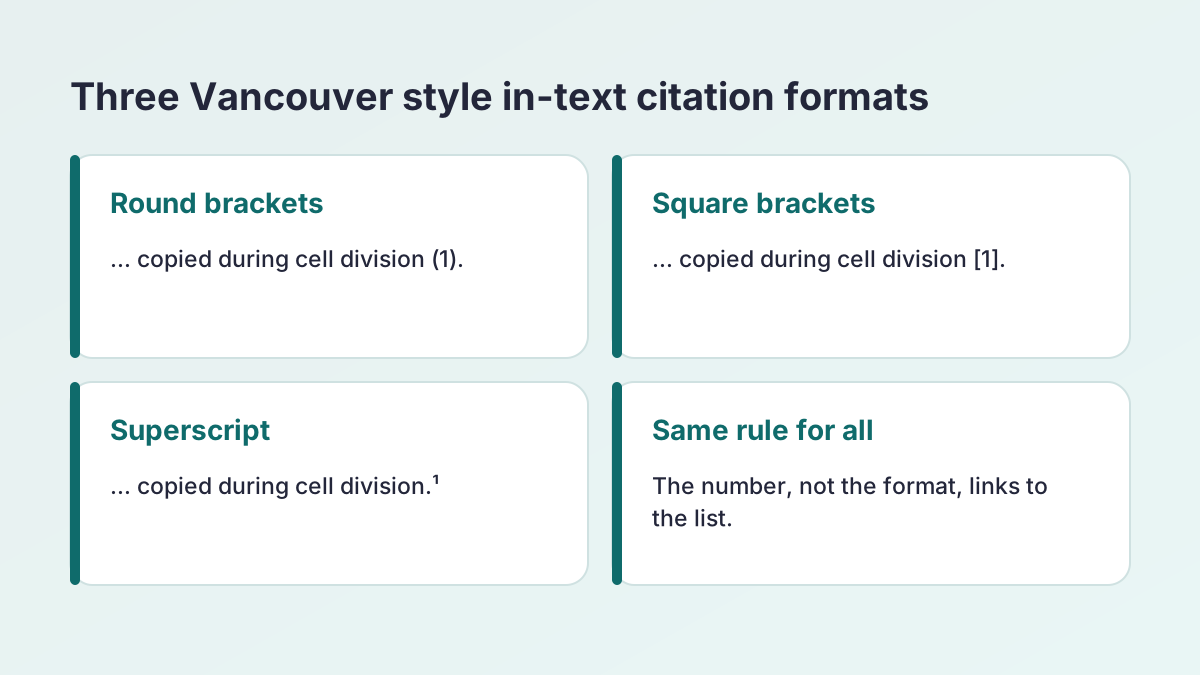
Brackets, Parentheses or Superscript: Vancouver Style In-Text Citation Formats
Students often ask which Vancouver style in-text citation format is correct. The honest answer is that all three are used. ICMJE asks for "Arabic numerals in parentheses," so many medical journals print (1). Many university library guides prefer superscript numbers. Monash University's guide, for example, uses superscript and accepts round or square brackets if your instructor prefers them, while the University of Queensland's guide uses superscript with no brackets.
Which one to choose
Your syllabus, your instructor or your target journal decides. If nothing is specified, round brackets are a safe choice because they match ICMJE and are easy to type.
Stay consistent
Whatever you choose, don't mix formats within one Vancouver in-text citation style. A paper with (1) on page 2 and a superscript³ on page 5 looks careless. If you switch formats late, use find and replace to fix every number at once.
Where the Number Goes: Punctuation and Placement
Put the citation right after the fact it supports, not at the end of a long paragraph. If a sentence draws on two sources for two different points, cite each one where its point ends. Placement against punctuation depends on the format you use, so check the table and then your school's guide.
| Format | Usual placement | Example |
|---|---|---|
| Round brackets | Before the period or comma (Monash: after) | … wound around one axis (1). |
| Square brackets | Before the period or comma (Monash: after) | … wound around one axis [1]. |
| Superscript (Monash, UQ) | After periods and commas; before colons and semicolons | … wound around one axis.¹ |
| Author named | Right after the name | Watson and Crick (1) proposed … |
Quotation marks and parentheses
Monash University's guide places superscript numbers outside quotation marks and closing parentheses. With round or square brackets, most writers put the citation right after the closing quotation mark and before the period: Watson and Crick described "two helical chains each coiled round the same axis" (1 p. 737).
Numbering Rules: Repeated Sources and Citation Order
The number follows the order of first citation. It has nothing to do with the author's name, the year or the type of source. If your first sentence cites a 2009 WHO report, the WHO report is 1, even though "World Health Organization" would come last alphabetically.
A repeated source keeps its number
When you cite the same source again, reuse its original number. The University of Queensland guide states it directly: "If the source is referred to again, the same reference number is reused." So if Watson and Crick are source 1 and you cite them again on page 6, they're still (1), even if you've cited sources 2 to 12 in between.
Several works by one author
In a Vancouver in-text citation, each separate work gets its own number. If you cite two different articles by the same research group, they get two numbers, such as (3) and (7), in the order you first cite each.
Vancouver In-Text Citation for Multiple Sources
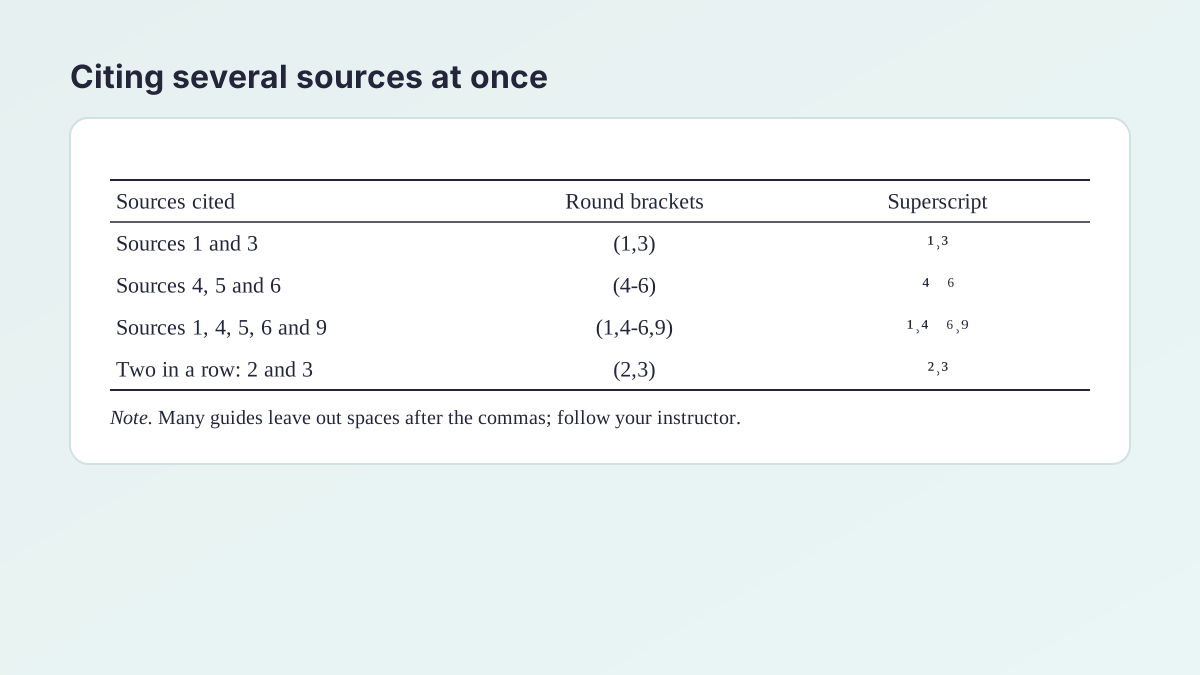
When one statement draws on several sources, put all their numbers in one Vancouver in-text citation. A Vancouver in-text citation for multiple sources follows two simple rules.
Separate numbers with commas
Use commas between numbers that aren't consecutive: (1,3) or (2,5,8). Most library guides, including Queensland's, leave out the spaces: (1,3) rather than (1, 3). Some instructors accept either.
Join a run with a hyphen
For three or more numbers in a row, give the first and last joined by a hyphen: (4-6) instead of (4,5,6). The Queensland guide adds a useful rule: "Do not use a hyphen if there are no citation numbers in between," so two consecutive sources are written (2,3), not (2-3).
Mixing both
You can combine the two: (1,4-6,9) cites sources 1, 4, 5, 6 and 9. In superscript, the same citation is written ¹˒⁴⁻⁶˒⁹, all raised. Keep the numbers in ascending order inside the brackets.
Naming Authors in Your Sentence
In a Vancouver style in-text citation, sometimes you want the author to be part of your sentence, for example when you compare two studies. You can name the author in the text and still give the number. Library guides call this an author-prominent citation; the alternative, with only the number, is information-prominent.
One, two, or three or more authors
- One author: Borkowski (7) surveyed Hispanic American parents about infant sleep.
- Two authors: Watson and Crick (1) proposed a double helix.
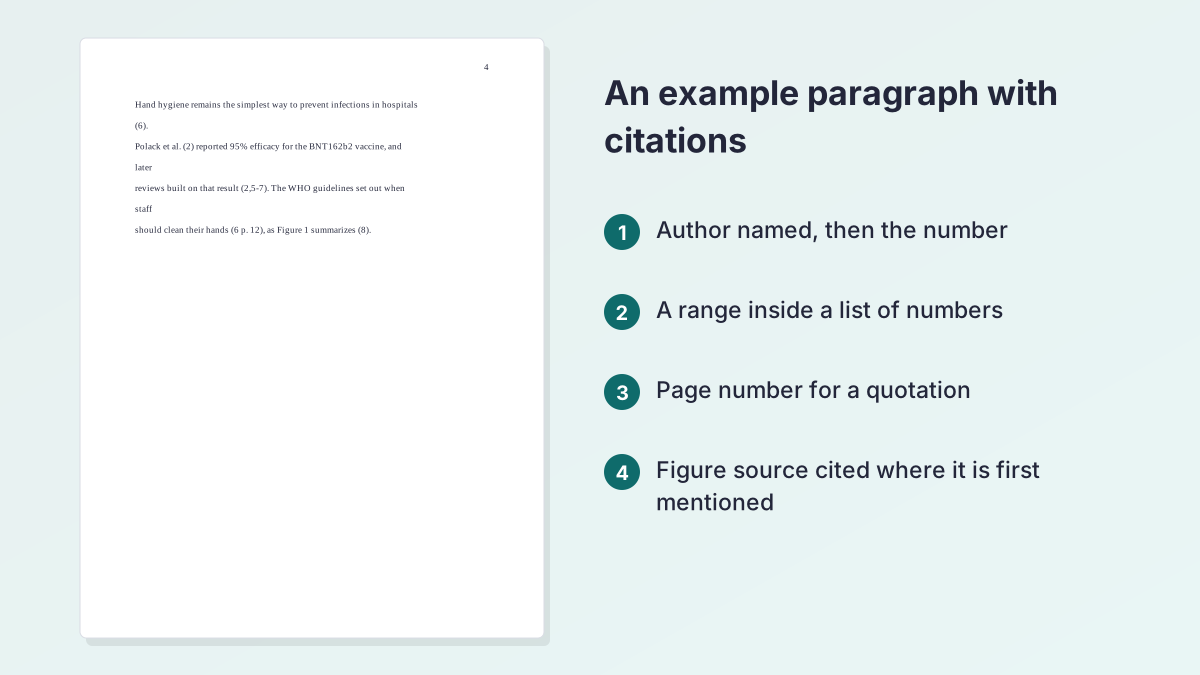
- Three or more authors: Polack et al. (2) reported 95% efficacy.
The number goes right after the name, not at the end of the sentence. Monash and Queensland both use "and" for two authors and "et al." for three or more.
Page Numbers in a Vancouver In-Text Reference
Vancouver doesn't require page numbers for paraphrases, because the reference list already gives the page range of an article or chapter. Add a page when you quote directly, or when you want to send the reader to one spot in a long book or report.
Forms you'll see
The format of a page number varies by school more than any other part of a Vancouver in-text reference. Common forms include:
- Round brackets: (6 p. 12) or (6, p. 12)
- Square brackets: [6 p. 12]
- Superscript: ⁶⁽ᵖ¹²⁾, with the page in parentheses after the number
- More than one page: (3 pp. 45-7)
Monash's guide writes "p" for one page and "pp" for several, in brackets after the number. The page numbers here are illustrative; take the real page from the source you quote.
Citing Sources in Tables and Figures
Tables and figures use the same Vancouver in-text citation numbers as your text. If a table reports data from source 4, cite (4) in the table title, a column heading or the note under the table.
The ICMJE rule for numbering
A source can appear for the first time in a table or figure legend. ICMJE says such references should be numbered in the sequence set by the first time you mention that table or figure in the text. So if your text first mentions Table 1 right after citing source 5, a new source that appears only in Table 1 becomes 6.
How the Numbers Match the Reference List
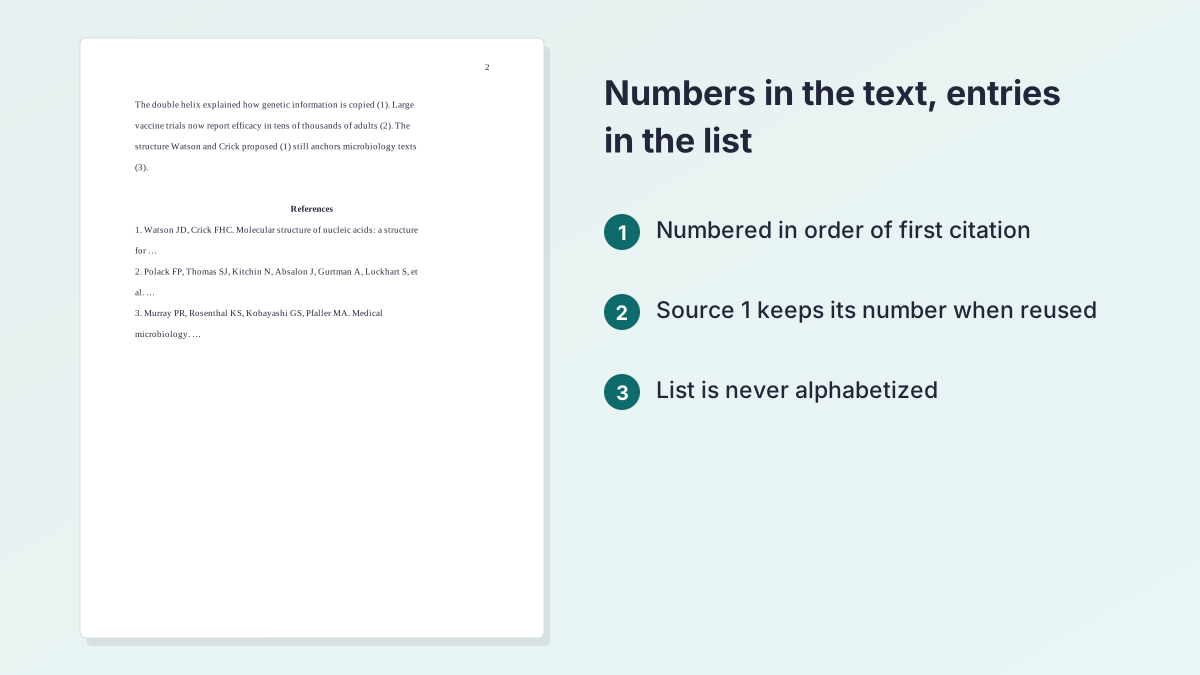
Every Vancouver in-text citation points to one entry in the list at the end, titled References. The list is numbered in the same order as your citations: entry 1 is the first source you cited, entry 2 the next new one, and so on. It's never alphabetized.
What each entry looks like
A journal article entry gives the authors as last name and initials, the article title, the abbreviated journal name, the date, volume, issue and pages: "1. Watson JD, Crick FHC. Molecular structure of nucleic acids: a structure for deoxyribose nucleic acid. Nature. 1953 Apr 25;171(4356):737–8." Our Vancouver referencing examples guide has worked entries for books, chapters, websites, WHO and CDC reports, theses and conference papers, plus a full sample list.
Example of Vancouver In-Text Citation in a Paragraph
Here's an example of Vancouver in-text citation in a short passage from an invented nursing student's paper, using round brackets. The numbers refer to the sample list in our Vancouver referencing examples guide.
The discovery of the double helix explained how genetic information is copied (1). In a trial of more than 40,000 participants, Polack et al. (2) found the BNT162b2 vaccine 95% effective. Both findings now appear in standard medical microbiology textbooks (3) and in reviews of cancer genetics (4). Watson and Crick (1) could not have predicted that reach.
What to notice
- The numbers run 1, 2, 3, 4 in the order each source first appears.
- Source 1 comes back in the last sentence with its original number.
- The author-prominent citations put the number right after the names.
- Sources 3 and 4 could also be cited together as (3,4) if they supported the same clause.
The most common slip in a Vancouver in-text citation is breaking that order: numbers must follow the order sources first appear on the page, not the order you found them.
In-Text Referencing Vancouver vs. APA and IEEE
If you've used other styles, in-text referencing in Vancouver will feel closest to IEEE, which also numbers sources in order of first citation.
| Style | In-text form | Reference list order |
|---|---|---|
| Vancouver | (1), [1] or superscript¹ | By number, in citation order |
| IEEE | [1] on the line, never superscript | By number, in citation order |
| APA 7 | (Watson & Crick, 1953) | Alphabetical by author |
| MLA 9 | (Watson and Crick 737) | Alphabetical by author |
Where to learn the others
The IEEE reference format guide covers bracketed numbers in engineering, the APA format guidelines guide covers author-date citations, and the MLA in-text citation guide covers author-page citations. If your instructor wants AMA style, which also uses superscript numbers in order of citation, the AMA citation generator handles that version.
Common Vancouver In-Text Citation Mistakes
These are the errors instructors mark most often in Vancouver style citation in text, with the fix for each.
| Mistake | Fix |
|---|---|
| Numbering sources alphabetically | Number them in the order you first cite them |
| A new number for a repeated source | Reuse the source's first number every time |
| Mixing (1), [1] and superscripts | Pick one format and use it throughout |
| Writing (4,5,6) | Join three or more in a row: (4-6) |
| Writing (2-3) | Two consecutive numbers take a comma: (2,3) |
| Author and year, as in (Polack, 2020) | Use the number only, or name the author and add the number |
| Citation numbers that skip or jump | Renumber after revising so first citations run 1, 2, 3 |
| A number with no matching entry | Check every number against the reference list |
Where the Vancouver Rules Come From
There's no single Vancouver citation style manual for in-text citations. Two sources set the core rules, and university guides fill in the details.
ICMJE and NLM
The ICMJE Recommendations set numbering in order of first mention and Arabic numerals in parentheses. The National Library of Medicine's Citing Medicine, 2nd edition, is the full manual for formatting the references themselves, and its journal article chapter gives the pattern most of your entries will follow.
University library guides
Details such as superscript placement and page number format come from library guides, which differ slightly. Monash University's Vancouver guide is one of the clearest. When your school publishes its own guide, it overrides any general advice, including this page.
Next steps
When your citations are in place, let the Vancouver reference generator format the list, then compare it with the worked entries in our Vancouver referencing examples guide. Every guide we publish is listed on the student writing guides page.
Vancouver In-Text Citation FAQ
How do you do an in-text citation in Vancouver style?
Put a number in place of the author and year. The first source you cite is 1, the next new source is 2, and each number matches an entry in the reference list.
Is a Vancouver in-text citation in brackets or superscript?
Either. ICMJE uses round brackets, many university guides use superscript, and some schools use square brackets. Follow your instructor and stay consistent.
Does the in-text citation go before or after the period in Vancouver?
Superscript numbers usually go after periods and commas. Bracketed numbers usually go before the period, inside the sentence. Check your school's guide.
What if I cite the same source twice in Vancouver?
Use the same number again. A source keeps the number it got when you first cited it.
How do you cite multiple sources in Vancouver in-text?
Separate numbers with commas, as in (1,3), and join three or more consecutive numbers with a hyphen, as in (4-6).
How do you put page numbers in a Vancouver in-text citation?
Add the page after the number when you quote, such as (6 p. 12) or a superscript ⁶⁽ᵖ¹²⁾. The exact form varies by school.
Can you name the author in a Vancouver in-text citation?
Yes. Name the author and put the number right after: Watson and Crick (1), or Polack et al. (2) for three or more authors.
Is the Vancouver reference list in alphabetical order?
No. It's numbered in the order you first cite each source, so entry 1 is the first source in your text.
More free guides
- Vancouver Referencing ExamplesReference list examples for journals, books, websites and reports in Vancouver style.
- MLA In-Text CitationsAuthor-page citations for every kind of source, with examples.
- How to Cite a Website in MLAWorks Cited entries and in-text citations for web pages.
- MLA Works Cited PageFormat, order and hanging indents, with a full example page.
- MLA Annotated BibliographyFormat, annotation types and a complete example.
- APA Table FormatNumber, title, body and notes for APA 7 tables, with templates.
See all 80 free tools for students
Related tools
Last updated by The Study Corp editorial team.