ASA Style Paper Example: Common Mistakes and Fixes
Each pair shows a habit instructors often mark and the form that fits ASA's 7th edition. The in-text forms and reference entries came from our citation engine; italics don't show here, so italicize journal and book titles. The mistakes in the left column were written by hand.
Common mistake(Granovetter, 1973)
ASA 7 style(Granovetter 1973)
ASA puts no comma between the name and the year.
Common mistake(Hochschild 1983, p. 7)
ASA 7 style(Hochschild 1983:7)
The page follows a colon with no space and no p.
Common mistake(Aiken, Clarke, Sloane, Sochalski, and Silber 2002)
ASA 7 style(Aiken et al. 2002)
Use the first author's surname and et al. for four or more authors.
Common mistakeGranovetter, M. S. (1973). The strength of weak ties. American Journal of Sociology, 78(6), 1360–1380.
ASA 7 styleGranovetter, Mark S. 1973. “The Strength of Weak Ties.” American Journal of Sociology 78(6):1360–80. doi:10.1086/225469.
The left side is APA. ASA gives full first names, a bare year and title case.
Common mistakeHochschild, A. R. (1983). The managed heart. University of California Press.
ASA 7 styleHochschild, Arlie Russell. 1983. The Managed Heart: Commercialization of Human Feeling. Berkeley, CA: University of California Press.
Publisher location comes before the publisher, with a colon between them.
Common mistakeData and Methods (bold, centered)
ASA 7 styleDATA AND METHODS (capitals, flush left, not bold)
That is how the university guides describe level 1. Check your instructor's version.
How to Format an ASA Style Paper, Step by Step
These steps turn the ASA style guidelines in university guides into a checklist for any ASA style paper. Where guides disagree, the safe choice is named.
- Set up the page. Use 1-inch margins unless your instructor asks for more, a 12-point serif font such as Times New Roman, double spacing everywhere, and page numbers at the top right.
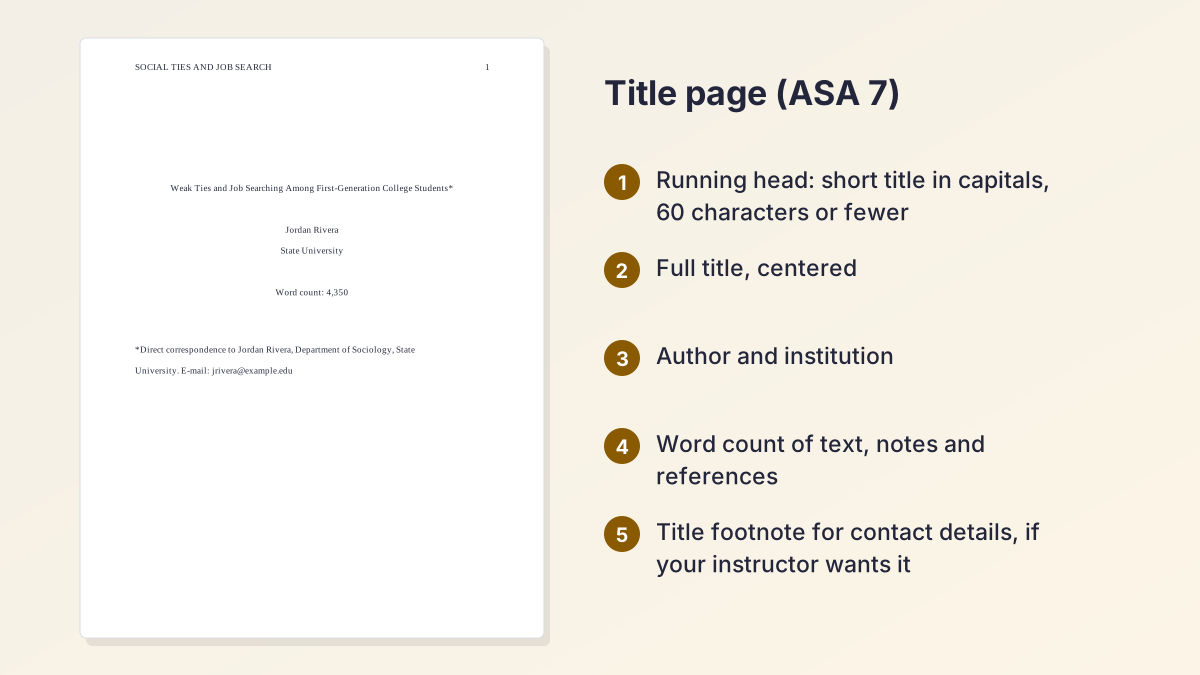
- Build the title page. For the ASA style title page, add a running head in capitals, the full title, your name, your institution and a word count. Add the title footnote only if your instructor wants it.
- Add the abstract. If it's required, start a new page with the title, then one paragraph of up to 200 words and three to five keywords.
- Write with headings. Begin the text on a new page with the title. Use level 1 capitals, level 2 italics and level 3 run-in italics, without numbering.
- Cite as you write. Use the surname and year in parentheses with no comma, plus a colon and the page for a quotation or a specific passage.
- Finish with References. Start a new page labeled References. Alphabetize, double-space, use a 0.5-inch hanging indent and match every entry to a citation.
What Are the ASA Style Guidelines?
The American Sociological Association publishes the ASA Style Guide, now in its seventh edition (2022). Sociology and criminology instructors assign it, and ASA's own journals use it. The ASA style guidelines cover three things: how a manuscript is laid out, how you cite sources in the text, and how you list them at the end.
Why guides disagree
ASA's guide is written for journal authors, and classroom handouts adapt it. One handout says ASA doesn't separate student and professional requirements, so follow your instructor. Where guides differ, this page says so.
Sources for this guide
It draws on the seventh-edition handouts from Douglas College, CSU Channel Islands, Sierra College and several other libraries, plus the manuscript checklist on asanet.org. Entries on this page were formatted with our engine; the free ASA citation generator does the same for your sources.
Margins, Font, Spacing and Page Numbers
Page setup is where an ASA style paper is least consistent from guide to guide. Use this table, and when your instructor gives a number, use theirs.
| Setting | What the guides say | Safe choice |
|---|---|---|
| Margins | 1 inch (Douglas College, Sierra College); at least 1.25 inches (one handout and ASA's journal checklist) | 1 inch for a class paper |
| Font | 12-point serif such as Times New Roman (Douglas College); Times New Roman or Palatino (one handout); Arial preferred for journal manuscripts | 12-point Times New Roman |
| Spacing | Double-spaced throughout, including the title page, references and block quotations | Double-space everything |
| Page numbers | Sequential; top right is the common choice, and ASA doesn't fix a location | Top right, every page |
| Indents | Paragraphs indented 0.5 inch | Use the paragraph setting, not spaces |
Running head
The running head is a shortened version of the title in capital letters at the top left of each page. The guides above cap it at 60 characters.
The ASA Style Title Page
The ASA style title page is a separate first page that holds everything a reader needs to identify the paper. For an ASA style title page, the seventh-edition guides list the same pieces: the full title, the name and institution of each author, the word count and a title footnote. There's no course or instructor line in the guides' lists, unlike APA, so add one only if your instructor asks.
What goes on it
- Running head: a shortened title in capitals, top left, with page number 1 at the top right.
- Title: the full title, centered, with a capital after any colon. A Sierra College guide suggests 10 to 12 words with no abbreviations and no italics, underlining or bold; a handout from Austin Peay State University shows the title in bold.
- Author and institution: your name and school on separate lines. Co-authors are stacked vertically.
- Word count: the total for text, notes and references.
- Title footnote: an asterisk after the title, with a footnote giving the corresponding author's address and e-mail plus any acknowledgments. Ask whether your class wants it.
ASA citation title page for a class
Students searching for an ASA citation title page sometimes expect an APA-style cover page. The free title page generator can produce a separate first page that you adapt to the ASA items above. It follows APA, so change the lines yourself.
ASA style title page sample
The first illustration above is an ASA style title page sample for an invented paper. Copy its order, then replace the details.
The Abstract and Keywords
Include an abstract in your ASA style paper only when the assignment requires one. The university guides agree on the details. It starts on a new page after the title page, repeats the title as its heading, and runs as a single paragraph of no more than 200 words in your own words. ASA's journal checklist asks for 150 to 200 words and a descriptive summary without jargon.
Keywords
If you need keywords, list three to five after the abstract on the same page, in italics.
ASA Style Headings: Three Levels
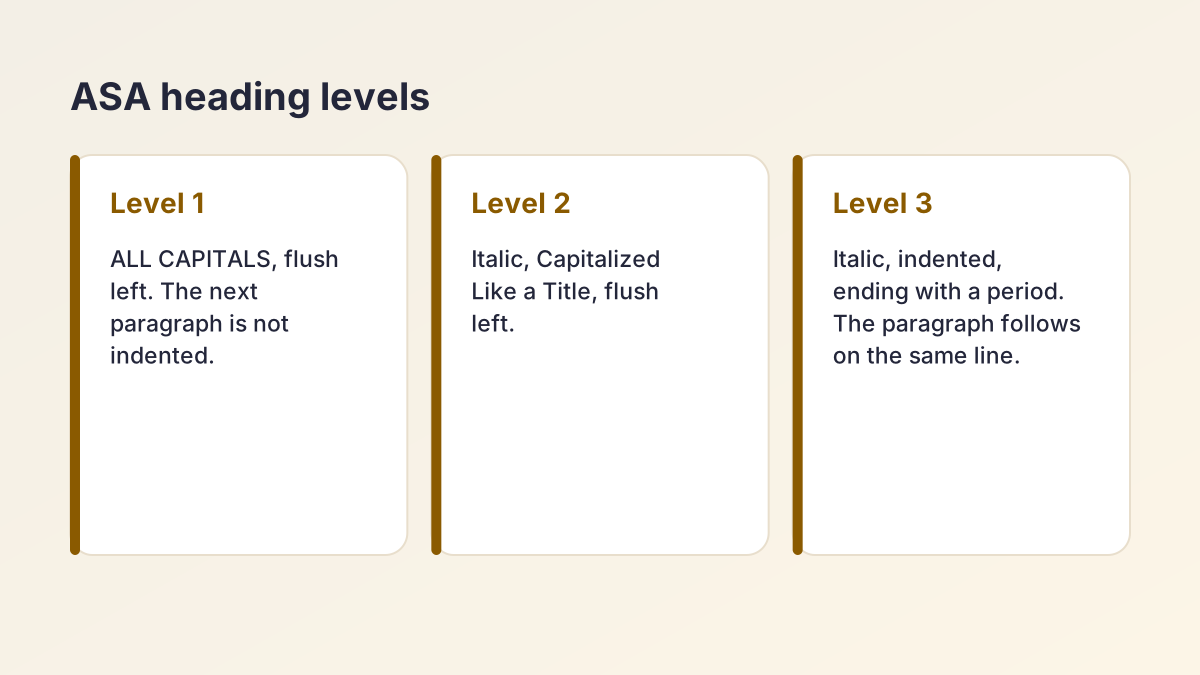
ASA style guidelines for headings are simpler than APA's. There are three levels, all in the same type size as the text, and most class papers use only the first two.
| Level | Format | Where the text begins |
|---|---|---|
| 1 | ALL CAPITALS, flush left | New paragraph, not indented |
| 2 | Italic, capitalized like a title, flush left | New paragraph |
| 3 | Italic, indented, ending with a period; capitalize only the first word and proper nouns | Same line as the heading |
Level 2 capitalization
The Jefferson Community and Technical College guide describes level 2 as italic title case: capitalize the major words and leave prepositions, articles and coordinating conjunctions lowercase. Don't bold the headings, and don't number them.
ASA style essay or short paper
A short ASA style essay may need no headings at all, though a long ASA style paper usually does. Add level 1 headings once the paper has distinct parts, such as Background, Data and Methods, Results and Discussion. The sample outline below shows a typical order.
Citing Sources in the Text: Author Year:Page
ASA is an author-date system, so you cite the author's surname and the year in the sentence and give the full source in the references. This is the pattern most often missed: there is no comma between the name and the year, and the page follows a colon. For a full set of forms, the ASA in-text citation generator formats them from your source.
The basic forms
- Author in your sentence: Granovetter (1973) argued…, with the page after the year for a quotation: (1973:1362).
- Author in parentheses: (Granovetter 1973) or (Granovetter 1973:1362).
- Two authors: both surnames joined by "and" every time: (Walker and Allen 2004).
- Several sources: separate with semicolons: (Granovetter 1973; Merton 1938).
- Same author, several years: Wilson (1978, 1987).
Three or more authors
Guides differ here. The Texas A&M-San Antonio and CSU Channel Islands guides say to name all three authors the first time and use et al. afterward, and to use et al. from the start for four or more. Check which rule your instructor uses, and apply it consistently.
Page numbers and block quotes
Include a page only when you quote or point to a specific passage. Quotations of 50 or more words become an indented block with no quotation marks. Most guides single-space it, but Douglas College double-spaces block quotations, so ask your instructor.
The ASA Citation Reference Page
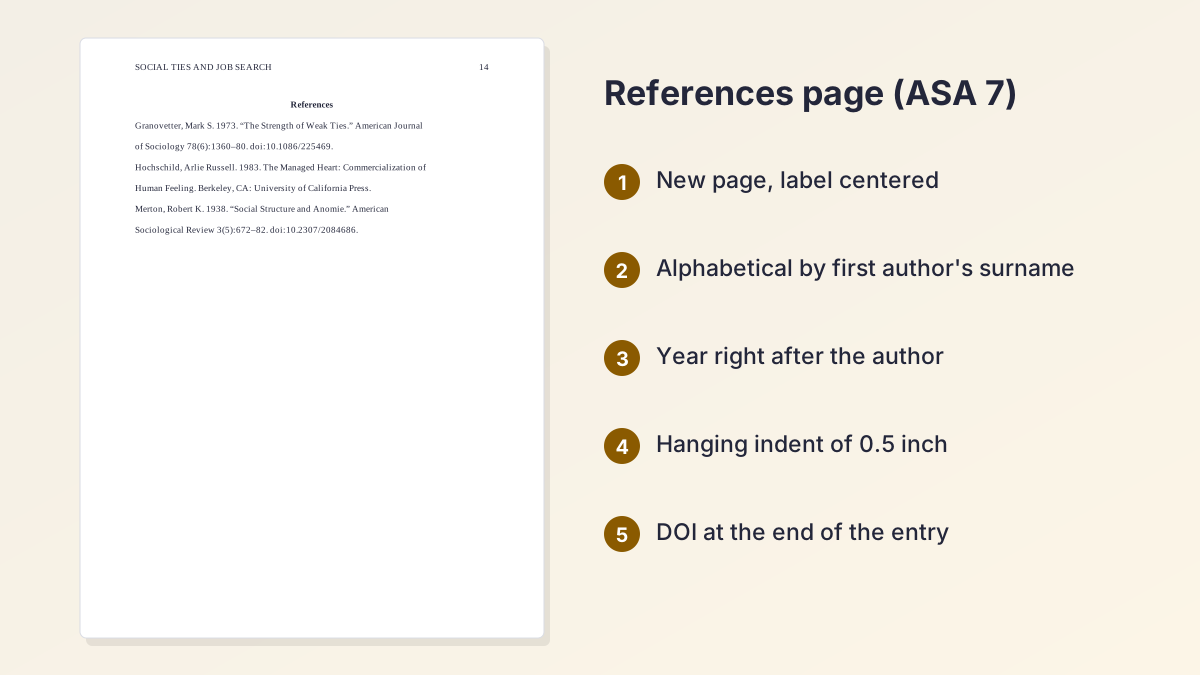
In an ASA style paper, the ASA citation reference page lists every work you cited, and only those. It begins on a new page after the text and before any tables, figures or appendices, with References centered at the top. Guides differ on whether the label is bold, plain or all capitals, so match your instructor's example.
Setting up the ASA citation reference page
Double-space the whole list, including between entries. Alphabetize by the first author's surname, and put works with no author under the first significant word of the title. Give each entry a hanging indent of 0.5 inch (several guides give this number; Douglas College says to indent later lines five to seven spaces). Use "and" rather than an ampersand.
Example entries
These entries were rendered with the engine. Italicize the journal and book titles in your paper.
- Granovetter, Mark S. 1973. “The Strength of Weak Ties.” American Journal of Sociology 78(6):1360–80. doi:10.1086/225469.
- Hochschild, Arlie Russell. 1983. The Managed Heart: Commercialization of Human Feeling. Berkeley, CA: University of California Press.
- Merton, Robert K. 1938. “Social Structure and Anomie.” American Sociological Review 3(5):672–82. doi:10.2307/2084686.
Seventh-edition details
Only the first author's name is inverted. Page ranges drop repeated digits: 1360–80, not 1360–1380. The DOI follows doi: with a final period in the CSU Channel Islands handout; other guides vary.
Format your entries
Paste a source into the citation tool above, or use the ASA citation generator, to get entries in this pattern. Review them against your source.
Footnotes, Endnotes and Tables
The ASA style guidelines ask you to use notes sparingly. The Douglas College guide gives three reasons: to explain or expand on the text, to cite material that readers can't easily find, and to add information to a table. Mark a note with a superscript number, and keep one type, footnotes or endnotes, for the whole paper. Footnotes on the title page and in tables are the exception.
Footnotes or endnotes
Footnotes sit at the bottom of the page where the number appears. Endnotes gather in a section titled Notes or Endnotes. Guides disagree on where it goes, and ASA's journal checklist puts Endnotes after the references, so ask your instructor. Double-space either type.
Tables and figures
Number tables and figures separately and in order (Table 1, Figure 1). Table titles sit left-aligned above the table and figure captions below the figure, per the Sierra College guide. That guide puts tables at the end, each on its own page, as ASA's journal checklist does; ask whether your class allows tables in the text. For comparison, APA table format shows the APA version.
Appendices
Label appendices with letters, Appendix A and Appendix B, each with a title. A single appendix is simply labeled Appendix.
ASA Style Paper Example: A Full Sociology Outline
Here's an ASA style paper example in outline form. The paper is invented, for a sociology course; the three cited works are real and match the reference page above. Your assignment may override parts of it.
| Part | What goes there | Format |
|---|---|---|
| Title page | Weak Ties and Job Searching Among First-Generation College Students; author; State University; word count; running head | Separate page, centered title |
| Abstract | One paragraph, 200 words or fewer, on the question, data, finding and meaning; three to five keywords | New page, title above |
| Opening | The research question and why it matters, citing (Granovetter 1973) | Starts under the title, no label |
| BACKGROUND | Weak ties and job information; social structure and goals (Merton 1938) | Level 1, with a level 2 heading inside |
| DATA AND METHODS | The sample, measures and analysis plan | Level 1; level 3 run-in headings for Sample. and Measures. |
| RESULTS | Findings in prose, with Table 1 referred to by number | Level 1 |
| DISCUSSION AND CONCLUSION | What the findings mean, limits and next steps, with emotional labor (Hochschild 1983) as one point of comparison | Level 1 |
| REFERENCES | Granovetter, Hochschild and Merton entries | New page, hanging indent |
ASA style paper example: sample first paragraph
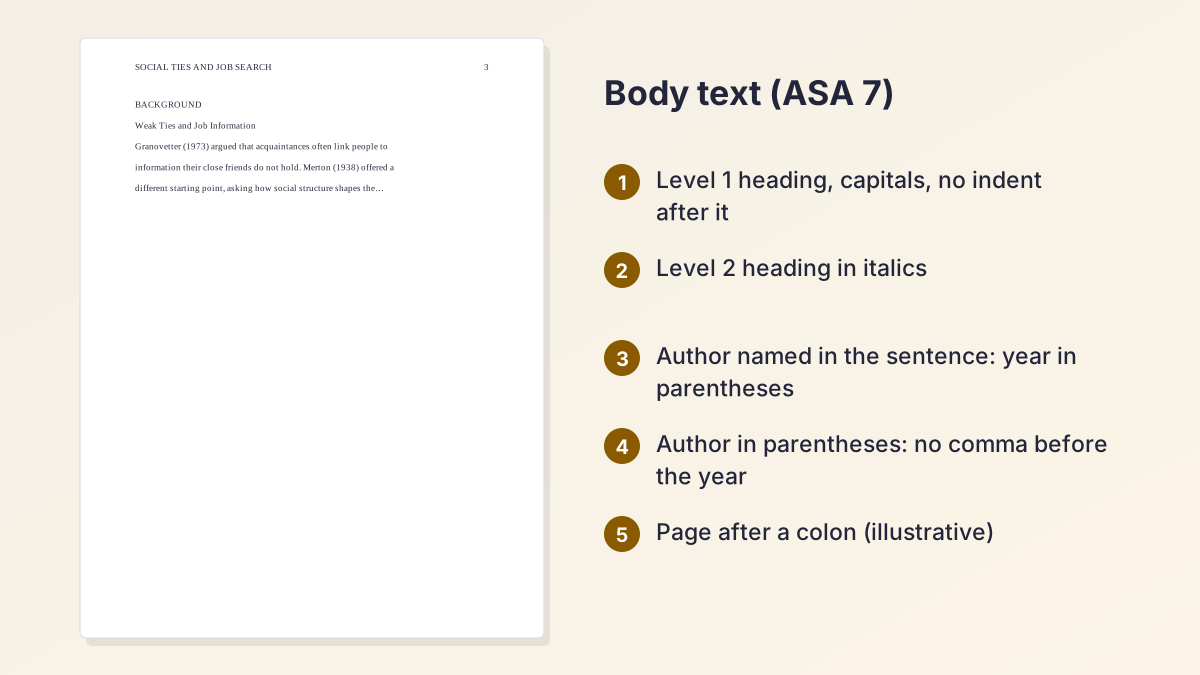
The last illustration above shows body text with a level 1 heading, a level 2 heading and two citations. Its page number is illustrative.
ASA vs. APA: Which Rules Differ?
Many sociology students also write in APA, and the pages look alike. The big differences are the citation form, (Author Year:Page) against (Author, Year, p. #), the title page, and the reference entries, which use full first names and a bare year in ASA. For APA setup, see the APA format guidelines. To compare two author-date systems, Harvard vs APA shows a similar contrast. Browse every topic on the student writing guides page.
ASA Style Paper FAQ
What is an ASA style paper?
An ASA style paper is formatted with the American Sociological Association's style guide, 7th edition. It has a title page, an optional abstract, double-spaced text, Author Year:Page citations and a References page.
What does an ASA style title page include?
The university guides list the full title, the author's name and institution, a word count and a running head. A title footnote with contact details is included in journal submissions, so ask if your class wants it.
Does ASA style have a cover page?
ASA's guides describe a title page, not an APA-style cover page with a course and instructor. Many classes add those lines, so follow your assignment.
What font and margins does ASA use?
Use a 12-point serif font such as Times New Roman and double spacing. Margins are 1 inch in several guides and at least 1.25 inches in others, so use your instructor's number.
How do I cite a page number in ASA style?
Put the page after the year with a colon and no space, as in (Hochschild 1983:7). Include it only for a quotation or a specific passage.
Does ASA use et al. in citations?
Yes. Two authors are both named every time. For four or more authors, use the first surname and et al. Some guides name all three of three authors the first time.
How do I format the ASA citation reference page?
Start a new page, center References, double-space, alphabetize by the first author's surname and use a 0.5-inch hanging indent. Include a DOI when the article has one.
Do ASA headings use bold type?
Not in the university guides' descriptions. Level 1 is in capitals, level 2 is italic and level 3 is indented italic with a period.
More free guides
- MLA In-Text CitationsAuthor-page citations for every kind of source, with examples.
- How to Cite a Website in MLAWorks Cited entries and in-text citations for web pages.
- MLA Works Cited PageFormat, order and hanging indents, with a full example page.
- MLA Annotated BibliographyFormat, annotation types and a complete example.
- APA Table FormatNumber, title, body and notes for APA 7 tables, with templates.
- MLA HeadingThe four-line first-page heading and the page header, with Word and Google Docs steps.
See all 80 free tools for students
Related tools
Last updated by The Study Corp editorial team.