Quotation Harvard Referencing Examples for Eight Situations
Every quotation below is an invented sample from an invented book, Smith (2020), so that no real author is misquoted, except the two Kennedy examples, which come from the University of Sussex's guide. The in-text forms for Smith were rendered by our citation engine in the Harvard (Cite Them Right) style. We wrote the quotation marks, the block layout, the pp. range and the cited-in forms by hand. Italics don't show here: in your paper, book titles are italic.
SituationA phrase from page 45 of the invented book
Harvard quotation and citationGood readers ‘return to the same page more than once’ (Smith, 2020, p. 45).
For quotation Harvard referencing, the period goes after the closing bracket (Sussex).
SituationThe same phrase, with Smith named
Harvard quotation and citationSmith (2020, p. 45) argues that good readers ‘return to the same page more than once’.
When the name is in your sentence, the year and page follow it (Sussex).
SituationA passage that runs from page 45 to 46
Harvard quotation and citation‘plan their reading before they begin’ (Smith, 2020, pp. 45–46)
Use pp. for a range and p. for a single page (Westminster, UCL).
SituationA passage of several lines
Harvard quotation and citation[indented block, no quotation marks] Readers who plan their reading ask what they need before they begin. (Smith, 2020, p. 46)
For long quotes, Sussex puts the citation after the final punctuation.
SituationSussex's examples from a book by Kennedy
Harvard quotation and citation‘The Habsburg Empire … would act as the central fulcrum to the balance’ (Kennedy, 1989, p. 209). — ‘For three years he [Louis XIV] dithered …’ (Kennedy, 1989, p. 133)
Both are Sussex's examples: … marks omitted words; [ ] marks added ones.
SituationAn error or a stressed word in the original
Harvard quotation and citationSmith (2020, p. 45) wrote that ‘students should of [sic] read the brief’. — (Egan, 2002:186 emphasis added)
MMU gives [sic] for errors and the emphasis added note; the Smith error is invented.
SituationA line from a web page
Harvard quotation and citationThe library says the service is ‘free to all students’ (Example University Library, 2023). — a video: (Green, 2022, 02:15)
Invented sample. BCU says a site without page numbers needs none; Sussex gives time stamps.
SituationSmith quoted in an article you read by Jones and Lee
Harvard quotation and citation‘return to the same page more than once’ (Smith, 2020, cited in Jones and Lee, 2021, p. 105)
UCL's pattern for Harvard referencing quotes. List only Jones and Lee.
How to Do Harvard Referencing of Quotes, Step by Step
These steps for Harvard referencing quotes cover short and long quotations alike, so keep them beside your draft.
- Copy it exactly. Quote the words exactly as written, including the spelling, and mark an error with [sic].
- Choose short or long. Check your school's limit. A short one stays in the sentence; a long one becomes a block.
- Add quotation marks. Put a short quotation in the marks your school uses and leave a block quotation without them.
- Cite author and year. Give the author and year in brackets after the quotation, or name the author in the sentence.
- Add the page. Add p. and the page number, or pp. for a range, after the year.
- List the source. Put the full entry in your reference list. The page number usually stays out of it.
Which Harvard Rules Apply to Quotations?
Harvard referencing quotes has no single official manual. Harvard is a family of author-date styles, and each university writes its own version. Our generator follows Cite Them Right (12th edition) by Richard Pears and Graham Shields; many UK library pages now cite its 13th edition. The rules below come from university library guides, and we name the school each time. Where schools disagree, we say so, because quotation rules are exactly where they differ.
Check your assignment brief first
If your department gives its own guidance, follow it. MMU's page states that you should check with your department which referencing style to use, and BCU's pages say the same about its Harvard guide.
The pattern for Harvard referencing quotes in one line
Quote exactly, mark it, then cite: ‘words’ (Author, Year, p. number). Our free Harvard referencing generator builds the reference-list entry for the source, and you write the quotation and its in-text citation yourself.
Quotation Harvard Referencing: Short Quotes
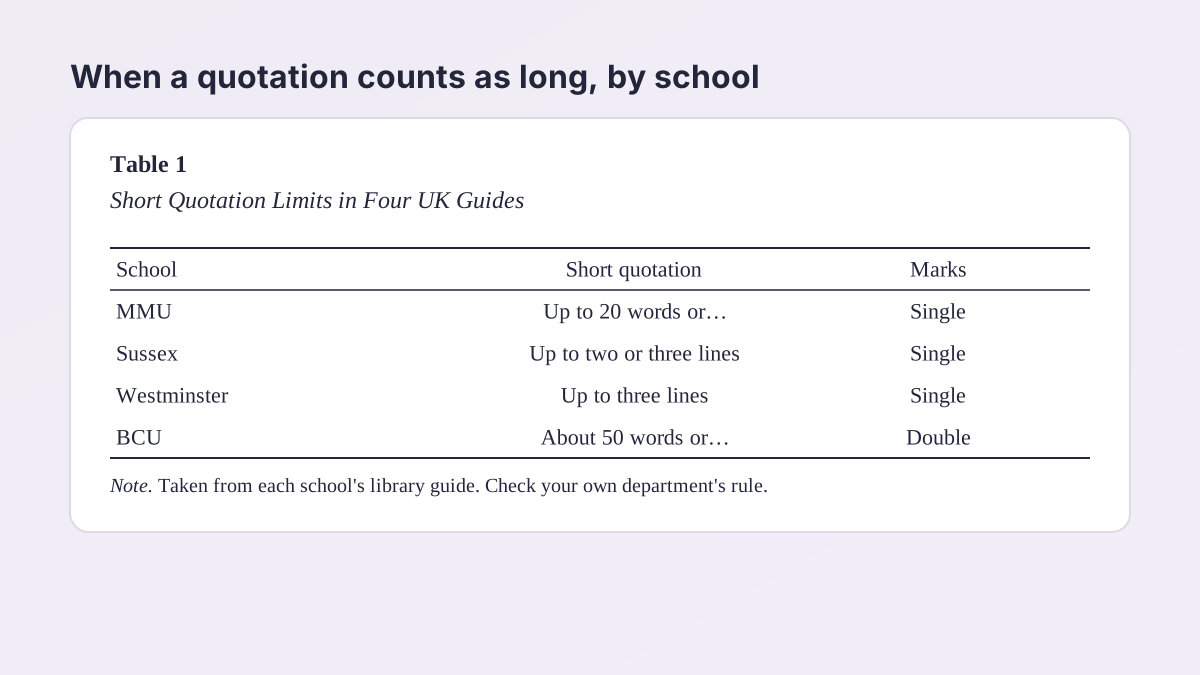
Quotation Harvard referencing starts with the short quotation, which stays inside your sentence. Sussex allows up to two or three lines and Westminster up to three, and MMU sets it at up to and including 20 words or two sentences, whichever is greater. BCU's limit is about 50 words or two sentences.
Quotation marks
Westminster says Cite Them Right recommends single quotation marks. MMU and Sussex use single marks too. BCU specifies double quotation marks for short quotes, so follow your own school. Whichever you choose, use it for every quotation in the paper.
An example
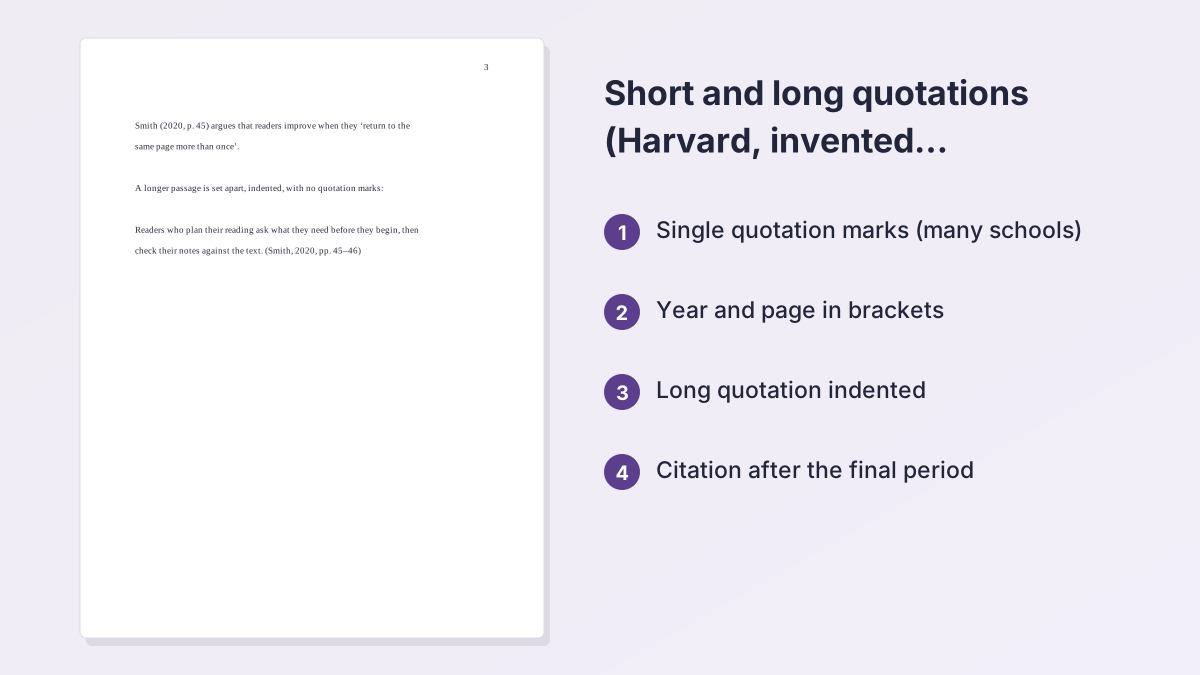
Good readers ‘return to the same page more than once’ (Smith, 2020, p. 45).
Sussex puts punctuation after the closing bracket, so the period comes after (Smith, 2020, p. 45). When the author is in your sentence, the year and page follow the name: Smith (2020, p. 45) argues that good readers ‘return to the same page more than once’.
When to quote at all
Sussex advises paraphrasing in general and quoting only for precise definitions, memorable wording or when you need the author's exact phrasing. A paraphrase still needs a citation. APA has its own quotation rules, covered in how to cite a quote in APA, so don't mix the two styles.
Harvard Referencing Long Quotes
Harvard referencing long quotes means setting the passage apart as a block. Sussex says to start a new indented paragraph, leave out quotation marks and place the citation after the final punctuation mark. Westminster adds single-line spacing for the block, and BCU says to indent it on both the left and the right.
An example block
Readers who plan their reading ask what they need before they begin, then check their notes against the text. (Smith, 2020, pp. 45–46)
Set that invented line as its own indented paragraph, without quotation marks.
The length threshold varies
The point at which a quotation becomes long depends on the school: more than three lines at Sussex and Westminster, over about 50 words or two sentences at BCU, and anything above 20 words or two sentences at MMU. The table below shows these limits next to each other, so check your own guide.
Use long quotes sparingly
On Harvard referencing long quotes, BCU advises against using them unless your guidelines require them. A block of someone else's writing does little to show your own thinking, so follow it with a sentence of your own that explains why it matters.
Page Numbers and Quotes Without Page Numbers
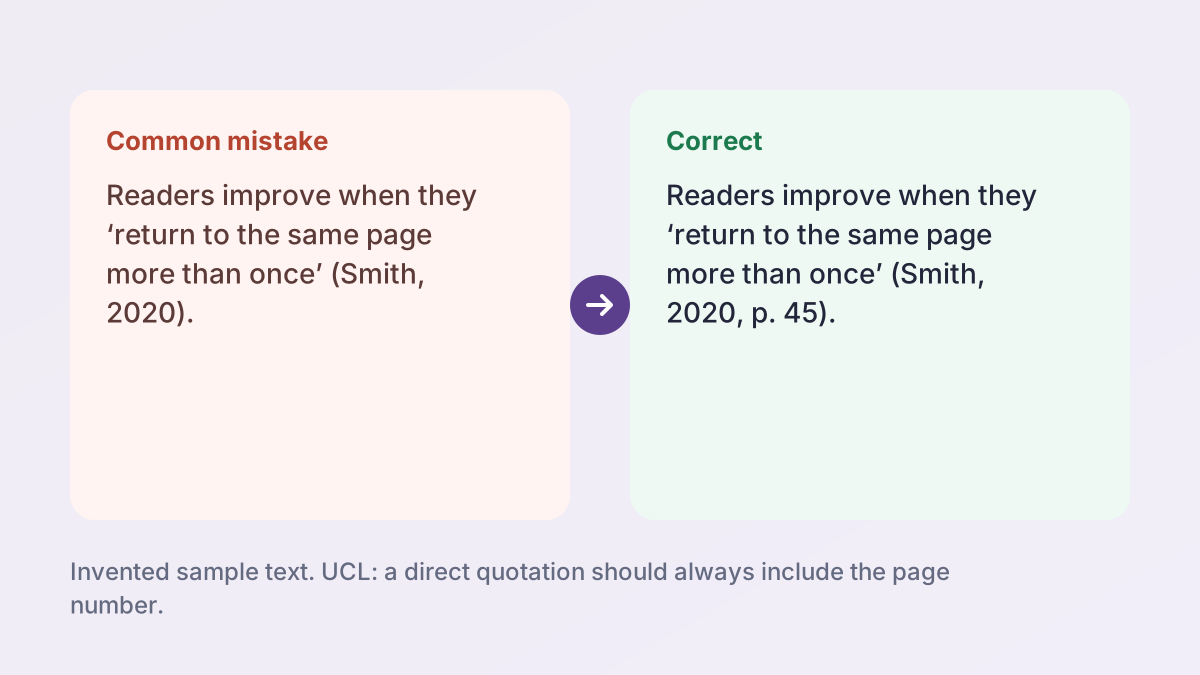
A direct quotation needs a page number. UCL says a direct quotation should always include the page numbers, and Leeds says to add a page number when you quote directly. Use p. for one page and pp. for a range, as in (Skelton, 2011, p.266) and (Skelton, 2011, pp.259-260), UCL's examples. Westminster gives the same p. and pp. rule.
How the number is written
Most guides write a comma, as in (Smith, 2020, p. 45). MMU and BCU use a colon after the year instead, as in MMU's (Cottrell, 2005:97). Follow your own school. UCL says the pages you quoted usually stay out of the reference-list entry, except for an article or a chapter in a larger work.
Quotes without page numbers
Harvard referencing quotes from a source with no pages work differently. BCU says a source such as a website needs no page number. For a video or slides, Sussex suggests another locator: a time stamp, as in (Green, 2022, 02:15), or a slide number, as in (Lee, 2021, slide 4). For an ebook with no pages, BCU suggests the reader's location number, for example (Freire, 2018: Kindle location 536).
MMU uses "no date:online" for a web source, and our guide to Harvard referencing images shows the same author-date method for pictures.
Changing Quotations: Ellipses, Brackets and [sic]
Harvard referencing quotes must match the original, but you can trim or clarify a quotation if you mark every change. Sussex and MMU agree on the main tools.
Ellipsis for omitted words
Use an ellipsis (…) where you leave words out. Sussex's example is ‘The Habsburg Empire … would act as the central fulcrum to the balance’ (Kennedy, 1989, p. 209). MMU adds that the quotation must still make grammatical sense.
Square brackets for added words
Put words you add in square brackets. Sussex's example is ‘For three years he [Louis XIV] dithered …’ (Kennedy, 1989, p. 133). MMU explains why: round brackets signal the author's own text, so they are not used for your additions.
[sic] for errors in the original
MMU says to mark an error in the original with [sic], and that this also covers spelling variants such as color and colour. An invented example is Smith (2020, p. 45) wrote that ‘students should of [sic] read the brief’.
Emphasis
If you stress a word, say so. MMU's form is (Egan, 2002:186 emphasis added), while Sussex says to italicize the words and add "my emphasis" after the page. Don't change anything else in a way that alters the author's meaning.
Quoting a Source Quoted in Another Source
Sometimes you read a quotation inside another author's work and can't reach the original. Use secondary referencing. UCL, Westminster and Newcastle use "cited in" or "quoted in"; BCU uses "cited in" too and advises against second-hand citing where you can avoid it. Read and cite the original whenever possible.
The in-text form
UCL's pattern names the original author, then "cited in", then the source you read, with the page: Festinger's (1957, cited in Skelton, 2011, p.258). With our invented sources it looks like this:
‘return to the same page more than once’ (Smith, 2020, cited in Jones and Lee, 2021, p. 105)
The reference list
With secondary Harvard referencing quotes, list only the source you actually read, here Jones and Lee. UCL, Westminster and BCU agree on this. The entry, rendered by our engine:
Jones, P. and Lee, M. (2021) ‘Note taking in first-year seminars’, Journal of Study Practice, 12(3), pp. 101–118.
That article is invented. Smith (2020) stays out of the list because you haven't read it.
Harvard Style Footnote Referencing: Does It Exist?
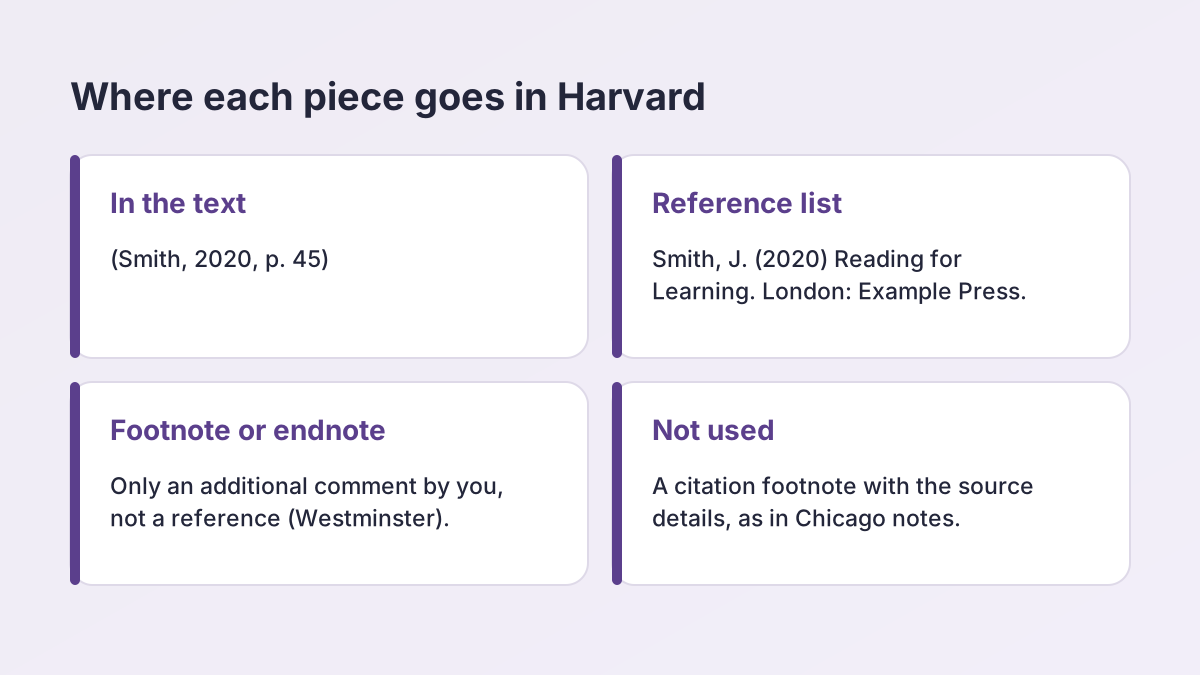
Harvard style footnote referencing doesn't exist in the sense most people mean. Harvard is an author-date system: the citation goes in brackets in your text and the full entry in the reference list. BCU's Harvard page states that footnotes and endnotes are not used in the Harvard (author-date) referencing style.
Harvard referencing footnotes: what the guides say
Westminster's guide says footnotes and endnotes are not typically used in Harvard, and that you shouldn't use them for references. It allows them only for additional authorial notes, and says endnotes appear before the reference list. Sussex's guide sends footnote questions to Cite Them Right.
What a note can hold
A note of the kind Harvard referencing footnotes allow is an aside of your own: a definition, a short explanation or a caveat that would break the flow of the sentence. It isn't a place for a source. If your tutor wants an author-date citation, keep it in the text. If your assignment asks for notes with full source details, that is a different style, such as Chicago notes; see Turabian vs Chicago.
Why the confusion
People search for Harvard style footnote referencing because many essay styles do put the source in a footnote. If you are asked for Harvard referencing footnotes, check your module guide, because some departments adapt the style.
Common Mistakes With Harvard Quotations
These slips cost the most marks in Harvard referencing quotes.
| Mistake | Fix |
|---|---|
| No page number on a direct quote | Add p. and the number after the year, as UCL advises. |
| Long passage inside quotation marks | Set a long quotation as an indented block with no marks. |
| Mixing single and double marks | Use your school's marks for every quotation. |
| Changing words without marking it | Use … for omissions and [ ] for additions. |
| Listing the original in a secondary quote | List only the source you read. |
| Using a footnote for the reference | Put the citation in the text; a note holds only a side comment. |
| Too many quotations | Paraphrase most of the time and quote only exact wording. |
One last check
Count your quotations against your word limit. Whether quoted words count depends on your department, and the word counter shows the total. Layout varies by school, so follow your department's handout.
Put Your Quotations Together
You now have every piece of Harvard referencing quotes: short and long quotations, page numbers, changes, secondary quotations and the footnote question. For Harvard referencing quotes in a class paper, quote sparingly, cite each one with the author, year and page, and list every source you used.
When you build the list, the Harvard referencing generator formats books, articles and web pages. Browse more topics on the student writing guides page, and compare the styles in Harvard vs APA. For one university's own advice, see the Sussex Harvard quotations guide.
Harvard Referencing Quotes FAQ
How do you reference a quote in Harvard style?
For Harvard referencing quotes, put the exact words in quotation marks and add the author, year and page in brackets, such as (Smith, 2020, p. 45). The full entry goes in the reference list.
Do you need a page number for a quote in Harvard?
Yes. In quotation Harvard referencing, a source with page numbers needs one. UCL says a direct quotation should always include the page number. Use p. for one page and pp. for a range.
How long can a short quotation be in Harvard?
The limit, which also marks where Harvard referencing long quotes begin, depends on the school. MMU allows up to 20 words or two sentences, Sussex and Westminster up to about three lines, and BCU about 50 words or two sentences.
How do you format long quotes in Harvard?
Use an indented block with no quotation marks, and put the citation after the final punctuation, as Sussex says. Westminster adds single-line spacing.
Does Harvard referencing use footnotes?
No. For Harvard referencing footnotes, BCU says footnotes and endnotes are not used in the author-date style. Westminster allows them only for additional authorial notes, not for references.
What is Harvard style footnote referencing?
Harvard style footnote referencing isn't standard. The citation goes in the text. Check your module guide if your tutor asks for notes.
How do I cite a quote with no page number in Harvard?
For Harvard referencing quotes from a website, some schools need none. For video or slides, Sussex suggests a time stamp or slide number, such as (Green, 2022, 02:15).
How do you quote a source quoted in another source?
For quotation Harvard referencing of a secondary source, use cited in, following UCL's example: (Festinger, 1957, cited in Skelton, 2011, p.258). List only the source you read in the references.
More free guides
- Harvard Referencing ImagesPhotos, illustrations, artwork and images from websites in Harvard style.
- Harvard Referencing LegislationActs, statutes, bills, case law and regulations in Harvard style.
- Harvard vs APAThe differences between Harvard and APA, side by side, with examples.
- MLA In-Text CitationsAuthor-page citations for every kind of source, with examples.
- How to Cite a Website in MLAWorks Cited entries and in-text citations for web pages.
- MLA Works Cited PageFormat, order and hanging indents, with a full example page.
See all 80 free tools for students
Related tools
Last updated by The Study Corp editorial team.