Harvard Referencing Law Examples for Eight Source Types
The engine in our Harvard referencing generator has no legislation or case source type, so every entry below was written by hand from the examples in university library guides. Each shows the pattern one school publishes, and the note names that school. Access dates are today's. Italics don't show here: in your paper, Act titles and case names are italic where the school's guide says so.
SourceThe Data Protection Act 2018 on legislation.gov.uk
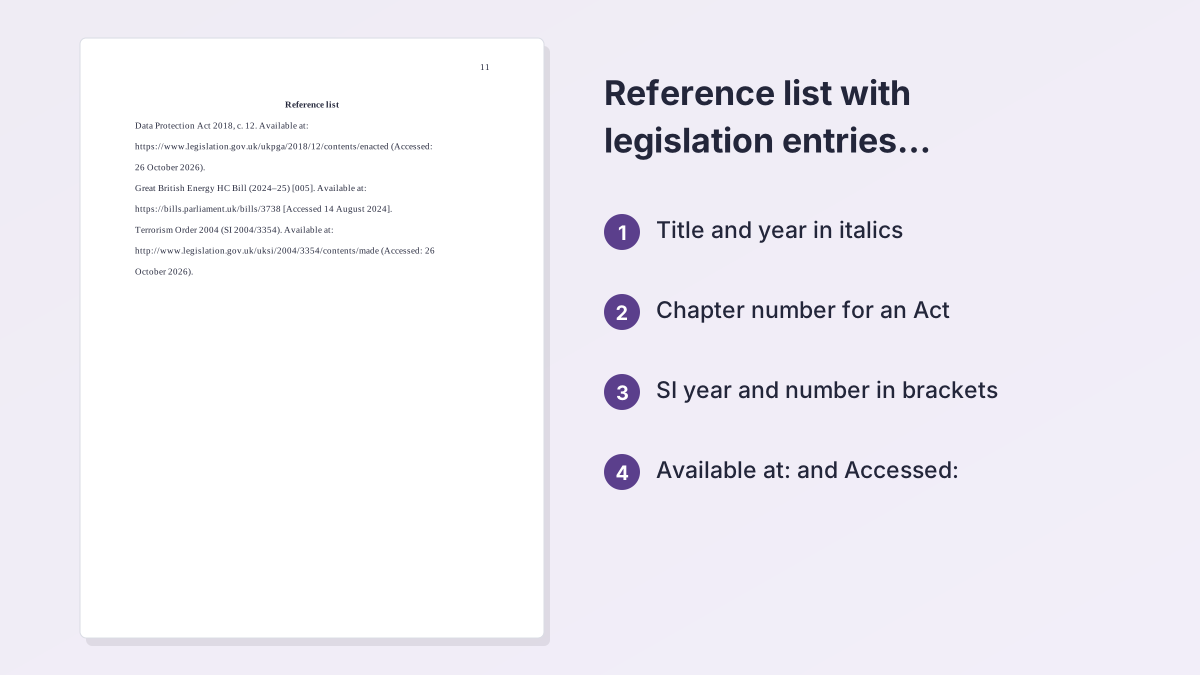
Harvard reference and in-text formData Protection Act 2018, c. 12. Available at: https://www.legislation.gov.uk/ukpga/2018/12/contents/enacted (Accessed: 26 October 2026). — in text: (Data Protection Act 2018), or name it in the sentence
For referencing legislation Harvard style, St George's, UCL and BCU give title and year in italics, then the chapter number.
SourceThe Terrorism Order 2004 on legislation.gov.uk
Harvard reference and in-text formTerrorism Order 2004 (SI 2004/3354). Available at: http://www.legislation.gov.uk/uksi/2004/3354/contents/made (Accessed: 26 October 2026). — (Terrorism Order 2004)
UCL's pattern. The title and year are italic; the SI number isn't.
SourceA House of Commons bill on bills.parliament.uk
Harvard reference and in-text formGreat British Energy HC Bill (2024–25) [005]. Available at: https://bills.parliament.uk/bills/3738 [Accessed 14 August 2024]. — in text: see the table below for the forms schools use
BCU's example, with its square-bracketed Accessed date. UCL and LSBU use other forms.
SourceA Supreme Court judgment from 2014
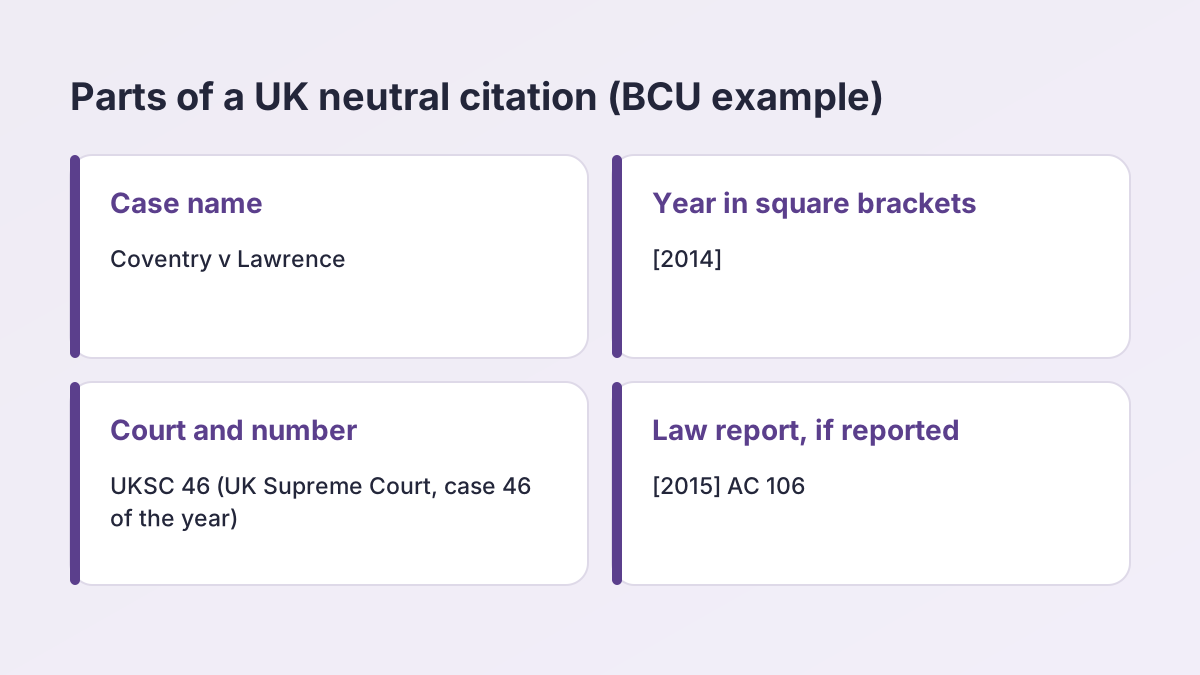
Harvard reference and in-text formCoventry v Lawrence [2014] UKSC 46, [2015] AC 106. — in text: Coventry v Lawrence [2014] UKSC 46
For Harvard referencing case law, BCU gives the neutral citation first, then the report.
SourceA House of Lords case reported in 1932
Harvard reference and in-text formDonoghue v Stevenson [1932] AC 562. — Donoghue v Stevenson [1932] AC 562
BCU's example. Square brackets mean the year identifies the volume.
SourceThe consolidated Treaty on the Functioning of the European Union
Harvard reference and in-text formEuropean Commission (2012) Consolidated version of the Treaty on the functioning of the European Union. OJ, C326, 26 October, pp. 47-390. — (European Commission, 2012)
BCU's example, with OJ in italics. Many schools send you to their own guide.
SourceSection 1983 of Title 42 of the US Code
Harvard reference and in-text form42 U.S.C. §1983. — in text: name the statute in your sentence
For Harvard referencing US statutes, BCU says to use the Bluebook. Ask your tutor.
SourceThe National Environmental Policy Act of 1969
Harvard reference and in-text formNational Environmental Policy Act of 1969 (1970) Pub. L. No. 91-190, § 102, 83 Stat. 852. — in text: name the Act in your sentence
BCU's second US example. The section is the one you rely on.
How to Reference Legislation in Harvard, Step by Step
These steps for Harvard referencing legislation work for any Act, statutory instrument or bill.
- Find the exact title. Copy the short title and year from the official page, brackets included.
- Add the number. For an Act add the chapter number (c. 12). For an SI add its year and number, such as SI 2004/3354.
- Add the web address. Write Available at: with the URL, then the Accessed date in your school's form.
- Italicize the title. Set the Act or SI title and year in italics if your school's guide shows italics.
- Cite it in the text. Name the Act and its year in your sentence, and put any section number in your wording.
- List it alphabetically. Place the entry in the reference list by the first word of the title.
Which Harvard Style Do You Need for Law Sources?
Harvard referencing legislation has no single official manual. Harvard is a family of author-date styles, and each university writes its own version. For Harvard referencing law and other sources, our generator follows Cite Them Right (12th edition) by Richard Pears and Graham Shields; many UK library pages now cite its 13th edition. The rules below come from university library guides, and we name the school each time. Where schools disagree, we say so.
Check your assignment brief first
Law is where your own department matters most. Cumbria's leaflet says law students use OSCOLA instead. If your module hands you a style sheet, follow it over this guide.
The pattern for Harvard referencing law sources in one line
In referencing legislation Harvard style, an Act follows this pattern: Short title Year, c. number. Available at: URL (Accessed: date). Bills, statutory instruments and cases use different patterns, covered below. Our free Harvard referencing generator builds the entries for your books, articles and web pages, but it can't format Acts or cases, so you add those by hand.
Referencing Legislation Harvard Style: Acts of Parliament
This is how referencing legislation Harvard style works for a UK Act passed since 1963. St George's, University of London, UCL and Birmingham City University (BCU) give the same elements: the short title and year in italics, the chapter number, Available at: with the web address, and the Accessed date.
A worked Act
Data Protection Act 2018, c. 12. Available at: https://www.legislation.gov.uk/ukpga/2018/12/contents/enacted (Accessed: 26 October 2026).
St George's says the chapter number appears when you view the Act on the government website.
The in-text citation
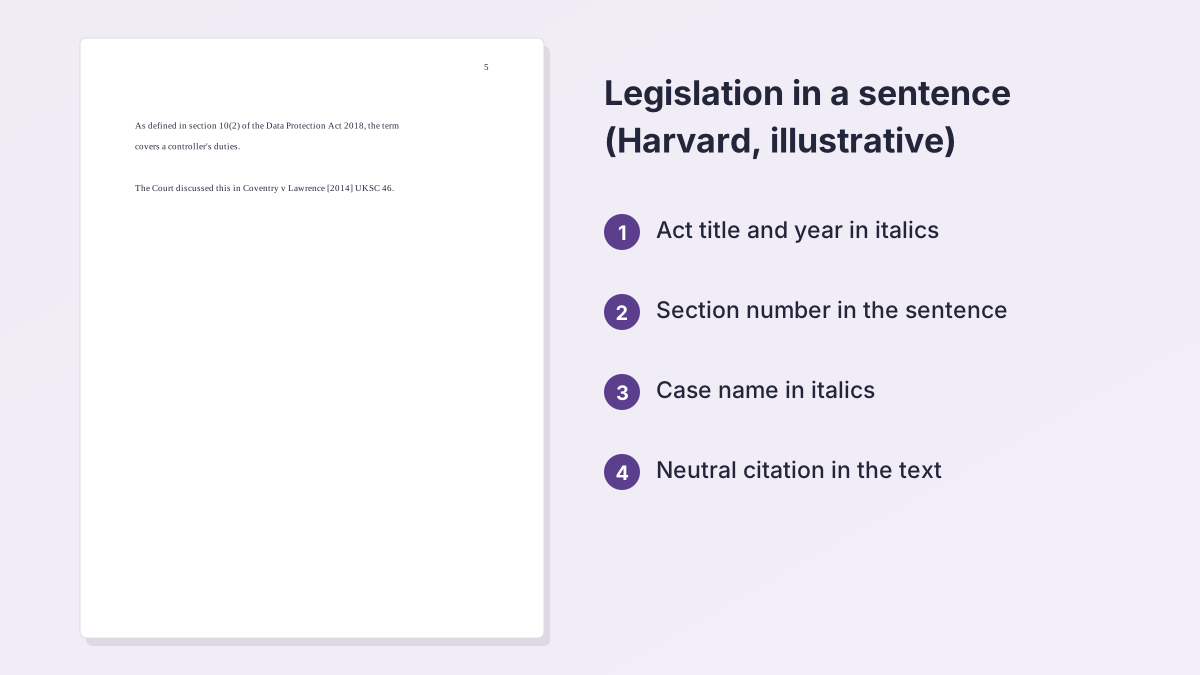
UCL's in-text example is the title and year in brackets, as in (Localism Act 2011). St George's names the Act inside the sentence: "As defined in section 10(2) of the Data Protection Act 2018..." The list entry stays the same for the whole Act, whichever section you use.
Devolved Acts and Acts before 1963
BCU adds that Welsh Acts use an anaw or asc number and Scottish Acts an asp number, as in Health and Care (Staffing) (Scotland) Act 2019, asp 6. For Acts before 1963, UCL and BCU include the regnal year and chapter, such as (5 & 6 Eliz. 2, c. 51), with place and publisher.
Statutory Instruments and Bills in Harvard
Statutory instruments (SIs) are regulations and orders made under an Act. Bills are proposed laws. Schools vary more here than for Acts.
Statutory instruments
UCL's pattern is the title and year in italics, the SI year and number in round brackets, Available at: and the Accessed date, as in Terrorism Order 2004 (SI 2004/3354). St George's says to write the title exactly as the government site shows it, brackets included. BCU's example, The Local Authority (Duty to Secure Early Years Provision Free of Charge) Regulations 2014, SI 2014/2147, uses a comma and no web address.
Bills
Three guides give three forms. UCL: Green Belt Bill (1999). Parliament: House of Commons. Bill no. 9. London: The Stationery Office. BCU gives the title, the session in brackets and the running number, then the web address. LSBU treats the House as the author: Parliament. House of Commons (2013) Food labelling (sugar content). [Bill 23].
In-text forms
UCL cites its bill as (Green Belt Bill, 1999) and its SI as (Terrorism Order 2004). LSBU uses (Parliament. House of Commons, 2013).
Harvard Referencing Case Law in the UK
Harvard referencing case law in the UK depends on how recent the case is. Newer judgments carry a neutral citation. Older ones are cited from a law report. Two kinds of school guide exist.
Italic case names (BCU and UCL)
BCU puts the case name in italics, then the neutral citation, then the law report citation if the case is reported: Coventry v Lawrence [2014] UKSC 46, [2015] AC 106. An unreported case drops the second part: KAT v Torbay Council [2018] EWCA Civ 3045. UCL's law report example is R v. Derek Roy Taylor (1977) 64 Cr App R 182, cited in text as (R v. Derek Roy Taylor, 1977).
Quoted case names (Cumbria and City St George's)
Both put the case name in single quotation marks, then the year, court and case number; Cumbria adds the database. For older cases, City St George's example is 'Bibby Cheshire v. Golden Wonder Ltd' (1972) Weekly Law Reports, 1, pp. 1487-1492.
Which brackets to use
BCU says round brackets are used when the volume number differs from the year, as in Vadera v Shaw (1999) 45 BMLR 162, and square brackets when the year identifies the volume. Add a pinpoint with "at" and the page, as BCU does.
Harvard Referencing US Statutes and Cases
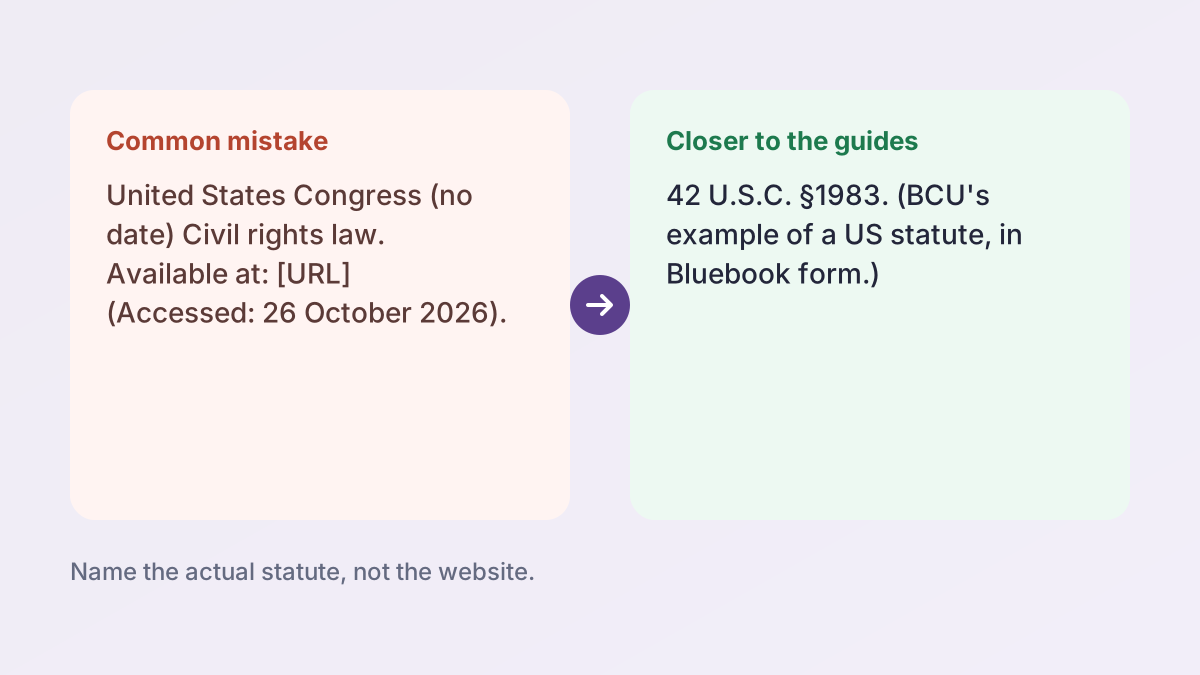
Harvard referencing US statutes is the least settled part of this topic, because the UK library guides behind most Harvard versions rarely cover American law. The one we found that does is BCU. It says to use the Bluebook quick style guide for US legislation.
Federal statutes and Public Laws
For Harvard referencing US statutes, BCU's first example is 42 U.S.C. §1983. That is Title 42 of the US Code, section 1983, which the Cornell Legal Information Institute's page titles "Civil action for deprivation of rights". Its second is National Environmental Policy Act of 1969 (1970) Pub. L. No. 91-190, § 102, 83 Stat. 852. Check statutes on the Cornell LII U.S. Code site.
Supreme Court cases
None of the UK guides we checked gives a template for a US case. The Bluebook form is the name, the volume and page of the United States Reports, and the year, as in Brown v. Board of Education, 347 U.S. 483 (1954), a citation the Library of Congress also uses. Treat it as the form for Harvard referencing case law from the US, and ask your tutor first. Unsure which style your course wants? See Harvard vs APA.
EU Legislation and Other Jurisdictions
BCU gives an Official Journal example: European Commission (2012) Consolidated version of the Treaty on the functioning of the European Union. OJ, C326, 26 October, pp. 47-390. Its in-text form gives the document's author and year: (European Commission, 2012).
Cumbria's leaflet and the Open University's law guide send you to Cite Them Right's full guidance for EU formats. For a non-UK Act, BCU says to cite it as its own jurisdiction does, as in Electoral Act 1993 (New Zealand).
Harvard Referencing Law: In-Text Citations
Legislation is cited differently from books in the body of a paper. Instead of an author, the title of the Act or case stands in. The table shows the in-text forms for Harvard referencing law that the guides above give, with the school each comes from.
| Source | In-text form | From |
|---|---|---|
| Act | (Localism Act 2011) | UCL |
| Section of an Act | section 10(2) of the Data Protection Act 2018 | St George's |
| Statutory instrument | (Terrorism Order 2004) | UCL |
| Bill | (Green Belt Bill, 1999) | UCL |
| Case | (R v. Derek Roy Taylor, 1977) | UCL |
| Case in a sentence | Broom v Cassell & Co [1972] AC 1027 | BCU |
| EU legislation | (European Commission, 2012) | BCU |
Names in the sentence
BCU's examples name the Act in the sentence with its section: "S 43 of the Care Act 2014 requires...". A direct quotation from a statute or judgment follows the usual quotation rules, covered in our guide to Harvard referencing quotes.
Finding Details on legislation.gov.uk and Congress.gov
You can build most entries for Harvard referencing legislation from the official page itself. On legislation.gov.uk, copy the title, year and chapter number of an Act, or the full title and SI number of an instrument. The address shows both numbers: in the Data Protection Act's address, 2018 is the year and 12 is the chapter.
On the US side, Congress.gov lists federal bills and laws. Search it by name, then copy the Public Law number and title exactly as shown there.
When a Law Course Needs OSCOLA or Bluebook Instead
Cumbria's leaflet notes that law students use OSCOLA, and the Open University's law guide shows an OSCOLA-style footnote, not a Harvard entry: Human Rights Act 1998, s 6(1).
Our generator makes neither OSCOLA nor Bluebook entries, so if your syllabus names one, follow that manual.
Common Mistakes in Harvard Referencing Legislation
These slips cost marks in Harvard referencing legislation and in Harvard referencing law generally.
| Mistake | Fix |
|---|---|
| Dropping the year from the Act's title | The year is part of the title: Data Protection Act 2018. |
| No chapter number | Add c. and the number to the Act's entry, as St George's, UCL and BCU do. |
| Writing an SI title from memory | Copy it exactly from the official page, brackets included. |
| Adding a page number for an Act | Name the section in your sentence instead. |
| Mixing school patterns | Use one school's pattern for bills and cases throughout. |
| Omitting the Accessed date | Add it after the URL for any online Act, SI or bill. |
One last check
Italic rules, bracket styles and Accessed dates vary by school, so follow your department's handout. Our guide to Harvard referencing images shows the same method for pictures and photographs.
Put Your Legal References Together
You now have the pieces of Harvard referencing legislation and Harvard referencing law: the Act pattern, statutory instruments, bills, UK cases, US statutes and the in-text forms. For Harvard referencing case law and statutes alike, aim for one reference-list entry per Act, case or bill, and cite each one wherever you rely on it.
For the rest of your list, the Harvard referencing generator formats books, articles and websites, and you add the legislation by hand. Start the paper with the Harvard title page generator, and see more topics on the student writing guides page. For one university's own legal examples, see the BCU Harvard legal sources page.
Harvard Referencing Law FAQ
How do you reference legislation in Harvard style?
For Harvard referencing legislation, give the Act's short title and year in italics, its chapter number, Available at: the URL and (Accessed: date). In your text, name the Act with its year.
How do you reference an Act of Parliament in Harvard?
For referencing legislation Harvard style, St George's, UCL and BCU give the title and year in italics, then c. and the chapter number, then the web address and Accessed date, as in Data Protection Act 2018, c. 12.
How do you reference a statutory instrument in Harvard?
For Harvard referencing legislation, UCL gives the title and year in italics, the SI year and number in brackets, then Available at: and the Accessed date. Copy the title exactly as the government site shows it.
How do you reference a bill in Harvard?
In Harvard referencing legislation, schools differ. UCL uses the title, year, House, bill number and publisher. BCU uses the title, session, number and web address. Follow your own school's pattern.
How do you do Harvard referencing of case law?
For Harvard referencing case law, BCU gives the case name in italics and the neutral citation, such as Coventry v Lawrence [2014] UKSC 46, then the law report if there is one. Some schools put case names in quotation marks.
How do you reference US statutes in Harvard?
For Harvard referencing US statutes, BCU says to use the Bluebook form, for example 42 U.S.C. §1983. Check with your tutor, because few UK guides cover American law.
Do you put a page number in the in-text citation for an Act?
No. In Harvard referencing law, name the section in your sentence, for example section 10(2) of the Data Protection Act 2018. The list entry is the same for the whole Act.
Do law students use Harvard referencing?
Often not. Cumbria's leaflet says law students use OSCOLA, and BCU points to the Bluebook for US law, so check your module guide before you start.
More free guides
- Harvard Referencing ImagesPhotos, illustrations, artwork and images from websites in Harvard style.
- Harvard Referencing QuotesShort and long quotations, page numbers and whether Harvard uses footnotes.
- Harvard vs APAThe differences between Harvard and APA, side by side, with examples.
- MLA In-Text CitationsAuthor-page citations for every kind of source, with examples.
- How to Cite a Website in MLAWorks Cited entries and in-text citations for web pages.
- MLA Works Cited PageFormat, order and hanging indents, with a full example page.
See all 80 free tools for students
Related tools
Last updated by The Study Corp editorial team.