Case converter examples
Real outputs from the tool. Each title or sentence is invented for a typical US class assignment.
Typedliving with type 1 diabetes in college
ConvertedLiving With Type 1 Diabetes in College
APA capitalizes every word of four letters or more, so the preposition With is capitalized. MLA and Chicago would write with.
Typedthe gap between what students learn from failure and what they are graded on
ConvertedThe Gap between What Students Learn from Failure and What They Are Graded On
MLA lowercases prepositions of any length (between, from) but always capitalizes the last word, so on becomes On.
Typedlife under the new deal: farming families across the dust bowl
ConvertedLife Under the New Deal: Farming Families Across the Dust Bowl
Chicago 18 capitalizes prepositions of five letters or more, so Under and Across are capitalized. MLA would lowercase both.
Typedlessons from a year without a phone
ConvertedLessons From a Year Without a Phone
AP capitalizes From and Without (four letters or more) and lowercases a. For the review's own news headline, AP uses sentence case: only the first word and proper nouns get capitals.
TypedSleep Duration And Academic Performance In High School Students: A Longitudinal Study
ConvertedSleep duration and academic performance in high school students: A longitudinal study
APA uses sentence case for article titles in the reference list. The first word after the colon stays capitalized.
TypedPLEASE SUBMIT YOUR LAB REPORT BY FRIDAY. LATE WORK LOSES 10 POINTS.
ConvertedPlease submit your lab report by friday. Late work loses 10 points.
Each sentence starts with a capital. The tool can't recognize names or days, so capitalize Friday yourself.
How to use the case converter
There is no button to press: the result updates as you type or switch styles.
- Paste your text. Paste a title, a heading list or a whole paragraph into Paste your text, or select Try an example. Each line of a list is converted separately.
- Choose a case. Pick from three rows: Title case (APA, MLA, Chicago, AP), Text (Sentence case, UPPERCASE, lowercase, Capitalize Each Word, aLtErNaTiNg) or Code (camelCase, PascalCase, snake_case, kebab-case, CONSTANT_CASE).
- Read the rule. The line under the buttons explains what the chosen style capitalizes and lowercases, so you can check the result against your assignment.
- Check names and acronyms. Acronyms such as NASA are kept unless half or more of the words are in capitals. Sentence case can't spot names, so capitalize them yourself.
- Copy the result. Select Copy result and paste it into Google Docs, Word or your code editor.
Title case converter for APA, MLA, Chicago and AP
Title case means capitalizing the major words of a title. Every style agrees on nouns, verbs, adjectives, adverbs and pronouns. They disagree about the small words: prepositions, conjunctions and articles. That is why a generic title case converter often gets your title wrong for the style your teacher asked for.
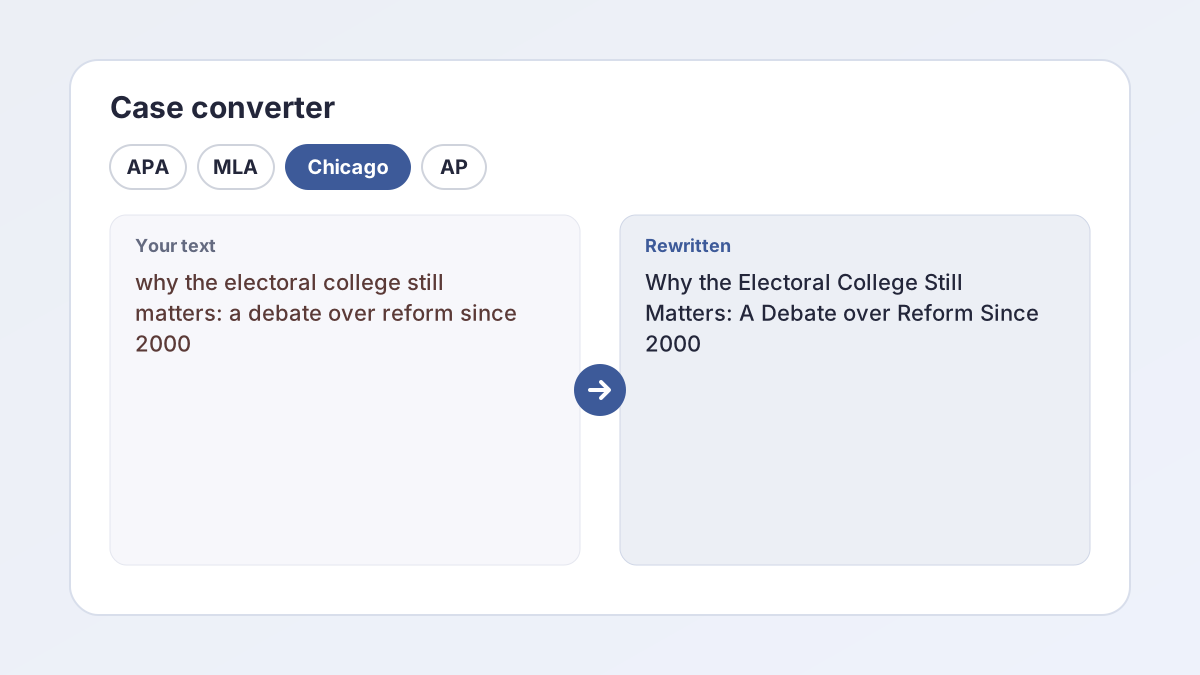
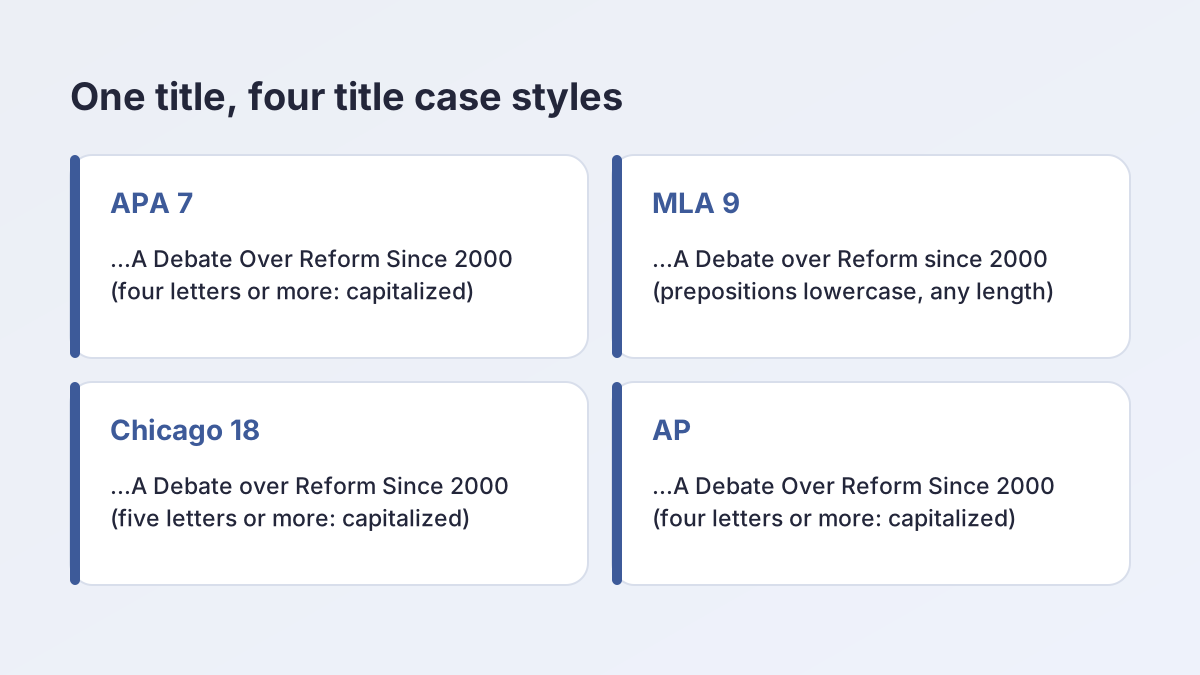
Here is one invented title, typed in lowercase, through each style in the title case converter:
| Style | Result | What changed |
|---|---|---|
| APA 7 | Why the Electoral College Still Matters: A Debate Over Reform Since 2000 | Over and Since have four letters or more, so both are capitalized |
| MLA 9 | Why the Electoral College Still Matters: A Debate over Reform since 2000 | Prepositions stay lowercase at any length |
| Chicago 18 | Why the Electoral College Still Matters: A Debate over Reform Since 2000 | Over (four letters) is lowercase; Since (five) is capitalized |
| AP | Why the Electoral College Still Matters: A Debate Over Reform Since 2000 | Words of four letters or more are capitalized |
APA title case
APA 7 capitalizes major words and any word of four letters or more, and lowercases short (three letters or fewer) conjunctions, articles and prepositions. The first word of a title and of a subtitle is always capitalized, and both parts of a hyphenated major compound are too: Self-Report, not Self-report. This follows the APA Style page on title case capitalization. APA states no last-word rule, so the case converter leaves a short last word such as on in lowercase.
MLA title case
MLA 9 lowercases articles, prepositions of any length, coordinating conjunctions and the to in infinitives. The first and last words are always capitalized. This makes MLA the style with the most lowercase words: between, through and without all stay small.
Chicago title case
The 18th edition of the Chicago Manual of Style (2024) changed the preposition rule. Earlier editions lowercased prepositions of any length; CMOS 18 capitalizes prepositions of five letters or more, as the University of Notre Dame's editors summarized the update. The case converter follows CMOS 18. If your teacher still uses the 17th edition, lowercase long prepositions such as between by hand.
AP title case
For titles of works such as books, films and songs, AP style, used by most US newspapers and many school papers, capitalizes words of four letters or more and lowercases articles, conjunctions and prepositions of three letters or fewer, unless they come first or last. AP also capitalizes To in an infinitive (What I Want To Be When I Grow Up); the case converter lowercases every to, so fix infinitives by hand. AP news headlines use sentence case: only the first word and proper nouns are capitalized.
Which small words are capitalized in a title?
This table shows how the title case converter treats common small words in the middle of a title. The first word, and the first word after a colon, is capitalized in every style.
| Word | APA | MLA | Chicago | AP |
|---|---|---|---|---|
| a, an, the | lower | lower | lower | lower |
| and, but, or, nor | lower | lower | lower | lower |
| so, yet | lower | lower | Capitalized | lower |
| to | lower | lower | lower | lower (To in an infinitive is capitalized) |
| in, of, on, at, by | lower | lower | lower | lower |
| with, from, into, over | Capitalized | lower | lower | Capitalized |
| about, under, since, between | Capitalized | lower | Capitalized | Capitalized |
| is, are, be (verbs) | Capitalized | Capitalized | Capitalized | Capitalized |
| short last word (on, for) | lower | Capitalized | Capitalized | Capitalized |
Why verbs are always capitalized
Short verbs like is, are and be look small but they are major words. "What Is Worth Fighting For" capitalizes Is in every style. A common mistake is lowercasing is because it is only two letters long.
Words that change role
Some words are prepositions in one title and adverbs in another ("Giving Up" vs "up the hill"). The case converter treats them as prepositions. If a short word is part of a phrasal verb, such as Up in "Why Teens Give Up on Sports", style guides generally capitalize it, so fix that one by hand.
Sentence case converter: APA reference titles and more
Sentence case capitalizes only what a normal sentence would: the first word, the first word after a colon, and proper nouns. The sentence case converter capitalizes the first word of every sentence and the first word after a colon, and lowercases the rest.
Where APA uses sentence case
APA puts the titles of articles, books, reports and webpages in sentence case in the reference list, even when the original used title case. It also uses sentence case for table column headings and figure notes. The rules are on the APA Style page on sentence case. In the body of your paper, the same titles go in title case.
A worked APA example
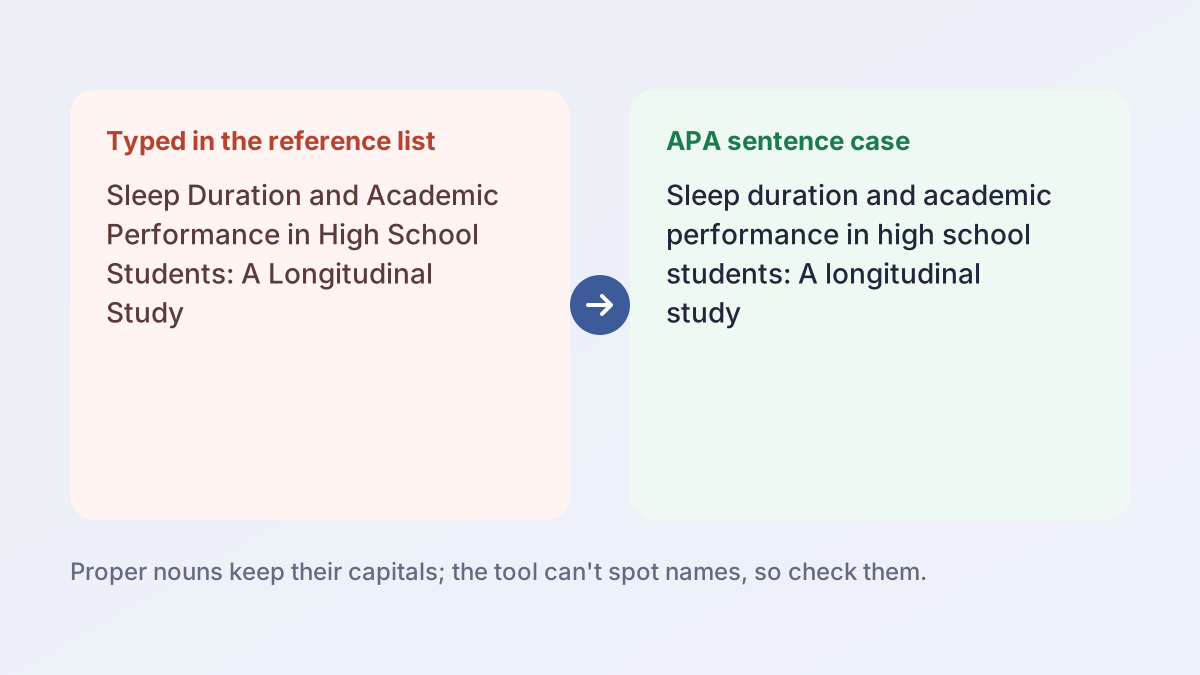
An invented reference, typed with the title copied from a journal website:
- Typed: Sleep Duration And Academic Performance In High School Students: A Longitudinal Study
- Sentence case: Sleep duration and academic performance in high school students: A longitudinal study
The journal name stays in title case and italics. Only the article title changes.
Fix proper nouns after converting
A case converter can't tell a name from an ordinary word. Run "life under the new deal" through sentence case and you get "Life under the new deal", but New Deal is a proper noun. Check names of people, places, organizations, historical events and days after every conversion.
Upper case converter and lower case converter: when to use each
The upper case converter (UPPERCASE) turns every letter into a capital. The lower case converter (lowercase) does the opposite, and you can switch between them in one click. Both are the most searched cases, and both are simple, but they are useful more often than you might think.
Good uses for UPPERCASE
- A short label on a poster or science fair board.
- Acronyms you typed in lowercase by mistake (nasa, fafsa).
- Teacher handouts where one word needs to stand out (DUE FRIDAY).
Avoid UPPERCASE for a whole paragraph. Long stretches of capitals are harder to read and look like shouting in an email to a professor.
Good uses for lowercase
- Fixing text typed with Caps Lock on. Convert to lowercase, then to sentence case, and check names.
- Cleaning a list before sorting it with the Alphabetizer, so "Biology" and "biology" sort together.
- Hashtags and web addresses, which are usually written in lowercase.
From all caps to something readable
Paste text written in all caps into the case converter and pick Sentence case or a title case style directly. The tool notices that the whole text is in capitals and lowercases it first, instead of keeping every word as an acronym.
Capitalize Each Word vs title case
Capitalize Each Word puts a capital on every word, including a, the, of and and. Some students use it as a quick title case converter, but no academic style capitalizes every word.
- Capitalize Each Word: The Effects Of Social Media On Sleep In High School Students
- APA title case: The Effects of Social Media on Sleep in High School Students
Capitalize Each Word is useful for names lists, form fields and tags, where every word really should start with a capital. For essay titles and headings, use one of the four title case styles instead.
aLtErNaTiNg case
The aLtErNaTiNg button switches lowercase and uppercase letter by letter. It is the "mocking" style used in memes and has no place in schoolwork, but it is there if you need it for a slide joke or a club flyer.
camelCase, snake_case and other code cases
Students in AP Computer Science, a coding bootcamp or a community college programming class need a different kind of case converter. The Code row joins words together with no spaces, using capitals, underscores or hyphens to show where each word starts.
The five code cases
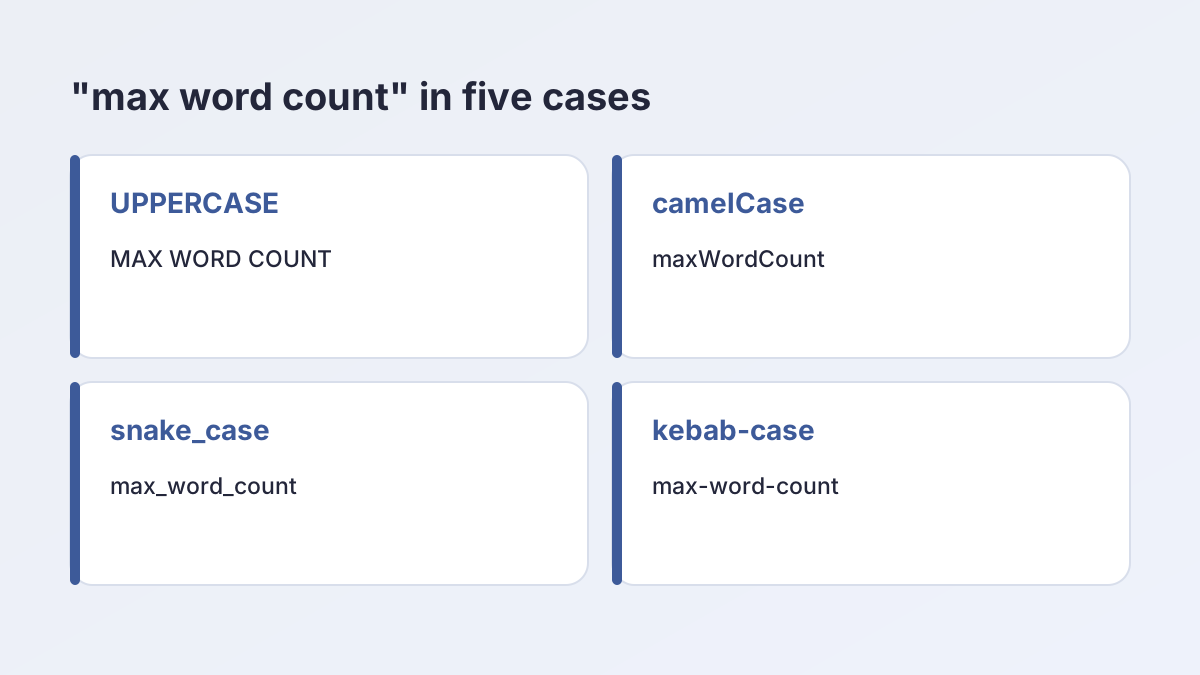
- camelCase: maxWordCount. Common for variables in Java and JavaScript.
- PascalCase: MaxWordCount. Common for class names.
- snake_case: max_word_count. Common in Python and database column names.
- kebab-case: max-word-count. Common in web addresses and CSS class names.
- CONSTANT_CASE: MAX_WORD_COUNT. Common for values that never change.
These are conventions, not rules. Your course or style guide (for example, the one your AP CSA teacher hands out) decides which one you use.
Converting between code cases
The case converter splits on spaces, punctuation and existing capitals, so you can paste one code case and get another. studentIDNumber becomes student_id_number in snake_case and studentIdNumber in camelCase. Paste a list of names, one per line, and each line is converted separately.
How to change case in Word, Google Docs and Excel
You don't always need a separate case converter. Each of the big three apps has its own way to change case, though none of them handles APA, MLA, Chicago or AP title case.
Microsoft Word
Select the text and go to Home > Change Case (the Aa button). The menu offers Sentence case, lowercase, UPPERCASE, Capitalize Each Word and tOGGLE cASE. The shortcut is Shift+F3: press it repeatedly to cycle through lowercase, UPPERCASE and Capitalize Each Word, as Microsoft's guide to changing the capitalization of text explains. Word's Capitalize Each Word capitalizes small words too, so it is not a style-correct title case.
Google Docs
Select the text, then choose Format > Text > Capitalization. You get lowercase, UPPERCASE and Title Case. Docs' Title Case is a general one, not tied to a style guide, so check the small words afterward.
Excel
Excel has no Change Case button. Use a formula in a helper column instead:
- =UPPER(A2) for capitals
- =LOWER(A2) for lowercase
- =PROPER(A2) to capitalize the first letter of every word
Fill the formula down, copy the results, and use Paste > Values over the original column, then delete the helper column. PROPER works like Capitalize Each Word, so it is fine for names but not for titles. For a long list of titles, paste the column into the case converter instead; each line is converted separately.
Common capitalization mistakes in student papers
These are the errors teachers mark most often, and how to catch them.
Mixing styles in one paper
A paper with APA headings in title case and APA reference titles in title case too is half wrong: reference titles belong in sentence case. Decide the style once, then use the matching button for each part of the paper.
Lowercasing short verbs
"Why Sleep is Important" should be "Why Sleep Is Important" in every style. Is, are, was and be are verbs, and verbs are major words.
Capitalizing every small word
"The Role Of Music In Memory" uses Capitalize Each Word. Every style lowercases of and in mid-title.
Losing proper nouns in sentence case
"the french revolution and the rights of man" in sentence case needs French and Revolution capitalized by hand. The same goes for course names: AP Biology, not ap biology.
Lowercasing acronyms
Type "the history of nasa" into the case converter and you get "The History of Nasa" because no case converter can know nasa is an acronym. Type NASA in capitals and it is kept: "How NASA Trains Astronauts for Life in Space".
Forgetting the subtitle capital
After a colon, the first word of a subtitle is capitalized in all four title case styles, even if it is A or The.
Which case does each school assignment need?
If you're unsure which button to press, start here. Your teacher's instructions always win.
| Assignment | Case | Button |
|---|---|---|
| Essay title in an MLA class (most high school English) | MLA title case | MLA |
| APA paper title and headings (psychology, nursing, education) | APA title case | APA |
| Article and book titles in an APA reference list | Sentence case | Sentence case |
| History paper with Chicago notes and bibliography | Chicago title case | Chicago |
| School newspaper headline | Sentence case (AP style); AP title case for titles of works | Sentence case or AP |
| Variable and file names in a coding class | Course convention | Code row |
Building the rest of the paper
Need a title first? The Essay Title Generator suggests titles you can then put in the right case. The APA Title Page Generator and MLA Title Page Generator lay out the first page, and the APA Citation Generator formats reference entries. To check length, use the Word Counter or the Words to Pages Converter.
Is the case converter free and private?
Yes. The case converter is free, with no account, no sign-up and no limit on how much you convert.
It runs entirely in your browser. Your text is converted on your own device as you type; nothing is sent to The Study Corp or anyone else, and no AI is involved. That makes it safe for unpublished essays, application drafts and code from class projects.
What it can't do
The case converter follows fixed rules, so it can't recognize proper nouns, phrasal verbs or an acronym typed in lowercase. Give every converted title a quick read before you submit.
Case converter FAQ
What is the difference between title case and sentence case?
Title case capitalizes the major words of a title (The Effects of Social Media on Sleep). Sentence case capitalizes only the first word, the first word after a colon and proper nouns (The effects of social media on sleep). APA uses title case for paper titles and headings, and sentence case for titles in the reference list.
Do you capitalize with in a title?
It depends on the style. APA and AP capitalize With because it has four letters. MLA lowercases all prepositions, and Chicago 18 lowercases prepositions of four letters or fewer, so both write with.
How do I convert a title to APA title case?
Paste the title into the case converter and select APA under Title case. Words of four letters or more and all major words are capitalized; short articles, conjunctions and prepositions stay lowercase. Then check proper nouns.
What is the shortcut to change case in Word?
Select the text and press Shift+F3. Each press cycles through lowercase, UPPERCASE and Capitalize Each Word. More options are under Home > Change Case.
How do I change capitalization in Google Docs?
Select the text and choose Format > Text > Capitalization, then lowercase, UPPERCASE or Title Case. Docs' Title Case isn't tied to APA, MLA, Chicago or AP, so check the small words.
How do I change all caps to lowercase in Excel?
Excel has no Change Case button. In a helper column, type =LOWER(A2), =UPPER(A2) or =PROPER(A2), fill it down, then copy and Paste > Values over the original column.
Is Capitalize Each Word the same as title case?
No. Capitalize Each Word capitalizes every word, including a, of and the. Title case in APA, MLA, Chicago and AP keeps those small words lowercase in the middle of a title.
Does the case converter keep acronyms like NASA?
Yes, if you type them in capitals and fewer than half the words are in capitals. When most of the text is in capitals, the tool lowercases everything first, so retype acronyms afterward.
Is my text saved or sent anywhere?
No. The case converter runs in your browser with no AI. Your text never leaves your device.
More free formatting tools
- Word CounterWords, characters and pages, with essay limits and citations left out if you like.
- Words to Pages ConverterHow many pages your word count fills, or how many words a page count needs.
- AlphabetizerSort a list or a reference list A to Z.
See all 80 free tools for students
Related tools
Last updated by The Study Corp editorial team.